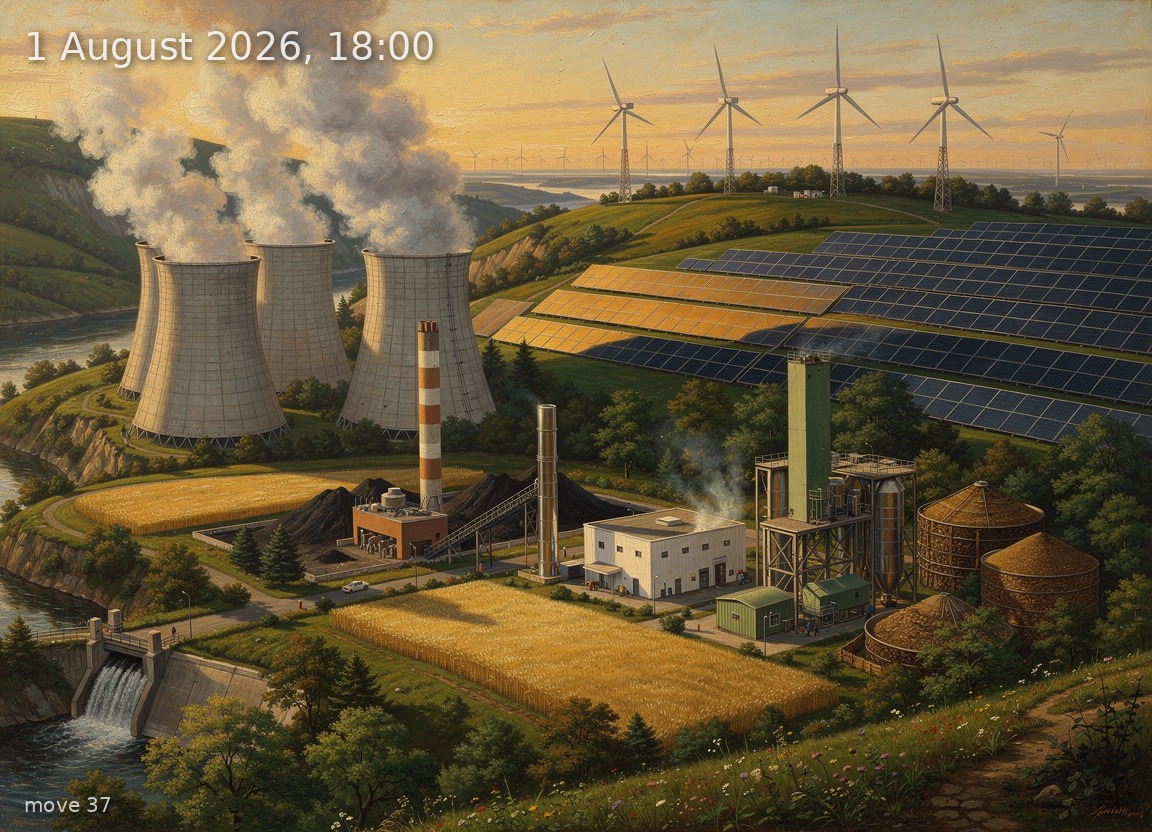
Solar leads at 16.9 GW but a 13.4 GW net import is needed as evening demand peaks at 49.3 GW.
Generation mix
Wind onshore 11%
Wind offshore 4%
Solar 47%
Biomass 11%
Hydro 3%
Natural gas 5%
Hard coal 4%
Brown coal 14%
77%
Renewable share
5.6 GW
Wind (on + offshore)
16.9 GW
Solar
35.9 GW
Total generation
13.5 GW
Net import
145.1 EUR/MWh
Day-ahead price
23.6°C / 12 km/h
Temp / Wind speed
Open-Meteo, Kassel (51.3°N 9.5°E) · surface estimate from 100 m wind
0.0% / 370.0 W/m²
Cloud cover / Radiation
170
gCO₂/kWh
Image prompt
Solar 16.9 GW dominates the right half of the scene as vast fields of aluminium-framed crystalline silicon photovoltaic panels stretching across gentle rolling hills, their surfaces glowing amber-gold in the low-angle evening sun. Brown coal 5.0 GW occupies the left foreground as a cluster of massive hyperbolic cooling towers with thick white-grey steam plumes rising heavily into the warm sky. Wind onshore 4.1 GW appears as a line of three-blade turbines with lattice towers on a distant ridge, their blades turning slowly in light wind. Biomass 3.9 GW is rendered as a mid-ground industrial plant with a tall rectangular stack and wood-chip storage silos. Natural gas 1.9 GW appears as a compact CCGT facility with a single polished exhaust stack and thin heat shimmer, tucked between the coal complex and the biomass plant. Wind offshore 1.5 GW is barely visible as tiny turbines on the far horizon line. Hard coal 1.4 GW shows as a smaller conventional power station with a single cylindrical smokestack and conveyor belt. Hydro 1.2 GW is suggested by a concrete dam and spillway at the far left edge near a river. The sky is dusk at 18:00 in August: the sun is still above the horizon but low, casting long golden-orange light across the landscape with a warm haze; the upper sky transitions from pale blue to a deeper tone, hinting at the coming evening. The atmosphere feels heavy, slightly oppressive — thick summer heat radiating from the ground, heat shimmer over asphalt and metal, reflecting the high electricity price. Lush green summer vegetation — wheat fields, dense deciduous trees in full canopy, wildflower meadows — fills the spaces between infrastructure, consistent with 23.6°C. Zero cloud cover means a perfectly clear sky with rich colour gradients. Painted in the style of a highly detailed 19th-century German Romantic oil painting — rich impasto brushwork, luminous atmospheric depth reminiscent of Caspar David Friedrich meets industrial realism, meticulous engineering detail on every turbine nacelle, every panel frame, every cooling tower's concrete ribbing. No text, no labels.