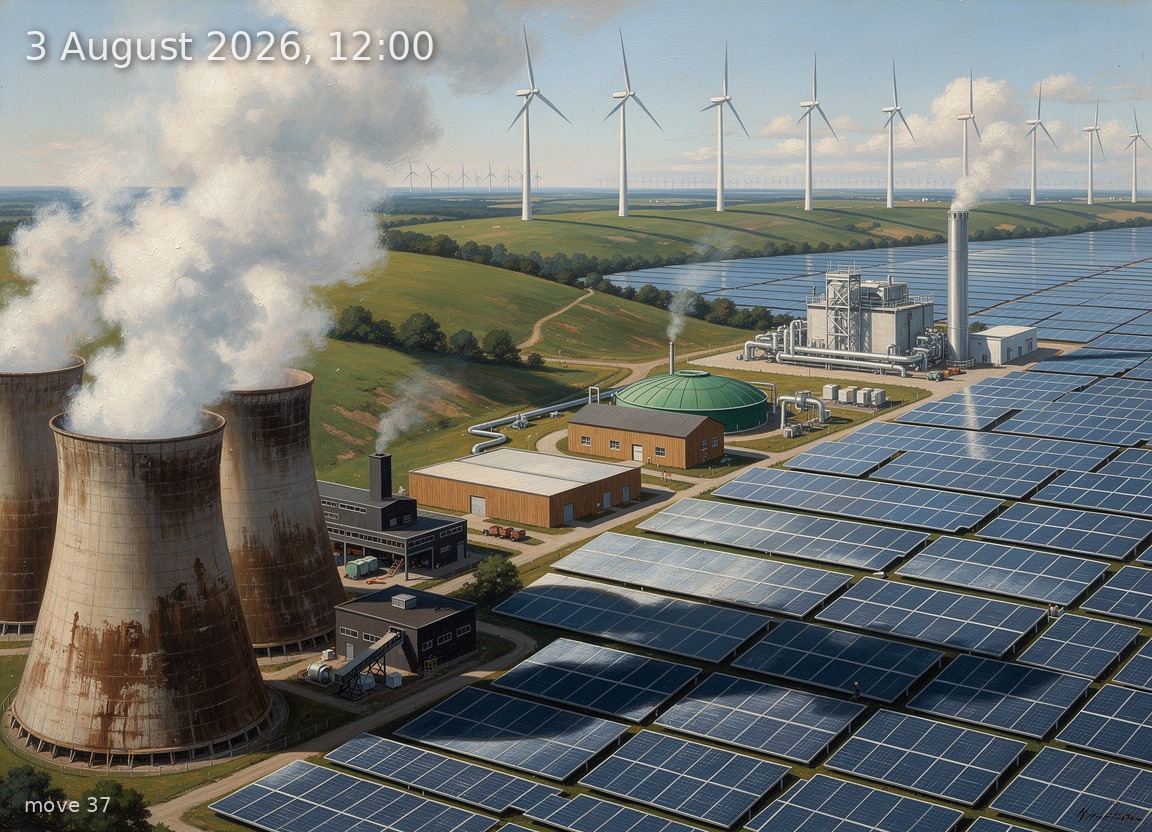
Solar at 54.2 GW drives 89.5% renewables and 16.9 GW net export on a warm August midday.
Generation mix
Wind onshore 7%
Wind offshore 3%
Solar 73%
Biomass 5%
Hydro 2%
Natural gas 2%
Hard coal 2%
Brown coal 6%
90%
Renewable share
7.6 GW
Wind (on + offshore)
54.2 GW
Solar
74.7 GW
Total generation
+16.9 GW
Net export
26.0 EUR/MWh
Day-ahead price
27.7°C / 3 km/h
Temp / Wind speed
Open-Meteo, Kassel (51.3°N 9.5°E) · surface estimate from 100 m wind
30.0% / 547.0 W/m²
Cloud cover / Radiation
77
gCO₂/kWh
Image prompt
Solar 54.2 GW dominates the scene as an enormous sweeping plain of aluminium-framed crystalline silicon photovoltaic panels stretching across roughly 72% of the composition, from the centre to the far right and deep into the background, catching brilliant midday sun and casting sharp reflections. Brown coal 4.6 GW occupies the left foreground as a cluster of massive hyperbolic concrete cooling towers with thick white-grey steam plumes rising into the sky. Wind onshore 5.1 GW appears as a line of modern three-blade turbines on gentle green hills in the mid-left background, their rotors barely turning in the near-still air. Wind offshore 2.4 GW is suggested by distant turbines visible on a hazy horizon line at the far left edge. Biomass 3.7 GW is rendered as a modest wood-clad biogas facility with a rounded green digester dome and a small exhaust stack in the left-centre middle ground. Natural gas 1.7 GW appears as a compact combined-cycle gas turbine plant with a single tall silver exhaust stack and a thin heat shimmer plume, placed just behind the biomass facility. Hard coal 1.5 GW is a smaller dark industrial complex with a rectangular smokestack emitting faint grey exhaust, tucked beside the brown coal towers. Hydro 1.3 GW is shown as a small concrete dam with cascading water on the far left edge, partially hidden by summer foliage. The sky is bright summer midday with roughly 30% cumulus clouds drifting in a blue sky, direct sunlight casting strong shadows. The landscape is lush midsummer German countryside — deep green deciduous trees, golden wheat fields bordering the solar arrays, heat shimmer rising from warm ground at 27.7 °C. The atmosphere is calm and open, reflecting the low 26.0 EUR/MWh price — expansive, unhurried, luminous. Style: highly detailed oil painting in the tradition of 19th-century German Romantic landscape painters such as Caspar David Friedrich and Carl Blechen, with rich saturated colour, visible confident brushwork, atmospheric aerial perspective, and meticulous engineering detail on every technology element — turbine nacelles with three-blade rotors on lattice towers, precise PV panel cell grids, hyperbolic cooling tower concrete textures, CCGT exhaust stack geometry. The painting should feel monumental and contemplative, a masterwork depicting the industrial energy landscape of modern Germany. No text, no labels.