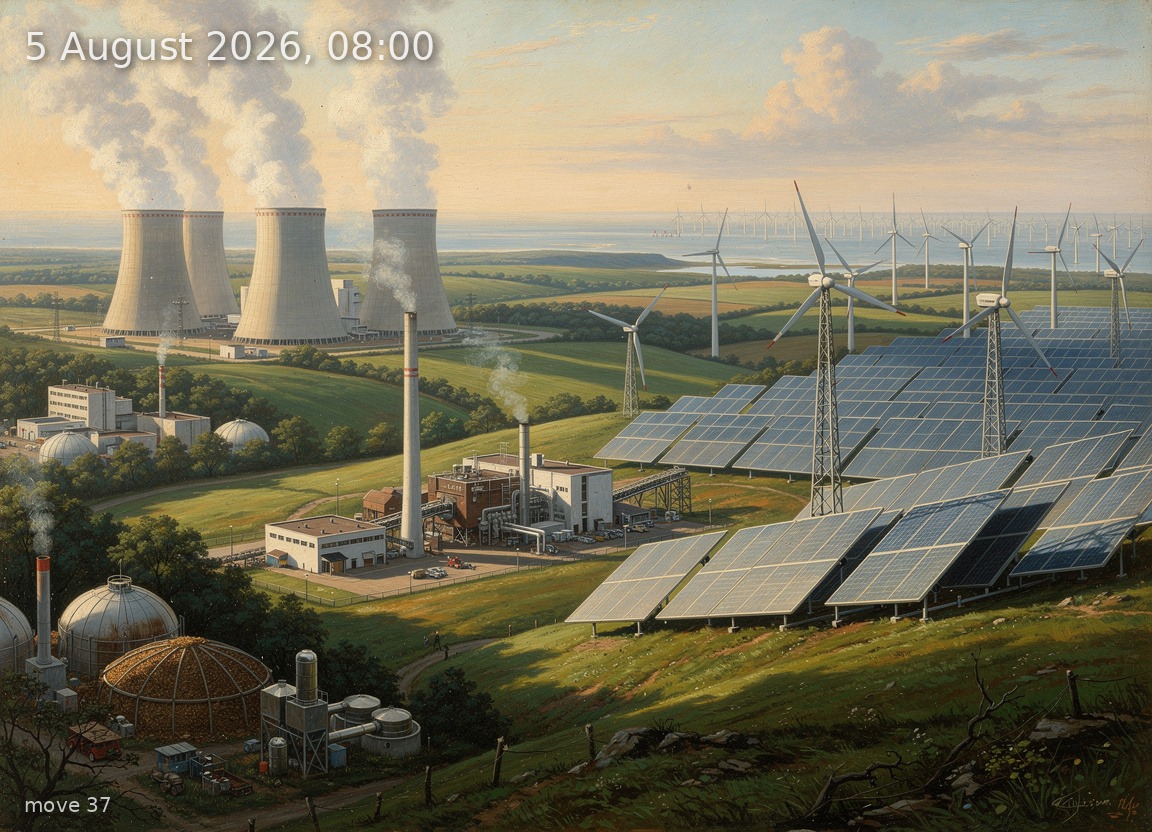
Solar 19.3 GW and wind 13.6 GW dominate, but 5.3 GW net imports fill the morning demand gap at elevated prices.
Generation mix
Wind onshore 16%
Wind offshore 9%
Solar 37%
Biomass 8%
Hydro 2%
Natural gas 10%
Hard coal 5%
Brown coal 13%
72%
Renewable share
13.6 GW
Wind (on + offshore)
19.3 GW
Solar
53.0 GW
Total generation
5.3 GW
Net import
139.8 EUR/MWh
Day-ahead price
20.9°C / 8 km/h
Temp / Wind speed
Open-Meteo, Kassel (51.3°N 9.5°E) · surface estimate from 100 m wind
34.0% / 78.0 W/m²
Cloud cover / Radiation
193
gCO₂/kWh
Image prompt
Solar 19.3 GW dominates the right half of the scene as vast fields of aluminium-framed crystalline silicon photovoltaic panels stretching across gentle green hills, angled to catch the morning sun. Wind onshore 8.7 GW appears as dozens of tall three-blade turbines with white nacelles and lattice-reinforced towers scattered across rolling farmland in the centre-right, their blades turning slowly in a light breeze. Wind offshore 4.9 GW is visible as a distant line of turbines on the hazy horizon where land meets the North Sea. Brown coal 6.9 GW occupies the left portion as a massive lignite power station with three hyperbolic concrete cooling towers emitting thick white steam plumes rising into the morning air. Natural gas 5.1 GW sits centre-left as a compact combined-cycle gas turbine plant with a tall slender exhaust stack and a single smaller cooling tower with a thin vapour trail. Hard coal 2.7 GW appears as a smaller coal-fired station with a rectangular boiler house, conveyor belts, and a single shorter cooling tower behind the gas plant. Biomass 4.0 GW is rendered as a cluster of medium-sized biomass facilities with wood-chip storage domes and modest chimneys with faint grey exhaust, nestled among trees at the left edge. Hydro 1.2 GW appears as a small concrete dam with a visible spillway set into a wooded valley in the far left background. The sky is early-morning summer daylight at 08:00, sun low in the east casting long golden shadows across the landscape, roughly two-thirds clear blue sky with scattered cumulus clouds covering about a third of the dome, the atmosphere slightly heavy and hazy suggesting elevated electricity prices. Vegetation is lush midsummer green — tall grasses, leafy deciduous trees, wildflowers. Temperature is warm, around 21°C, with a gentle summery haze. Highly detailed oil painting in the tradition of 19th-century German Romantic landscape painters such as Caspar David Friedrich and Carl Blechen — rich saturated colour palette, visible confident brushwork, atmospheric depth with subtle aerial perspective, dramatic compositional balance between industrial infrastructure and pastoral landscape. Each energy technology rendered with meticulous engineering accuracy. No text, no labels, no human figures.