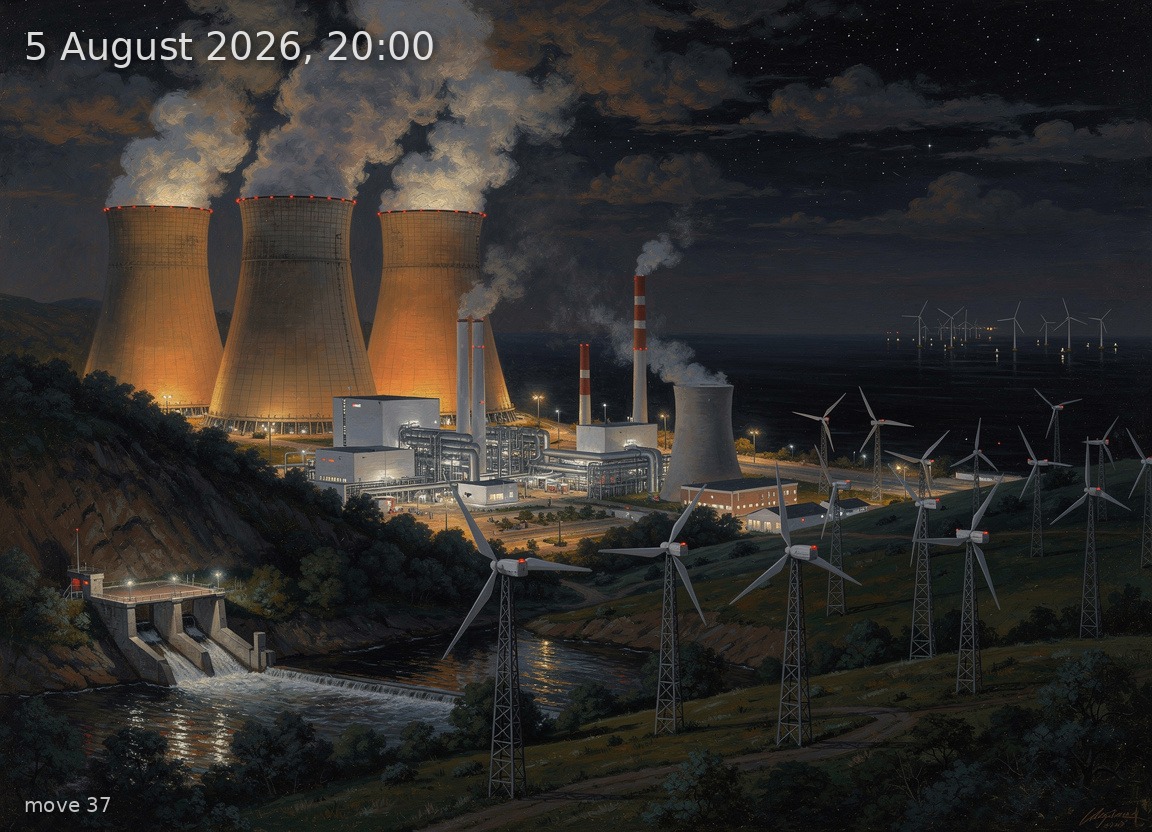
Brown coal and wind lead a 28.6 GW domestic supply against 56.0 GW demand, driving high prices and large net imports.
Generation mix
Wind onshore 27%
Wind offshore 10%
Solar 4%
Biomass 14%
Hydro 4%
Natural gas 12%
Hard coal 6%
Brown coal 22%
59%
Renewable share
10.8 GW
Wind (on + offshore)
1.0 GW
Solar
28.6 GW
Total generation
27.4 GW
Net import
187.5 EUR/MWh
Day-ahead price
27.7°C / 13 km/h
Temp / Wind speed
Open-Meteo, Kassel (51.3°N 9.5°E) · surface estimate from 100 m wind
47.0% / 41.0 W/m²
Cloud cover / Radiation
291
gCO₂/kWh
Image prompt
Brown coal 6.4 GW dominates the left quarter as a massive lignite power station with four hyperbolic cooling towers emitting thick white steam plumes, lit from below by orange sodium lamps; wind onshore 7.9 GW fills the centre-right as dozens of tall three-blade turbines on lattice towers stretching across rolling hills, their blades turning moderately in light wind; wind offshore 2.9 GW appears in the far right background as a cluster of offshore turbines barely visible against a dark sea horizon; biomass 4.0 GW is rendered as a mid-ground industrial plant with a wood-chip conveyor and a single stack emitting thin grey smoke, warmly lit; natural gas 3.5 GW sits centre-left as two compact CCGT units with slim exhaust stacks and small plumes, illuminated by facility lighting; hard coal 1.7 GW appears as a smaller coal plant with a single square cooling tower behind the gas units; hydro 1.1 GW is a modest dam and spillway in a valley to the far left, water glinting under artificial light; solar 1.0 GW is a small field of aluminium-framed crystalline silicon panels in the mid-ground, barely visible, catching no sunlight, reflecting only ambient facility glow. The sky is fully dark — a deep navy-to-black August night sky at 20:00 in Berlin, no twilight, no sunset glow remaining, scattered stars visible through 47 percent cloud cover with warm cumulus clouds faintly backlit by industrial light pollution. The atmosphere is heavy and oppressive, hinting at the 187.5 EUR/MWh price — humid summer air hangs thick, distorting distant lights. Vegetation is lush midsummer green, rendered in dark tones, with mature deciduous trees and tall grasses suggesting 27.7 °C warmth. High-voltage transmission pylons with sagging lines cross the scene, symbolising the enormous import flows. Style: highly detailed oil painting in the tradition of 19th-century German Romantic landscape painters — rich, saturated colour, visible impasto brushwork, dramatic chiaroscuro between the black sky and the glowing industrial facilities, atmospheric depth with haze and moisture in the air, meticulous engineering detail on every turbine nacelle, cooling tower rib, and panel frame. No text, no labels.