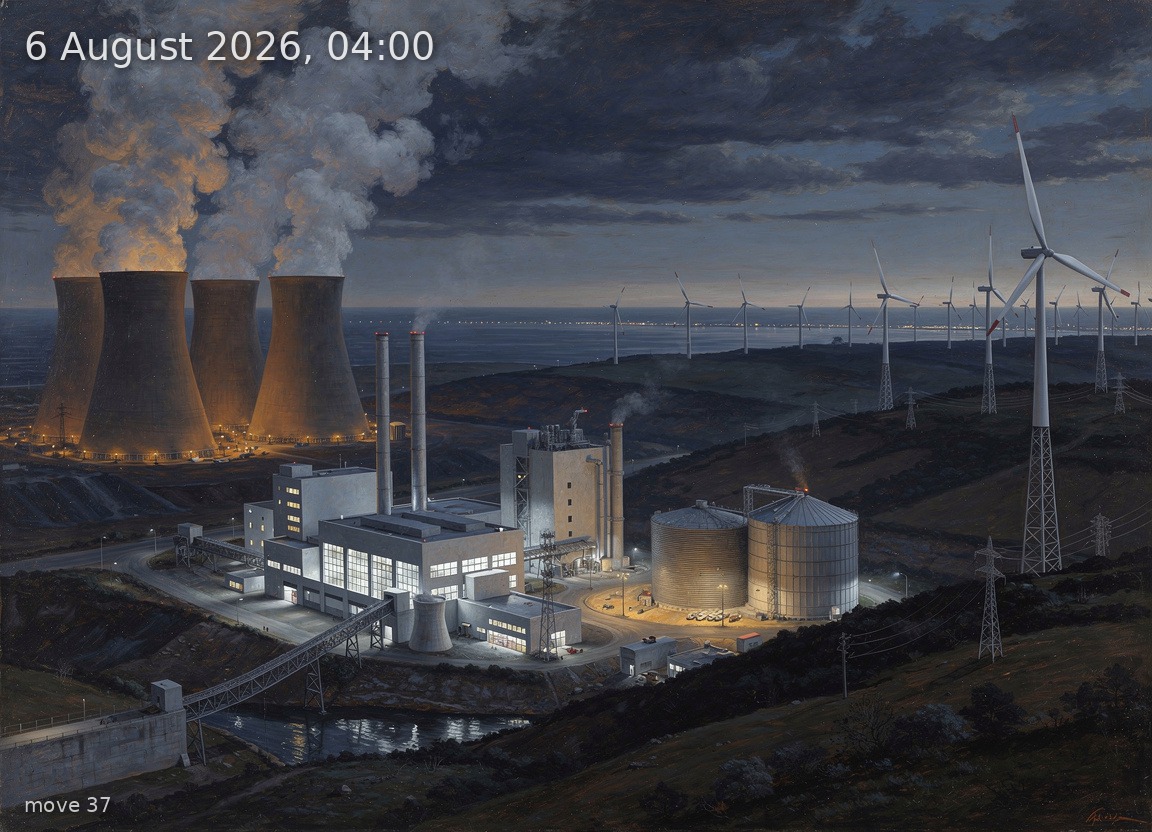
Wind leads at 13.1 GW but 8.4 GW net imports are needed as nighttime demand outstrips domestic supply at elevated prices.
Generation mix
Wind onshore 27%
Wind offshore 14%
Biomass 12%
Hydro 4%
Natural gas 16%
Hard coal 8%
Brown coal 20%
56%
Renewable share
13.1 GW
Wind (on + offshore)
0.0 GW
Solar
32.0 GW
Total generation
8.3 GW
Net import
134.1 EUR/MWh
Day-ahead price
20.6°C / 8 km/h
Temp / Wind speed
Open-Meteo, Kassel (51.3°N 9.5°E) · surface estimate from 100 m wind
81.0% / 0.0 W/m²
Cloud cover / Radiation
301
gCO₂/kWh
Image prompt
Wind onshore 8.5 GW and offshore 4.6 GW together dominate the right two-thirds of the scene as dozens of tall three-blade turbines on lattice and tubular towers, their rotors slowly turning in moderate breeze, some on dark rolling hills and others receding into a distant North Sea horizon implied by faint coastal lights; brown coal 6.5 GW occupies the left quarter as a massive lignite power station with four hyperbolic cooling towers emitting thick white-grey steam plumes lit from below by orange sodium lamps; natural gas 5.0 GW appears centre-left as two compact CCGT plants with slender exhaust stacks venting thin heat haze, their turbine halls glowing with interior fluorescent light; biomass 3.7 GW is rendered as a mid-ground industrial facility with a tall rectangular boiler house, woodchip storage domes, and a single stack with a faint warm-toned plume; hard coal 2.4 GW shows a smaller conventional boiler plant with conveyor belts and a single cooling tower behind the gas units; hydro 1.2 GW appears as a modest concrete dam structure in the far middle distance with water gleaming faintly under facility lighting. The sky is completely dark, deep navy-black, no twilight, no sky glow, heavy 81% cloud cover obscuring all stars, an oppressive overcast ceiling pressing down — reflecting the high electricity price. The summer landscape at 20.6°C features lush dark-green deciduous trees barely visible in the industrial glow. Scattered sodium streetlights cast amber pools along rural roads connecting facilities. Transmission pylons with high-voltage lines thread across the scene, symbolising import flows. Highly detailed oil painting in the tradition of 19th-century German Romantic landscape painters — Caspar David Friedrich meets industrial sublime — rich deep colour palette of indigo, amber, and charcoal grey, visible expressive brushwork, atmospheric depth and chiaroscuro, meticulous engineering accuracy on turbine nacelles, cooling tower parabolic profiles, and CCGT exhaust geometry. No text, no labels.