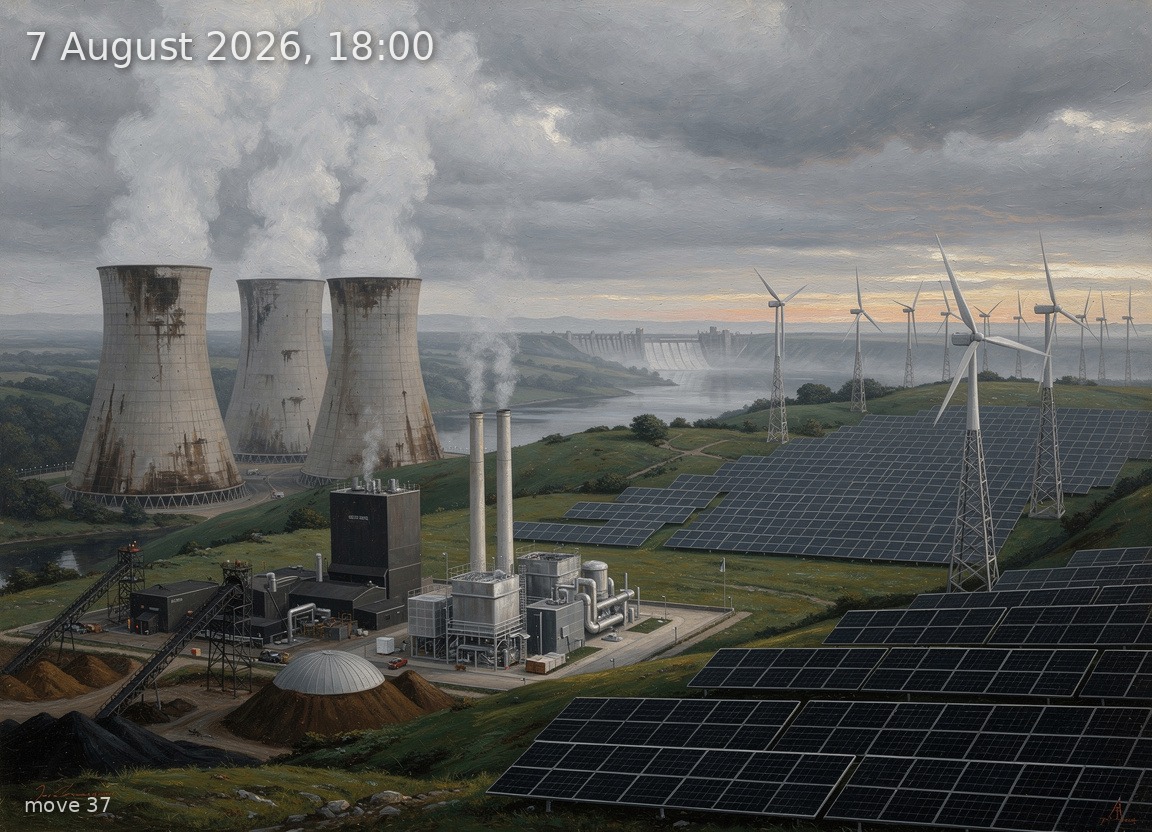
Solar leads at 15.6 GW but 16 GW net imports needed as evening demand peaks under overcast skies.
Generation mix
Wind onshore 13%
Wind offshore 3%
Solar 41%
Biomass 10%
Hydro 4%
Natural gas 6%
Hard coal 7%
Brown coal 16%
72%
Renewable share
6.3 GW
Wind (on + offshore)
15.6 GW
Solar
37.9 GW
Total generation
16.0 GW
Net import
144.7 EUR/MWh
Day-ahead price
21.5°C / 15 km/h
Temp / Wind speed
Open-Meteo, Kassel (51.3°N 9.5°E) · surface estimate from 100 m wind
100.0% / 141.0 W/m²
Cloud cover / Radiation
208
gCO₂/kWh
Image prompt
Solar 15.6 GW dominates the right half of the scene as vast fields of aluminium-framed crystalline silicon photovoltaic panels stretching across gentle green hills under a uniformly overcast sky with diffuse silvery light; brown coal 5.9 GW occupies the left quarter as a cluster of massive hyperbolic cooling towers with thick white steam plumes rising into the grey ceiling; wind onshore 4.9 GW appears as a line of three-blade turbines on lattice towers along a mid-ground ridge, blades turning slowly in moderate wind; biomass 3.9 GW is rendered as a mid-sized industrial plant with a wood-chip storage dome and a single smokestack emitting pale exhaust, positioned centre-left; hard coal 2.6 GW shows as a smaller coal-fired station with conveyor belts and a rectangular stack beside the brown coal complex; natural gas 2.3 GW appears as a compact CCGT facility with twin exhaust stacks and clean metallic housing near the centre; hydro 1.4 GW is depicted as a concrete dam with water cascading through spillways in the far background valley; wind offshore 1.3 GW is suggested by distant turbines on the hazy horizon line implying the North Sea coast. The time is 18:00 in August — dusk is approaching but not yet arrived, the sky is a heavy uniform blanket of cloud with a faint warm glow along the western horizon suggesting the sun is low but entirely hidden; the atmosphere feels oppressive and thick, reflecting the high electricity price. Summer vegetation is lush — dark green deciduous trees, tall grass, wildflowers — at 21.5°C. The wind bends the grass gently. Rendered as a highly detailed oil painting in the tradition of 19th-century German Romantic landscape painters such as Caspar David Friedrich and Carl Blechen — rich colour palette of muted greys, deep greens, and warm industrial ochres, visible confident brushwork, atmospheric aerial perspective with haze softening distant elements. Each energy technology is painted with meticulous engineering accuracy: turbine nacelles and three-blade rotors, PV panel grid patterns, hyperbolic concrete cooling tower textures, CCGT metallic housings. No text, no labels, no human figures prominent — the landscape and its machines are the subject.