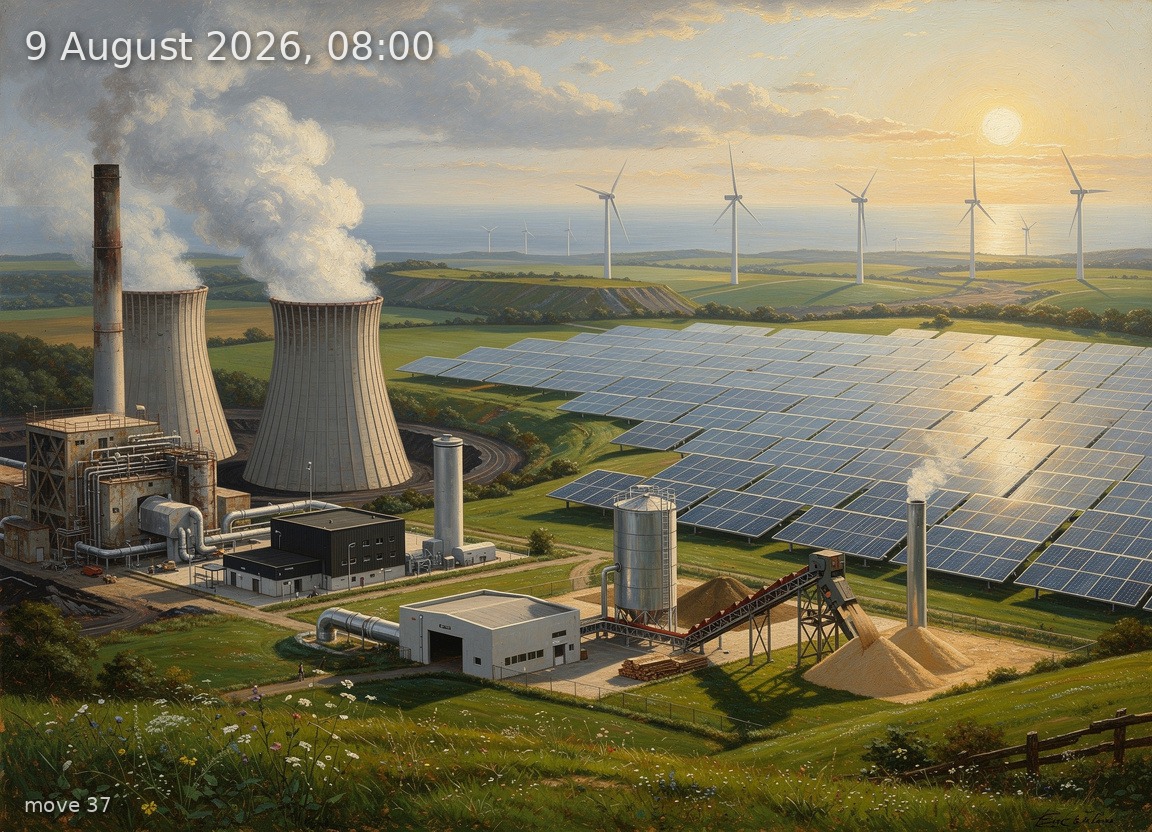
Solar dominates at 21.1 GW alongside persistent 6.3 GW brown coal as light winds and moderate demand shape the morning grid.
Generation mix
Wind onshore 16%
Wind offshore 2%
Solar 48%
Biomass 9%
Hydro 2%
Natural gas 4%
Hard coal 4%
Brown coal 14%
77%
Renewable share
8.0 GW
Wind (on + offshore)
21.1 GW
Solar
44.3 GW
Total generation
+1.4 GW
Net export
91.6 EUR/MWh
Day-ahead price
14.4°C / 2 km/h
Temp / Wind speed
Open-Meteo, Kassel (51.3°N 9.5°E) · surface estimate from 100 m wind
37.0% / 77.0 W/m²
Cloud cover / Radiation
171
gCO₂/kWh
Image prompt
Solar 21.1 GW dominates the right half and centre of the scene as vast fields of aluminium-framed crystalline silicon photovoltaic panels stretching across rolling green summer farmland, angled toward a morning sun at roughly 30° elevation; brown coal 6.3 GW occupies the left quarter as a massive lignite power station complex with three hyperbolic concrete cooling towers emitting heavy white steam plumes; wind onshore 7.2 GW appears as a line of tall three-blade turbines with white tubular towers on distant ridgelines, rotors barely turning in the still air; wind offshore 0.8 GW is suggested by two small turbines visible on a hazy horizon line where land meets sea; biomass 4.0 GW is rendered as a mid-ground industrial facility with a cylindrical silo, wood-chip conveyor, and a single low stack with pale exhaust; hard coal 1.9 GW sits adjacent to the lignite plant as a smaller conventional boiler house with a rectangular chimney; natural gas 1.9 GW appears as a compact combined-cycle gas turbine unit with a single tall exhaust stack and minimal visible emissions; hydro 1.1 GW is depicted as a concrete dam and spillway set into a wooded valley in the far background. The sky is summer morning light at 08:00 — sun well above the eastern horizon casting long warm shadows westward, 37% cloud cover rendered as scattered cumulus with bright white tops and blue-grey bases drifting across an otherwise blue sky. The atmosphere feels subtly heavy and oppressive, a faint warm haze hanging over the landscape to reflect the elevated electricity price. Temperature of 14.4°C produces light dew on grass, lush green midsummer vegetation, wildflowers along field margins. The wind is nearly still — no motion blur on grass or foliage. Rendered as a highly detailed oil painting in the tradition of 19th-century German Romantic landscape painters such as Caspar David Friedrich and Carl Blechen — rich saturated colour, visible impasto brushwork, dramatic atmospheric depth and chiaroscuro lighting, meticulous engineering detail on every turbine nacelle, panel frame, cooling tower fluting, and stack structure. No text, no labels, no people.