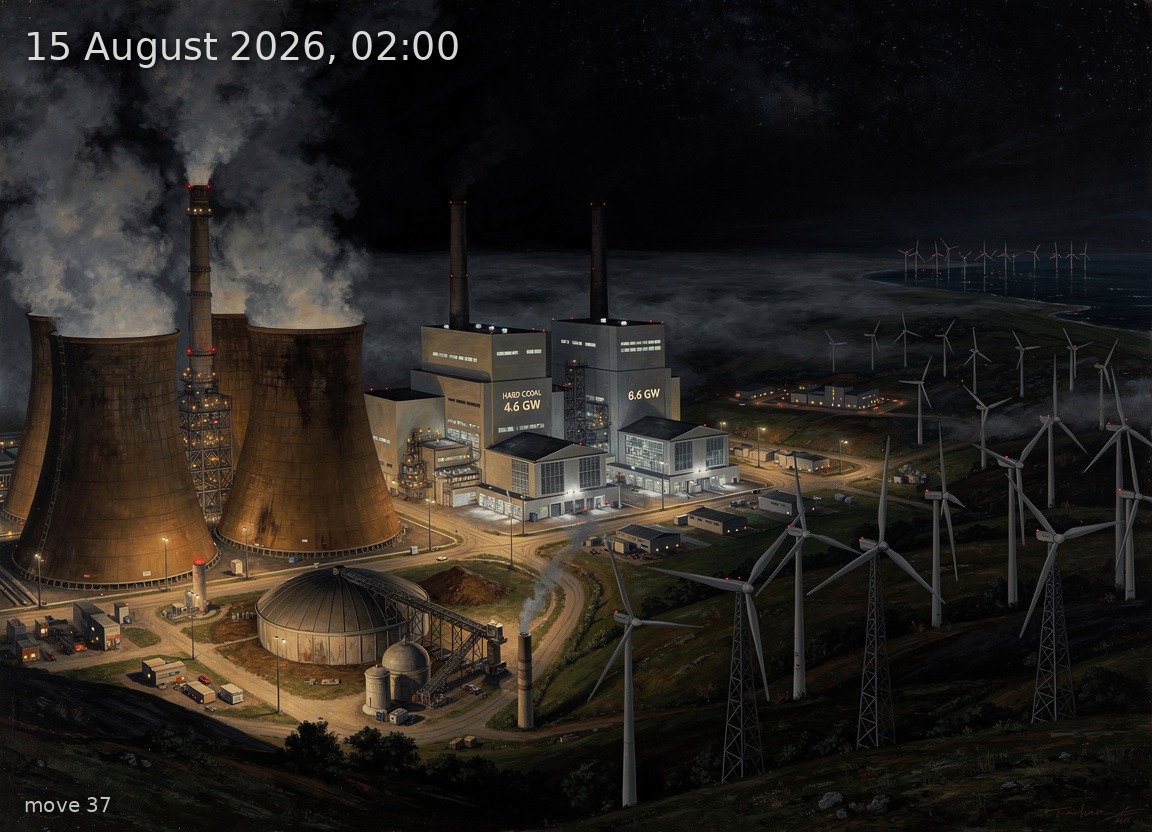
Coal and gas provide half of generation while 6.4 GW net imports fill the nighttime supply gap.
Generation mix
Wind onshore 28%
Wind offshore 7%
Biomass 12%
Hydro 3%
Natural gas 16%
Hard coal 15%
Brown coal 20%
49%
Renewable share
10.9 GW
Wind (on + offshore)
0.0 GW
Solar
31.3 GW
Total generation
6.4 GW
Net import
156.9 EUR/MWh
Day-ahead price
15.8°C / 3 km/h
Temp / Wind speed
Open-Meteo, Kassel (51.3°N 9.5°E) · surface estimate from 100 m wind
0.0% / 0.0 W/m²
Cloud cover / Radiation
354
gCO₂/kWh
Image prompt
Brown coal 6.4 GW dominates the left quarter as a cluster of massive hyperbolic cooling towers with thick white-grey steam plumes rising into blackness; hard coal 4.6 GW sits just right of centre-left as a large coal-fired plant with rectangular boiler houses and twin chimneys trailing thinner smoke; natural gas 4.9 GW occupies the centre as two compact CCGT units with tall single exhaust stacks and faint heat shimmer at the outlets; wind onshore 8.6 GW spans the entire right third as dozens of three-blade turbines on lattice and tubular towers receding into the distance across rolling hills, blades turning very slowly in near-calm air; wind offshore 2.2 GW appears as a distant row of larger turbines on the far-right horizon above a faintly reflective estuary; biomass 3.6 GW is rendered as a medium-sized industrial facility with a wood-chip storage dome and a single short stack with pale exhaust, positioned between the coal plants and the gas units; hydro 1.0 GW appears as a small dam and spillway structure nestled in a valley in the far background. The sky is completely dark, deep navy-black, no twilight, no sky glow—a clear starry August night with zero cloud cover, the Milky Way faintly visible above the industrial haze. All facilities are lit by warm sodium-orange and cool LED-white industrial lighting, windows glowing, security lights casting sharp cones. The atmosphere feels heavy and oppressive despite the clear sky, a subtle haze of industrial exhaust hanging low over the landscape, conveying the tension of high electricity prices. Summer vegetation—full dark-green deciduous trees and tall grass—is barely visible in the artificial light. The temperature is mild at 15.8 °C, no frost, soft humid summer night air. Painted in the style of a highly detailed 19th-century German Romantic oil painting—rich, deep color palette dominated by blacks, warm oranges, and cold steel blues—with visible confident brushwork, chiaroscuro lighting from the industrial sources, atmospheric depth achieved through layers of haze, and meticulous engineering accuracy in every turbine nacelle, cooling tower curvature, and smokestack detail. No text, no labels.