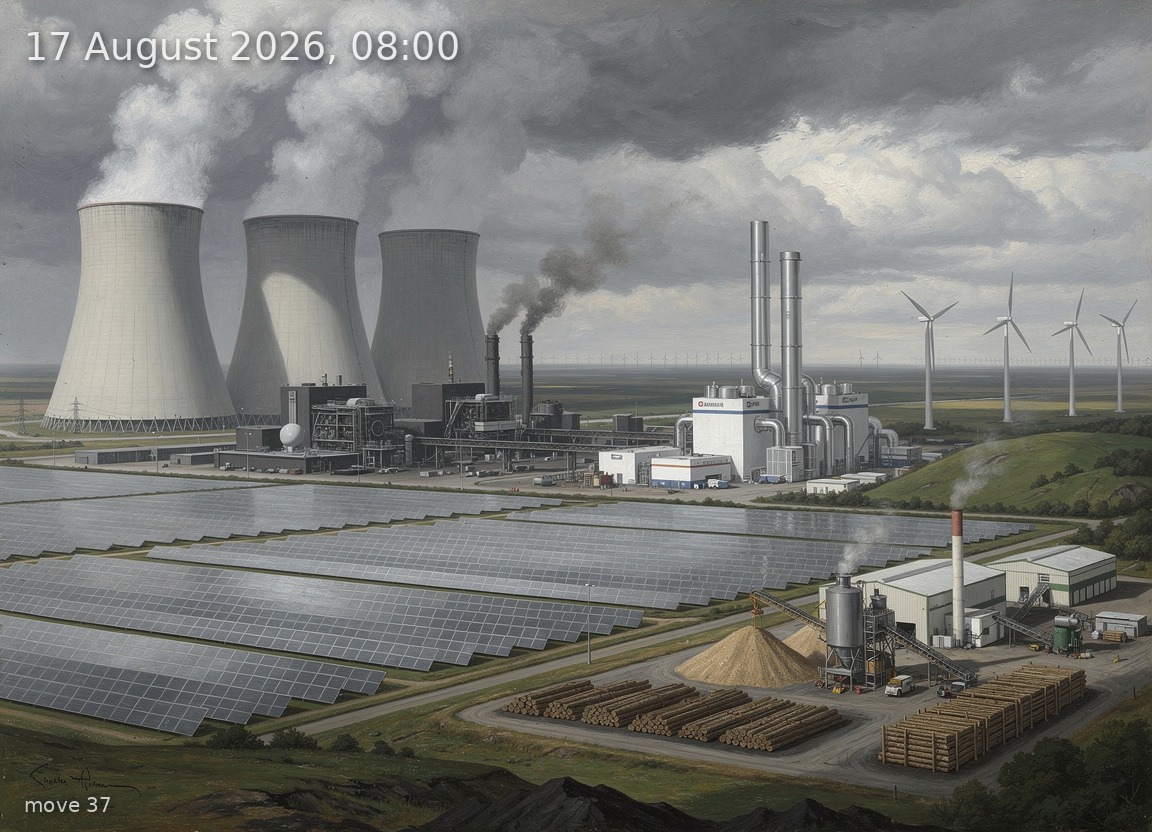
Overcast skies and light winds force heavy coal, gas, and import reliance, pushing prices above 200 EUR/MWh.
Generation mix
Wind onshore 8%
Wind offshore 3%
Solar 25%
Biomass 12%
Hydro 3%
Natural gas 19%
Hard coal 14%
Brown coal 16%
51%
Renewable share
3.9 GW
Wind (on + offshore)
8.6 GW
Solar
34.9 GW
Total generation
25.8 GW
Net import
208.6 EUR/MWh
Day-ahead price
15.8°C / 6 km/h
Temp / Wind speed
Open-Meteo, Kassel (51.3°N 9.5°E) · surface estimate from 100 m wind
100.0% / 1.0 W/m²
Cloud cover / Radiation
331
gCO₂/kWh
Image prompt
Brown coal 5.8 GW dominates the left quarter as three massive hyperbolic cooling towers with thick white-grey steam plumes rising into an oppressive leaden sky; hard coal 4.8 GW appears just right of centre as a cluster of dark industrial boiler houses with tall chimneys trailing dark smoke; natural gas 6.7 GW occupies the centre-right as compact modern CCGT plants with polished steel exhaust stacks emitting thin transparent heat haze; solar 8.6 GW fills the mid-ground as vast fields of aluminium-framed crystalline silicon PV panels stretching across flat farmland, their surfaces dull grey reflecting no sunlight under total overcast; wind onshore 2.7 GW appears as a short row of three-blade turbines on gentle hills in the right background, rotors turning sluggishly; wind offshore 1.2 GW is suggested by tiny turbines on a distant grey horizon line; biomass 4.0 GW is a mid-sized wood-chip plant with a modest smokestack and timber storage yard in the right foreground; hydro 1.2 GW is a small concrete run-of-river weir with white water visible at the far right edge. The time is 08:00 on a mid-August morning: full diffuse daylight but absolutely no sun visible, a uniform 100% cloud ceiling pressing low and heavy, creating a claustrophobic oppressive atmosphere suggesting high energy prices. Temperature is mild at 15.8°C, vegetation is full lush summer green—tall grasses, leafy deciduous trees—but all colours are muted under the flat grey light. The air feels heavy and still, with almost no wind motion in the grass. High-voltage transmission pylons and cables recede into the hazy distance, symbolising the heavy import flows. Style: highly detailed oil painting in the tradition of 19th-century German Romantic landscape painters such as Caspar David Friedrich and Carl Blechen—rich layered colour despite the grey palette, visible impasto brushwork, atmospheric depth with sfumato distance, meticulous engineering accuracy in every turbine nacelle, cooling tower curve, and panel frame. The scene conveys the vast industrial metabolism of a nation under cloud, rendered as a brooding masterwork. No text, no labels.