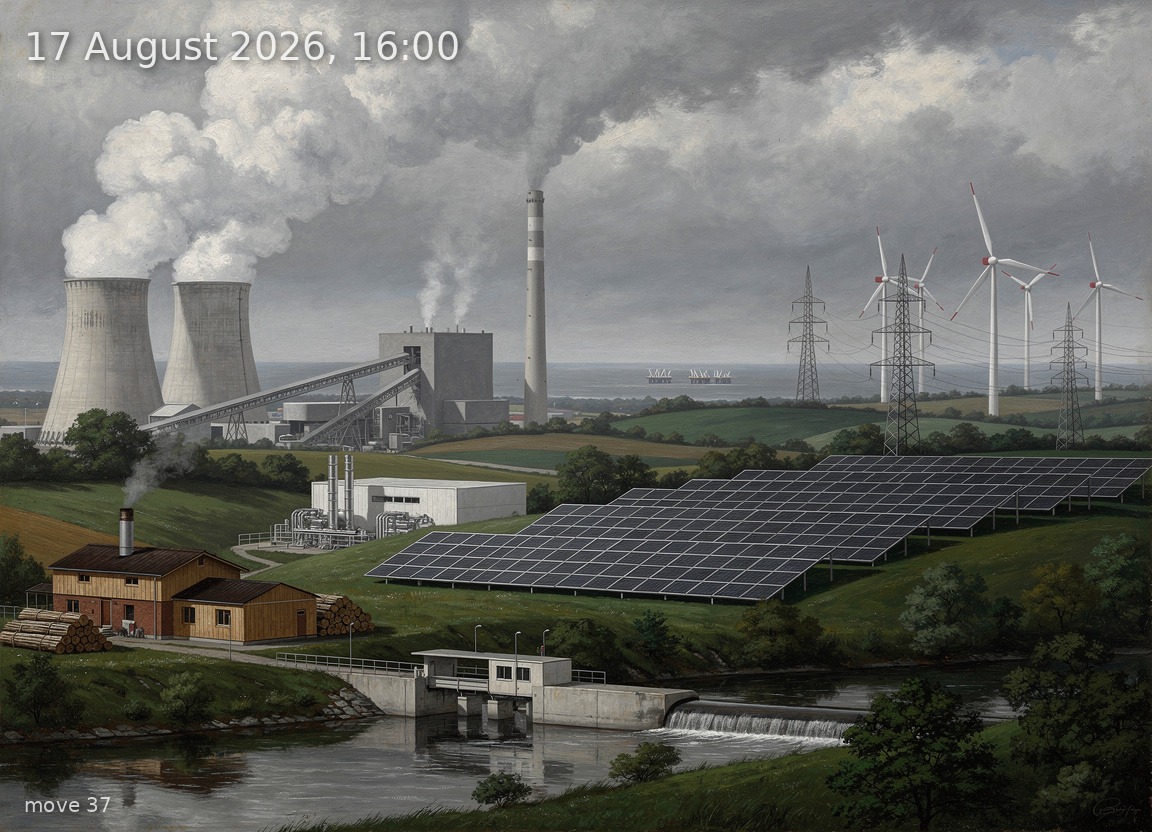
Overcast skies limit solar output; wind and thermal generation plus 7.3 GW net imports meet elevated demand.
Generation mix
Wind onshore 22%
Wind offshore 4%
Solar 37%
Biomass 7%
Hydro 3%
Natural gas 11%
Hard coal 9%
Brown coal 7%
72%
Renewable share
13.3 GW
Wind (on + offshore)
18.7 GW
Solar
51.0 GW
Total generation
7.3 GW
Net import
140.1 EUR/MWh
Day-ahead price
17.1°C / 11 km/h
Temp / Wind speed
Open-Meteo, Kassel (51.3°N 9.5°E) · surface estimate from 100 m wind
100.0% / 2.0 W/m²
Cloud cover / Radiation
184
gCO₂/kWh
Image prompt
Solar 18.7 GW dominates the centre-right as vast fields of aluminium-framed crystalline silicon PV panels stretching across gentle green summer hills, their surfaces reflecting only flat grey light under total overcast; wind onshore 11.3 GW fills the far right and background as dozens of tall three-blade turbines on lattice and tubular towers, rotors turning slowly in light breeze across rolling farmland; wind offshore 2.0 GW appears as a small cluster of turbines barely visible on a distant grey North Sea horizon at far right; natural gas 5.6 GW occupies the left-centre as a modern compact CCGT plant with paired exhaust stacks venting thin transparent heat shimmer; hard coal 4.7 GW stands at the left as a large power station with prominent boiler house, conveyor belts, and a single square concrete chimney trailing grey-white smoke; brown coal 3.8 GW anchors the far left with a pair of hyperbolic concrete cooling towers releasing heavy white steam plumes that merge into the overcast ceiling; biomass 3.6 GW appears as a modest wood-clad CHP plant with a short stack and stacked timber nearby; hydro 1.4 GW is a small concrete weir and powerhouse nestled along a river in the mid-ground. The sky is uniformly 100% overcast, a heavy blanket of stratiform cloud in tones of pewter and slate, oppressive and low-hanging, conveying the high electricity price atmosphere — no blue sky visible, no direct sunlight, diffuse daylight only at 16:00 Berlin time. Temperature 17 °C — lush dark-green deciduous trees in full August foliage, meadow grasses swaying gently. A broad German river — perhaps the Rhine or Elbe — runs through the mid-ground reflecting the grey sky. High-voltage transmission pylons with sagging conductor lines cross the scene, symbolising the net import flow. Painted in the style of a highly detailed 19th-century German Romantic oil painting — rich impasto brushwork, atmospheric depth and haze, Caspar David Friedrich's sense of sublime scale combined with meticulous engineering accuracy on every turbine nacelle, cooling tower rib, and PV module frame. No text, no labels.