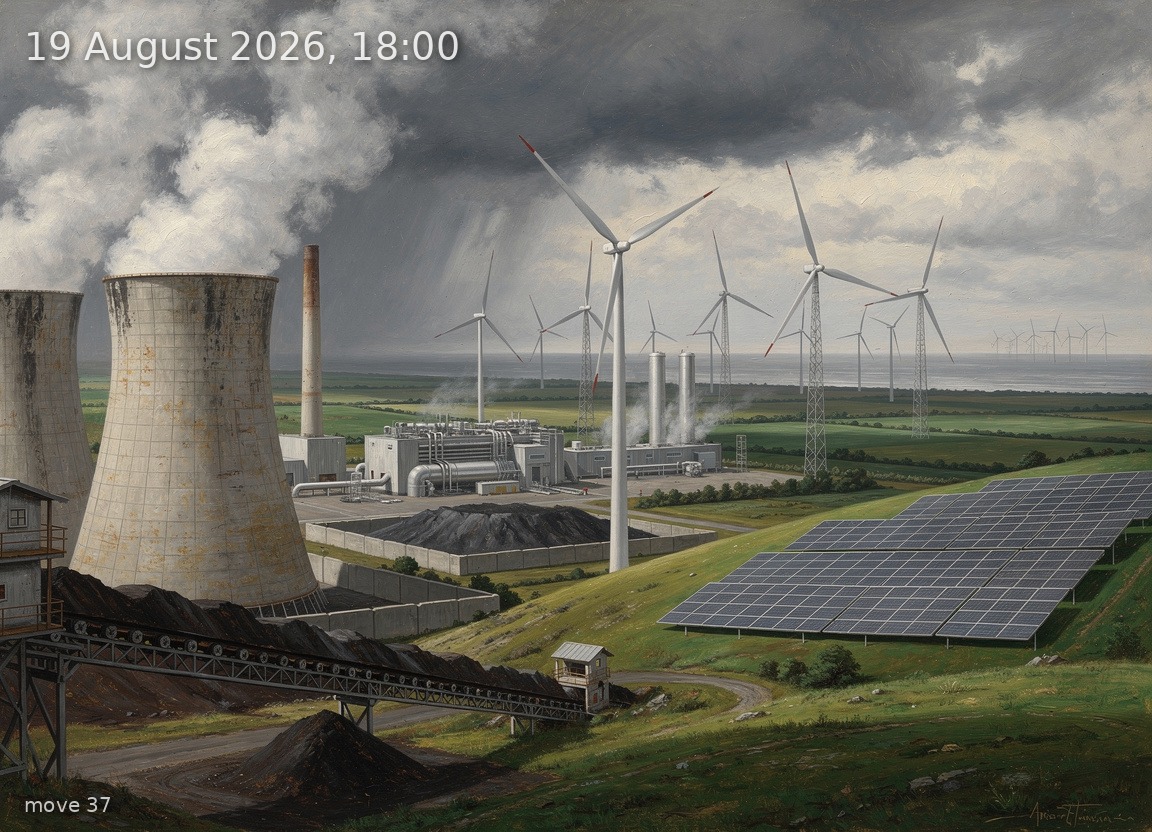
Wind leads at 13 GW but 10.9 GW net imports needed as overcast evening demand peaks at 55.1 GW.
Generation mix
Wind onshore 29%
Wind offshore 7%
Solar 21%
Biomass 8%
Hydro 3%
Natural gas 11%
Hard coal 8%
Brown coal 13%
68%
Renewable share
15.9 GW
Wind (on + offshore)
9.2 GW
Solar
44.2 GW
Total generation
10.9 GW
Net import
183.7 EUR/MWh
Day-ahead price
20.4°C / 1 km/h
Temp / Wind speed
Open-Meteo, Kassel (51.3°N 9.5°E) · surface estimate from 100 m wind
100.0% / 2.0 W/m²
Cloud cover / Radiation
217
gCO₂/kWh
Image prompt
Wind onshore 13.0 GW dominates the right half of the canvas as dozens of three-blade turbines on tall lattice and tubular towers stretching across rolling green farmland into the atmospheric distance; wind offshore 2.9 GW appears as a cluster of turbines on the far-right horizon above a faint grey sea line; solar 9.2 GW occupies the centre-right as extensive rows of aluminium-framed crystalline silicon PV panels on a gentle hillside, their surfaces dull and reflectionless under the heavy overcast; brown coal 5.6 GW fills the left foreground as two massive hyperbolic concrete cooling towers with thick white steam plumes drifting heavily in the still air, beside a conveyor belt carrying dark lignite; natural gas 4.8 GW sits centre-left as a compact combined-cycle gas turbine plant with twin cylindrical exhaust stacks emitting thin heat haze; hard coal 3.6 GW appears behind the gas plant as a smaller coal station with a single tall chimney and coal stockpile; biomass 3.8 GW is rendered as a mid-ground wood-chip facility with a modest smokestack and timber yard; hydro 1.3 GW is a small dam and spillway nestled in a forested valley at far left. The sky is entirely overcast with thick, low, oppressive grey clouds—no blue visible, no sunlight breaking through—matching 100% cloud cover. The lighting is dusk at 18:00 in August: a dim orange-red glow lingers on the lowest horizon to the west, but the sky above is darkening rapidly to slate grey and deep blue-grey, with the landscape already losing colour and detail. The air feels heavy and warm at 20°C; lush green summer vegetation, full leafy trees, tall grass. Virtually no wind motion at ground level—flags hang limp, grass is still. The oppressive cloud ceiling and warm haze convey a sense of atmospheric weight corresponding to high electricity prices. Style: highly detailed oil painting in the tradition of 19th-century German Romantic landscape painters such as Caspar David Friedrich and Carl Blechen—rich impasto brushwork, dramatic chiaroscuro, deep atmospheric perspective—but with meticulous engineering accuracy in every turbine nacelle, every PV module frame, every cooling tower curve. No text, no labels, no human figures prominent.