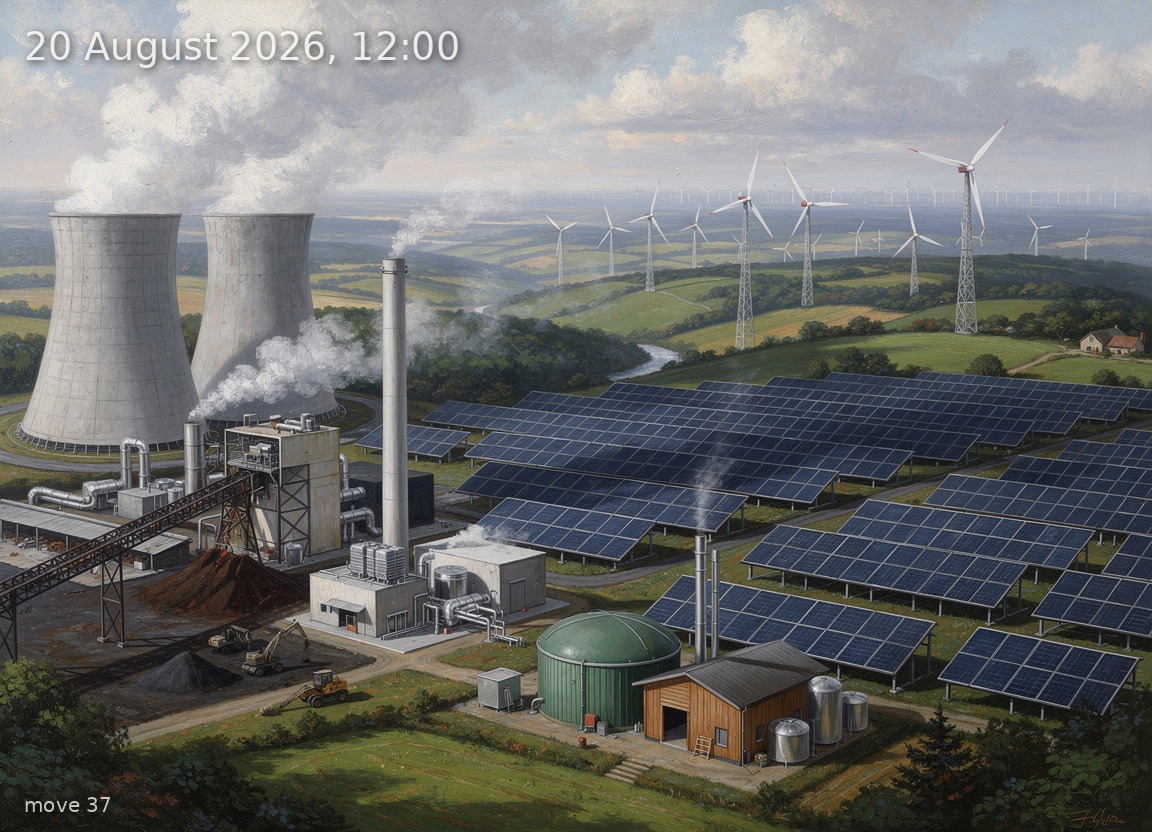
Solar at 39.2 GW and wind at 15.4 GW drive 11.9 GW of net exports under partly cloudy midday skies.
Generation mix
Wind onshore 20%
Wind offshore 3%
Solar 57%
Biomass 5%
Hydro 2%
Natural gas 3%
Hard coal 4%
Brown coal 6%
86%
Renewable share
15.4 GW
Wind (on + offshore)
39.2 GW
Solar
69.3 GW
Total generation
+11.9 GW
Net export
83.6 EUR/MWh
Day-ahead price
20.6°C / 13 km/h
Temp / Wind speed
Open-Meteo, Kassel (51.3°N 9.5°E) · surface estimate from 100 m wind
74.0% / 297.0 W/m²
Cloud cover / Radiation
101
gCO₂/kWh
Image prompt
Solar 39.2 GW dominates the scene as vast fields of aluminium-framed crystalline silicon photovoltaic panels stretching across more than half the canvas from the centre to the right, angled southward on metal racking, catching diffuse light through broken clouds. Wind onshore 13.6 GW appears as dozens of three-blade turbines on tall lattice and tubular towers arrayed along rolling green hills in the centre-right background, blades turning gently in moderate wind. Wind offshore 1.8 GW is suggested by a distant cluster of turbines on the hazy horizon line. Brown coal 4.4 GW occupies the left foreground as two large hyperbolic cooling towers emitting thick white steam plumes, with a conveyor belt feeding dark lignite into a massive boiler house. Hard coal 3.0 GW sits adjacent as a slightly smaller coal plant with a tall chimney stack and coal stockpile visible. Natural gas 2.3 GW appears as a compact combined-cycle gas turbine facility with a single sleek exhaust stack and modest heat shimmer. Biomass 3.6 GW is rendered as a wood-clad biogas facility with a rounded green digester dome and a small stack, nestled among farmland. Hydro 1.4 GW appears as a modest run-of-river weir with a small powerhouse on a meandering river in the middle distance. The sky is midday bright but hazy, with 74% cloud cover — a patchwork of cumulus and altostratus allowing shafts of direct sunlight (297 W/m² direct radiation) to break through in places, casting dappled light across the landscape. The atmosphere feels warm and slightly heavy, with a faint oppressive quality reflecting the 83.6 EUR/MWh price. Summer vegetation is lush: green deciduous trees, tall grass, wildflowers along field edges, temperature around 21°C. Style: highly detailed oil painting in the tradition of 19th-century German Romantic landscape painters such as Caspar David Friedrich and Carl Blechen — rich saturated colour, visible textured brushwork, atmospheric aerial perspective with depth receding to a hazy horizon, dramatic compositional balance between nature and industry. Every technology is rendered with meticulous engineering accuracy. No text, no labels, no human figures prominent.