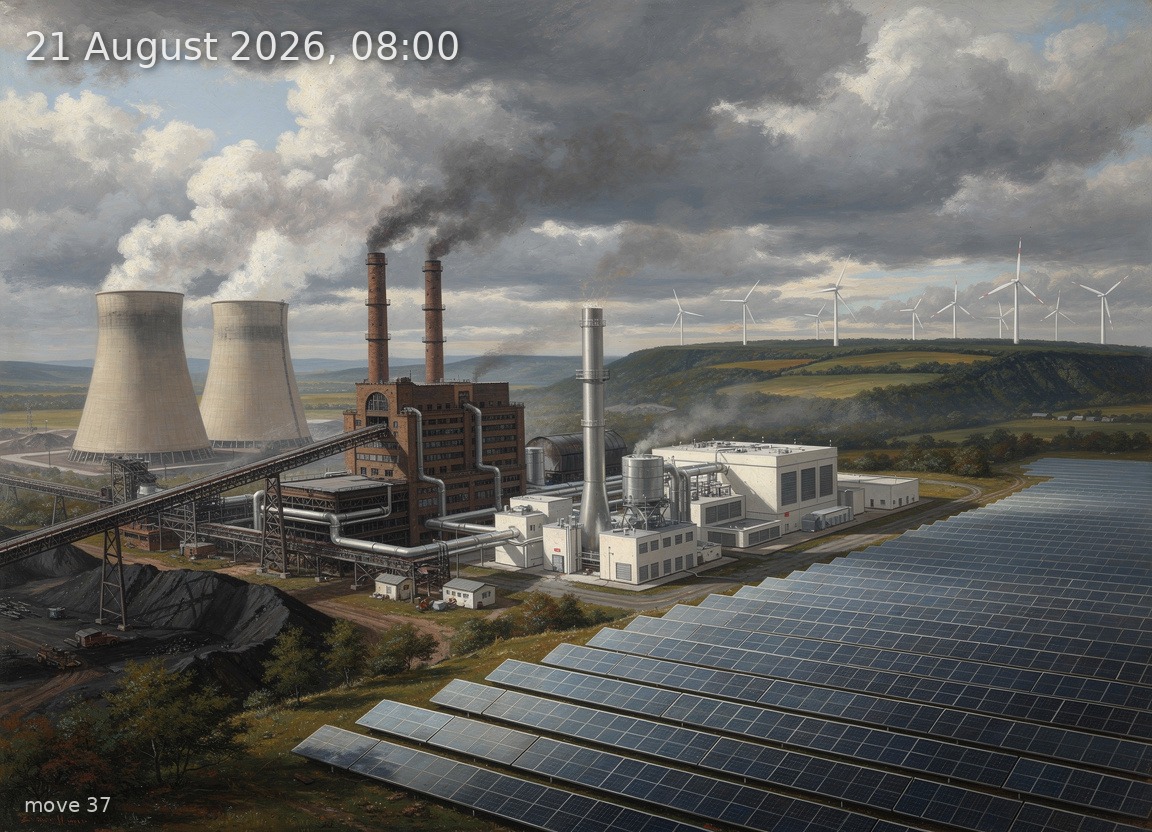
Solar leads at 13.7 GW but heavy cloud, weak wind, and 13.5 GW net imports drive prices above 190 EUR/MWh.
Generation mix
Wind onshore 12%
Wind offshore 3%
Solar 33%
Biomass 10%
Hydro 4%
Natural gas 13%
Hard coal 11%
Brown coal 15%
61%
Renewable share
6.3 GW
Wind (on + offshore)
13.7 GW
Solar
42.1 GW
Total generation
13.6 GW
Net import
192.6 EUR/MWh
Day-ahead price
13.9°C / 7 km/h
Temp / Wind speed
Open-Meteo, Kassel (51.3°N 9.5°E) · surface estimate from 100 m wind
70.0% / 39.0 W/m²
Cloud cover / Radiation
272
gCO₂/kWh
Image prompt
Brown coal 6.3 GW dominates the left quarter of the scene as a cluster of massive hyperbolic concrete cooling towers emitting thick white-grey steam plumes into the overcast sky, with conveyor belts feeding raw lignite into a sprawling plant; hard coal 4.7 GW sits just right of centre-left as a dark industrial complex with tall rectangular boiler houses and twin brick chimneys trailing darker smoke; natural gas 5.5 GW occupies the centre as a modern combined-cycle gas turbine facility with sleek cylindrical exhaust stacks and a single slender cooling tower; solar 13.7 GW fills the entire right third as an enormous field of aluminium-framed crystalline silicon photovoltaic panels stretching toward the horizon, their surfaces reflecting diffuse grey-white light rather than direct sun; wind onshore 5.0 GW appears as a line of white three-blade turbines on a distant ridge behind the solar field, blades turning slowly in light breeze; wind offshore 1.3 GW is suggested by tiny turbines on the far-right horizon above a faint strip of sea; biomass 4.0 GW is a medium-sized wood-chip-fuelled plant with a compact cylindrical smokestack and a dome-roofed fuel storage hall beside the coal complex on the left; hydro 1.5 GW appears as a small concrete run-of-river dam with water spilling through turbine outlets in the lower foreground, a narrow river flowing toward the viewer. The sky is 70% overcast with heavy stratocumulus clouds in shades of slate and pewter pressing down oppressively, but gaps allow pale morning daylight through—it is 08:00, full daytime illumination filtered by cloud, giving flat, diffuse lighting with no sharp shadows. The temperature is a cool 13.9 °C for late August, so vegetation is full green but muted and dewy, with meadow grass and deciduous trees in deep summer foliage slightly damp. The atmosphere feels heavy and expensive, an oppressive humid weight in the air echoing the high electricity price. Style: highly detailed oil painting in the tradition of 19th-century German Romantic landscape painters such as Caspar David Friedrich and Carl Blechen, with rich impasto brushwork, atmospheric depth and haze, dramatic tonal contrasts between the industrial structures and the natural land, meticulous engineering accuracy in every turbine nacelle, PV panel frame, and cooling tower curve. No text, no labels.