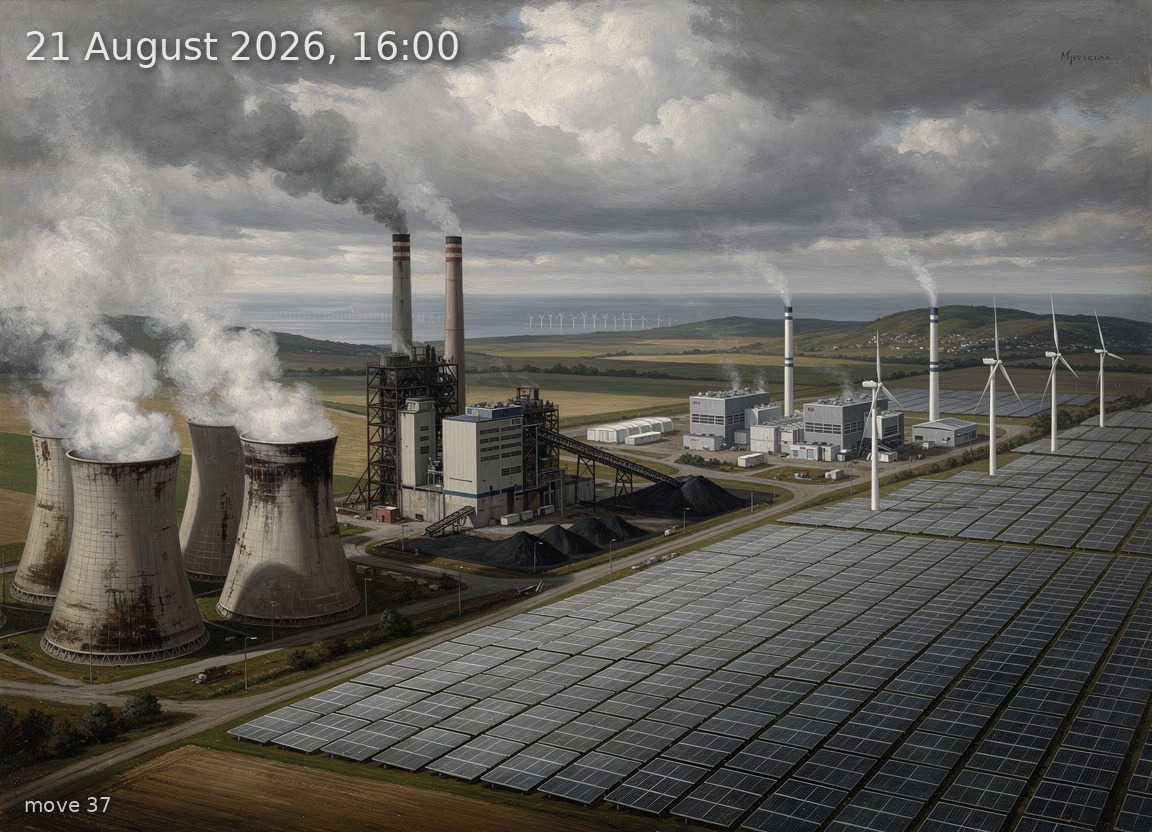
Overcast skies suppress solar to 14.5 GW; 13.8 GW of coal and gas plus 13.3 GW net imports cover peak demand.
Generation mix
Wind onshore 12%
Wind offshore 2%
Solar 37%
Biomass 9%
Hydro 4%
Natural gas 13%
Hard coal 12%
Brown coal 11%
65%
Renewable share
5.5 GW
Wind (on + offshore)
14.5 GW
Solar
39.0 GW
Total generation
13.3 GW
Net import
166.5 EUR/MWh
Day-ahead price
22.0°C / 9 km/h
Temp / Wind speed
Open-Meteo, Kassel (51.3°N 9.5°E) · surface estimate from 100 m wind
100.0% / 20.0 W/m²
Cloud cover / Radiation
239
gCO₂/kWh
Image prompt
Solar 14.5 GW dominates the right half of the scene as vast fields of aluminium-framed crystalline silicon PV panels stretching across flat agricultural land, their surfaces dull and matte under heavy overcast — no glint, no reflections, only diffuse grey light. Natural gas 5.0 GW appears centre-right as a cluster of modern CCGT power plants with sleek single exhaust stacks emitting thin heat shimmer. Hard coal 4.5 GW occupies the centre-left as a large coal-fired station with tall rectangular boiler houses, conveyor belts carrying dark fuel, and twin chimneys trailing grey-white smoke. Brown coal 4.3 GW fills the left foreground as massive hyperbolic cooling towers releasing thick white steam plumes that merge into the oppressive cloud ceiling. Wind onshore 4.7 GW appears as a scattered line of three-blade turbines on rolling hills in the deep background, rotors turning sluggishly. Wind offshore 0.8 GW is suggested as tiny turbine silhouettes on a distant grey horizon line. Biomass 3.6 GW is rendered as a wood-chip-fuelled plant with a modest stack and timber yard beside the coal station. Hydro 1.5 GW appears as a small concrete dam and powerhouse nestled in a green valley at far left. The sky is entirely covered by a thick, low, uniform stratus layer — no blue, no sun disc visible — casting flat, shadowless daylight at 16:00 in late August. The atmosphere feels heavy and oppressive, conveying the high electricity price. Summer vegetation is lush but muted green under the grey light; trees are full-leafed, fields of grain visible between infrastructure. Temperature is warm at 22 °C — no frost, slight humidity haze near the cooling towers. Painted in the style of a highly detailed 19th-century German Romantic oil painting — rich impasto brushwork, atmospheric depth receding into grey mist, meticulous engineering accuracy on every turbine nacelle, every lattice tower, every cooling tower's parabolic curve — yet infused with the brooding grandeur of Caspar David Friedrich meeting industrial sublime. No text, no labels, no human figures prominent.