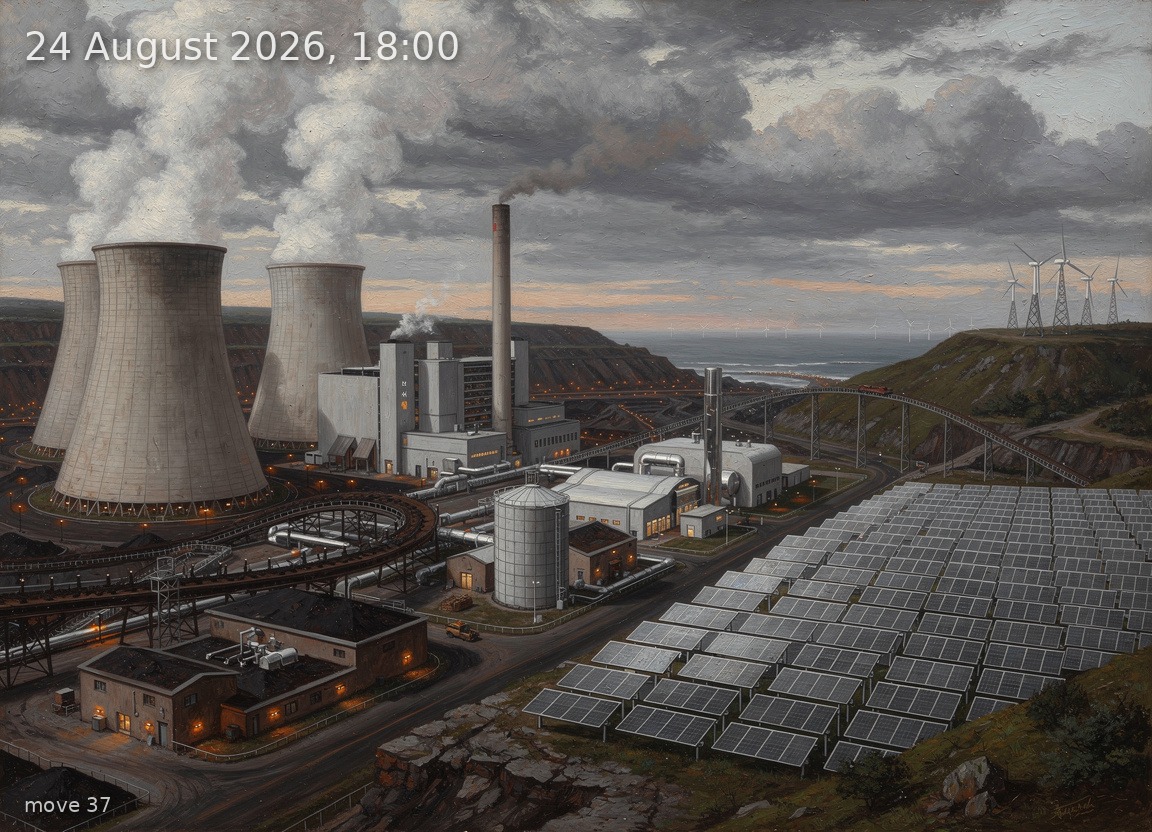
Coal and solar dominate generation as full overcast, weak wind, and a 17 GW import need drive prices to 182 EUR/MWh.
Generation mix
Wind onshore 12%
Wind offshore 1%
Solar 32%
Biomass 10%
Hydro 3%
Natural gas 8%
Hard coal 12%
Brown coal 22%
59%
Renewable share
5.1 GW
Wind (on + offshore)
12.7 GW
Solar
39.4 GW
Total generation
17.1 GW
Net import
182.3 EUR/MWh
Day-ahead price
20.6°C / 12 km/h
Temp / Wind speed
Open-Meteo, Kassel (51.3°N 9.5°E) · surface estimate from 100 m wind
100.0% / 82.0 W/m²
Cloud cover / Radiation
305
gCO₂/kWh
Image prompt
Brown coal 8.6 GW dominates the left quarter of the scene as a massive lignite power station complex with four hyperbolic cooling towers emitting thick white steam plumes, conveyor belts feeding dark brown lignite from open pits. Solar 12.7 GW fills the centre-right as an expansive field of aluminium-framed crystalline silicon PV panels stretching toward the horizon, their surfaces reflecting only a dull grey sky with no direct sunlight. Hard coal 4.5 GW appears centre-left as a tall coal-fired plant with rectangular boiler houses and a single tall chimney trailing grey smoke. Wind onshore 4.8 GW is rendered as a modest cluster of three-blade turbines on lattice towers along a distant ridge, their rotors turning slowly in the light breeze. Biomass 4.0 GW appears as a compact wood-chip-fired plant with a squat cylindrical silo and short stack near the coal station. Natural gas 3.1 GW is a sleek CCGT unit with a single polished exhaust stack and a smaller cooling tower set behind the biomass facility. Hydro 1.2 GW is a small run-of-river weir with a low concrete powerhouse visible at the edge of a green river in the foreground. Wind offshore 0.3 GW is barely suggested as tiny turbine silhouettes on a far-distant hazy horizon line. The sky is entirely overcast with heavy, oppressive stratiform clouds in tones of slate and pewter, pressing down on the landscape — the time is 18:00 in late August, so the light is dusk-transitional: a faint warm orange-red glow bleeds along the lowest horizon beneath the cloud layer, while the upper sky darkens to charcoal grey. The atmosphere feels thick and heavy, suggesting the high electricity price. Vegetation is lush late-summer green — full deciduous canopies, tall grasses, but the colours are muted under the overcast. Painted in the style of a highly detailed 19th-century German Romantic oil painting — rich impasto brushwork, atmospheric sfumato in the distance, chiaroscuro lighting from the dim horizon glow and the industrial sodium lights just beginning to flicker on at the coal plants. Meticulous engineering detail on every turbine nacelle, every PV cell edge, every cooling tower's parabolic curve. No text, no labels.