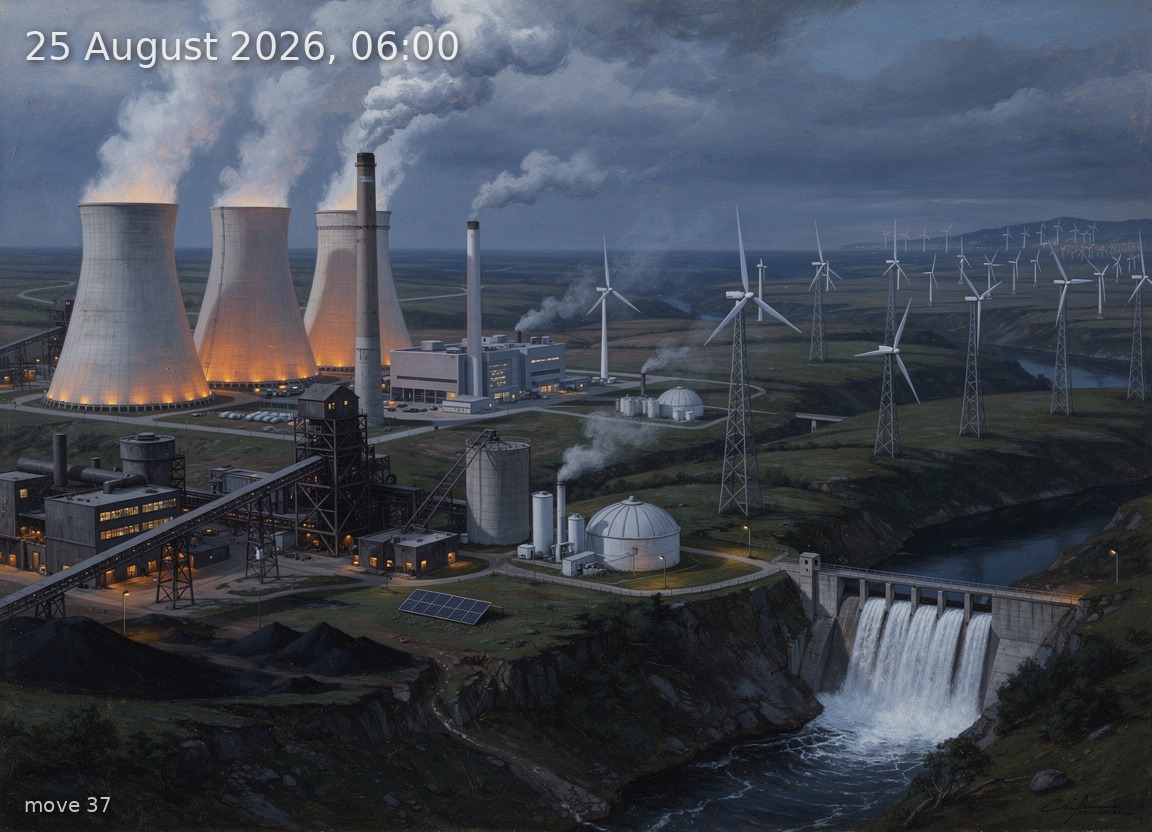
Onshore wind leads at 14.7 GW but 8.9 GW net imports are needed as thermal plants and pre-dawn demand drive prices high.
Generation mix
Wind onshore 36%
Wind offshore 4%
Solar 1%
Biomass 9%
Hydro 3%
Natural gas 11%
Hard coal 12%
Brown coal 23%
54%
Renewable share
16.3 GW
Wind (on + offshore)
0.5 GW
Solar
40.5 GW
Total generation
8.9 GW
Net import
171.4 EUR/MWh
Day-ahead price
11.3°C / 10 km/h
Temp / Wind speed
Open-Meteo, Kassel (51.3°N 9.5°E) · surface estimate from 100 m wind
12.0% / 0.0 W/m²
Cloud cover / Radiation
334
gCO₂/kWh
Image prompt
Wind onshore 14.7 GW dominates the right half of the scene as dozens of three-blade turbines on tall lattice and tubular towers stretching across rolling green hills; brown coal 9.3 GW occupies the far left as a massive lignite power station with four hyperbolic cooling towers emitting thick white steam plumes into the heavy air; hard coal 4.9 GW appears as a dark industrial complex with conveyor belts and a tall rectangular chimney just left of centre; natural gas 4.5 GW is rendered as a pair of compact CCGT units with slender exhaust stacks and visible heat shimmer slightly right of centre; biomass 3.6 GW shows as a mid-sized plant with a cylindrical wood-chip silo and low smokestack in the middle ground; hydro 1.4 GW appears as a small concrete dam with water cascading in the right foreground valley; wind offshore 1.6 GW is visible as a distant cluster of turbines on the far-right horizon above a faintly visible sea line; solar 0.5 GW is represented by a tiny patch of dark, inactive crystalline PV panels in the immediate foreground, catching no light. Time is 06:00 in late August: the sky is deep blue-grey pre-dawn with the faintest pale luminosity on the eastern horizon, no direct sunlight yet, landscape largely in shadow with artificial sodium-orange lighting on the industrial complexes. Temperature is cool at 11°C, light dew on late-summer grass, deciduous trees fully leafed but dark. The atmosphere is oppressive and heavy, reflecting a high electricity price — low-hanging haze clings to the valleys, the air feels thick and costly. Style: highly detailed oil painting in the tradition of 19th-century German Romantic landscape painters such as Caspar David Friedrich and Carl Blechen — rich, brooding colour palette of deep blues, greys, and warm industrial oranges, visible confident brushwork, dramatic atmospheric depth and chiaroscuro, meticulous engineering accuracy on every turbine nacelle, cooling tower, and smokestack. No text, no labels.