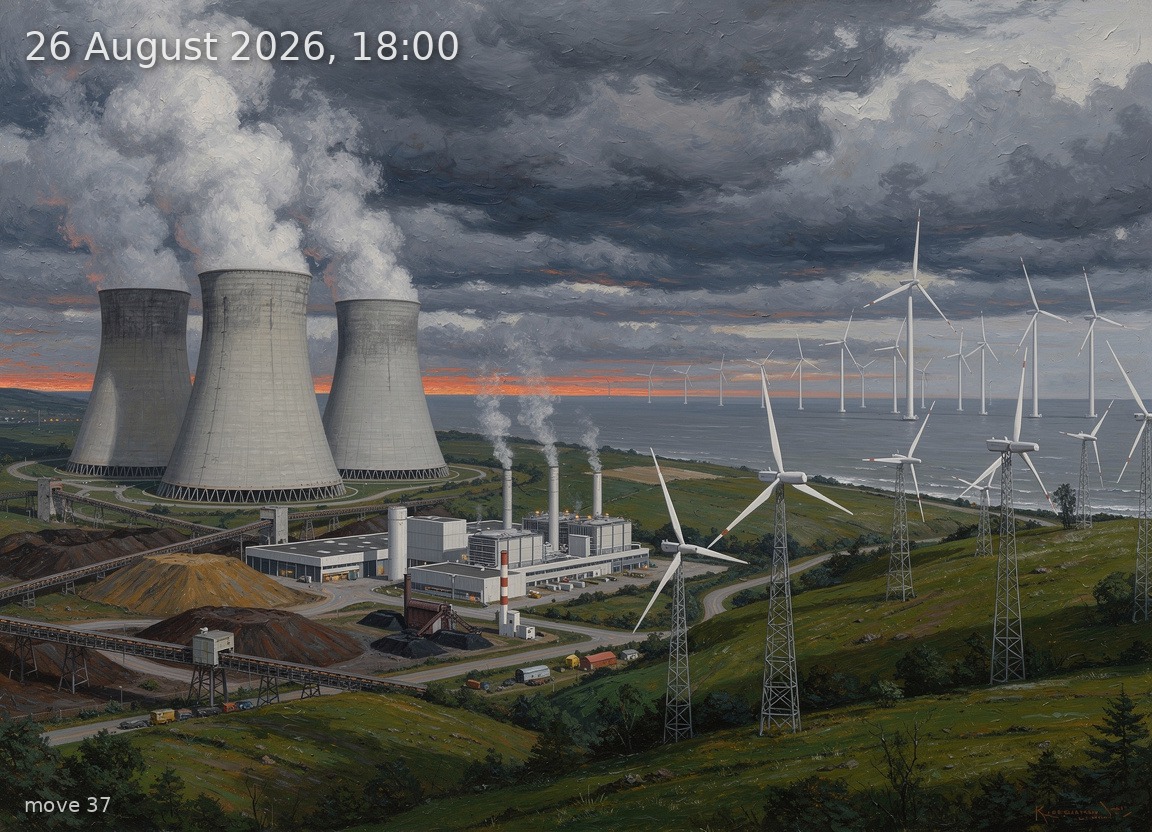
Wind leads at 18.3 GW under full overcast, but 15.7 GW of thermal and 7.3 GW net imports fill the evening demand gap.
Generation mix
Wind onshore 27%
Wind offshore 10%
Solar 21%
Biomass 8%
Hydro 3%
Natural gas 8%
Hard coal 7%
Brown coal 17%
68%
Renewable share
18.3 GW
Wind (on + offshore)
10.3 GW
Solar
49.6 GW
Total generation
7.3 GW
Net import
185.6 EUR/MWh
Day-ahead price
19.3°C / 7 km/h
Temp / Wind speed
Open-Meteo, Kassel (51.3°N 9.5°E) · surface estimate from 100 m wind
100.0% / 3.0 W/m²
Cloud cover / Radiation
230
gCO₂/kWh
Image prompt
Wind onshore 13.4 GW dominates the right half of the scene as dozens of three-blade turbines on lattice and tubular towers stretching across rolling green hills into the distance; wind offshore 4.9 GW appears as a cluster of taller turbines on the far-right horizon above a faintly visible grey sea; brown coal 8.6 GW occupies the left quarter as massive hyperbolic cooling towers with thick white-grey steam plumes rising into the overcast, flanked by conveyor belts and lignite stockpiles; natural gas 3.7 GW sits left-of-centre as a compact CCGT plant with slender exhaust stacks emitting thin heat shimmer; hard coal 3.4 GW stands adjacent as a smaller power station with rectangular chimneys and coal bunkers; biomass 4.0 GW appears centre-left as a cluster of modest industrial buildings with wood-chip silos and low steam vents; solar 10.3 GW is rendered as a large field of aluminium-framed crystalline silicon panels in the centre-right foreground, their surfaces dull and reflecting only grey sky, producing weak residual output; hydro 1.3 GW is a small dam and powerhouse visible in a valley at mid-distance. The sky is entirely overcast with heavy, oppressive, low stratiform clouds in shades of slate grey and charcoal, conveying the 185.6 EUR/MWh price tension. The time is 18:00 in late August—dusk is approaching with a faint orange-red glow barely visible on the lower western horizon, the upper sky already darkening to deep blue-grey. The temperature is a mild 19.3°C; vegetation is late-summer green but muted under the flat light. Wind is gentle at 6.6 km/h so turbine blades turn slowly. The atmosphere is dense, humid, weighty. Rendered as a highly detailed oil painting in the tradition of 19th-century German Romantic landscape painters—rich, saturated colour, visible impasto brushwork, dramatic atmospheric depth—with meticulous engineering accuracy on every turbine nacelle, cooling tower, panel frame, and exhaust stack. No text, no labels.