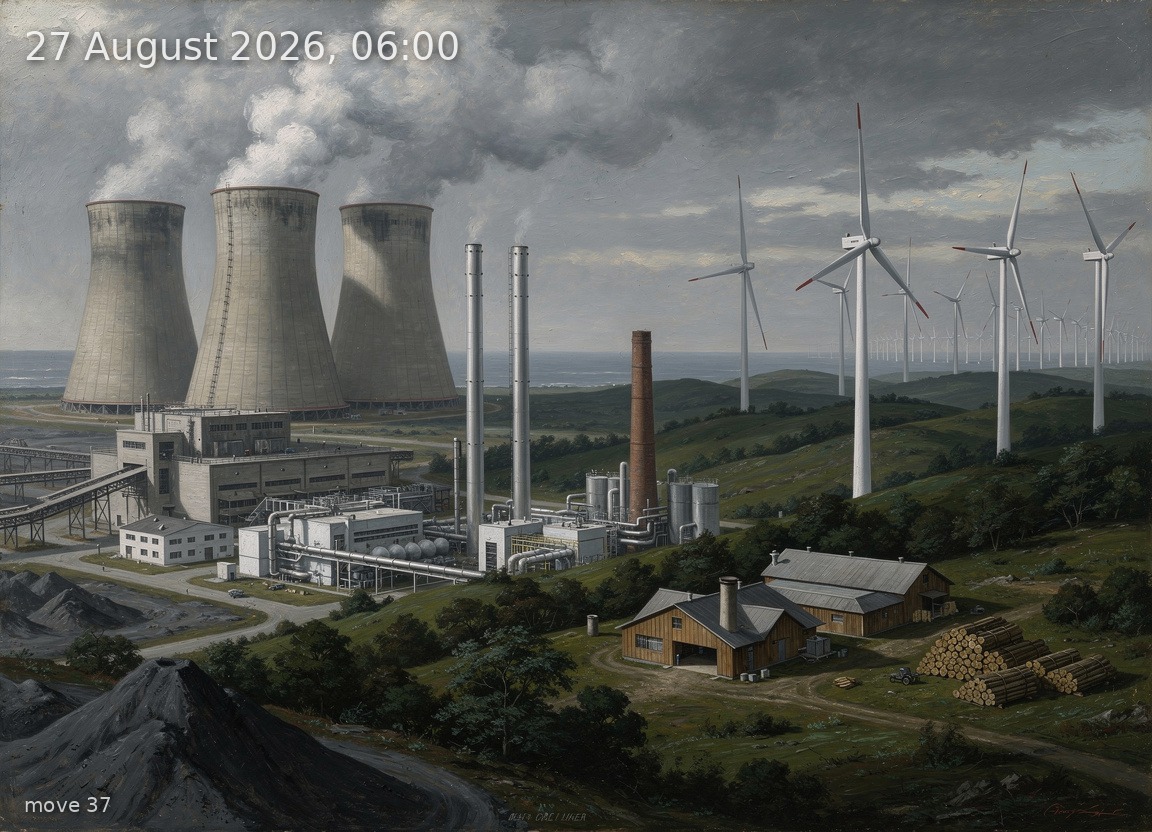
Wind dominates at 25.1 GW combined, brown coal provides 9.2 GW baseload as dense overcast eliminates solar at dawn.
Generation mix
Wind onshore 41%
Wind offshore 11%
Solar 1%
Biomass 8%
Hydro 3%
Natural gas 10%
Hard coal 7%
Brown coal 19%
64%
Renewable share
25.1 GW
Wind (on + offshore)
0.5 GW
Solar
47.8 GW
Total generation
1.5 GW
Net import
167.6 EUR/MWh
Day-ahead price
12.9°C / 4 km/h
Temp / Wind speed
Open-Meteo, Kassel (51.3°N 9.5°E) · surface estimate from 100 m wind
94.0% / 0.0 W/m²
Cloud cover / Radiation
255
gCO₂/kWh
Image prompt
Wind onshore 19.6 GW dominates the right half of the scene as dozens of tall three-blade turbines with white tubular towers and nacelles receding across rolling green hills into the grey distance; wind offshore 5.5 GW appears as a distant row of larger turbines on the far-right horizon above a faint strip of slate-grey sea; brown coal 9.2 GW occupies the left quarter as three massive hyperbolic concrete cooling towers with thick white-grey steam plumes merging into the overcast, flanked by a sprawling lignite power station with conveyor belts and ash-grey fuel piles; natural gas 4.7 GW sits left of centre as a compact CCGT plant with two slender steel exhaust stacks emitting thin heat shimmer; hard coal 3.1 GW appears as a smaller conventional power station with a single tall brick chimney and coal bunkers just behind the gas plant; biomass 3.9 GW is rendered as a mid-ground cluster of wooden-clad CHP buildings with short stacks and neat log piles; hydro 1.2 GW is a small weir and turbine house beside a dark river in the lower foreground; solar 0.5 GW is barely visible as a tiny set of aluminium-framed crystalline panels on a rooftop catching no light. Time is 06:00 dawn in late August: the sky is a deep blue-grey pre-dawn tone with the faintest pale luminescence along the eastern horizon, no direct sunlight, no warm colours in the sky — heavy 94% cloud cover makes the atmosphere thick, oppressive, and uniformly grey above the horizon band. Temperature is cool at 12.9°C; late-summer vegetation is lush but dew-laden, grass dark green, some early morning mist clinging to low ground. The elevated price of 167.6 EUR/MWh is reflected in a brooding, heavy atmospheric pressure — dense low clouds pressing down on the landscape, a sense of weight and cost in the air. Style: highly detailed oil painting in the tradition of 19th-century German Romantic landscape painters such as Caspar David Friedrich and Carl Blechen — rich, sombre colour palette of slate blues, moss greens, and industrial greys, visible impasto brushwork, deep atmospheric perspective, meticulous engineering accuracy on every turbine blade, cooling tower curve, and exhaust stack joint. No text, no labels.