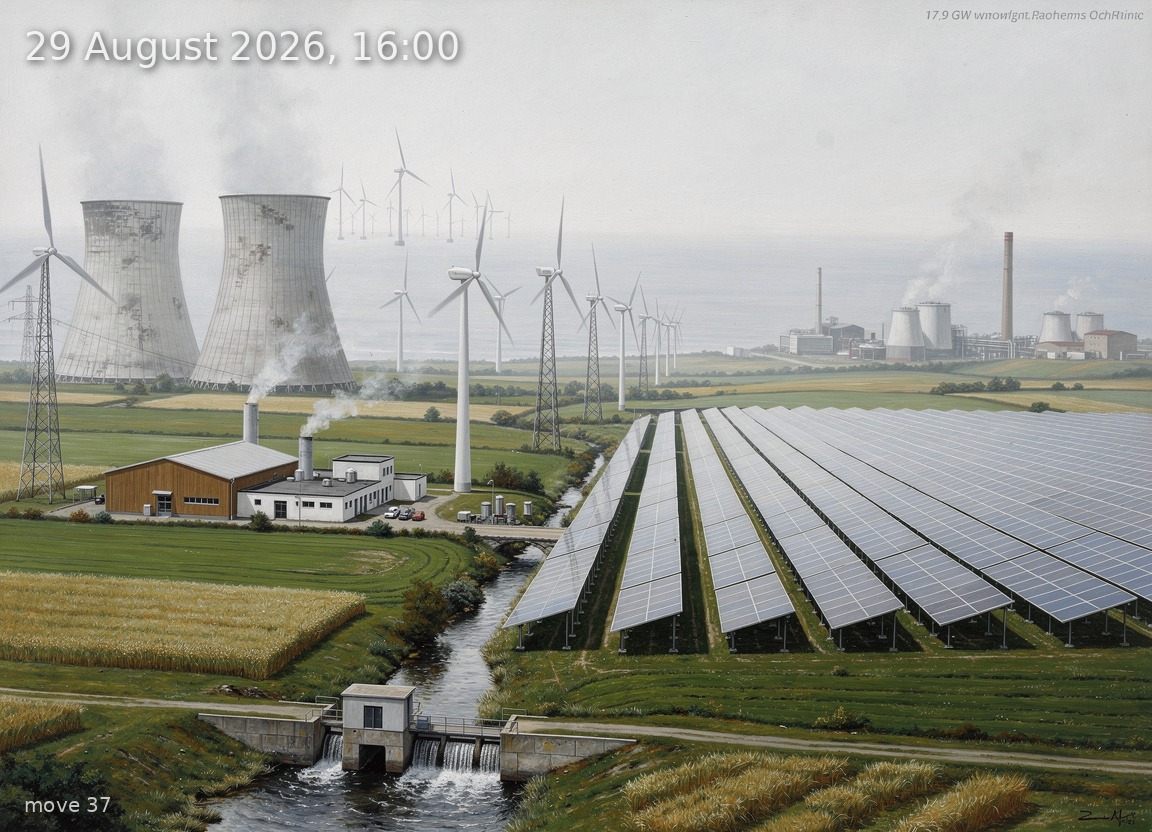
Wind and diffuse solar dominate at 92% renewables, driving 10.6 GW net exports and depressing thermal dispatch.
Generation mix
Wind onshore 32%
Wind offshore 6%
Solar 45%
Biomass 6%
Hydro 2%
Natural gas 1%
Hard coal 1%
Brown coal 5%
92%
Renewable share
21.5 GW
Wind (on + offshore)
25.3 GW
Solar
56.2 GW
Total generation
+10.6 GW
Net export
24.6 EUR/MWh
Day-ahead price
23.8°C / 23 km/h
Temp / Wind speed
Open-Meteo, Kassel (51.3°N 9.5°E) · surface estimate from 100 m wind
100.0% / 104.0 W/m²
Cloud cover / Radiation
58
gCO₂/kWh
Image prompt
Solar 25.3 GW occupies the broad centre-right as vast fields of aluminium-framed crystalline silicon photovoltaic panels stretching across gentle rolling farmland, their glass surfaces reflecting a flat white-grey overcast sky. Wind onshore 17.9 GW fills the left half and extends across the horizon as dozens of tall three-blade turbines on lattice and tubular steel towers, rotors visibly spinning in the strong breeze, set among green late-summer fields of stubble and mature crops. Wind offshore 3.6 GW appears in the far distance at the upper left as a cluster of turbines rising from a hazy grey sea horizon. Biomass 3.6 GW is rendered as a modest wood-clad biomass plant with a low steam plume near the centre-left. Brown coal 2.9 GW appears as two hyperbolic concrete cooling towers at the far left background, emitting thin wispy steam plumes. Hydro 1.3 GW is shown as a small concrete run-of-river weir and powerhouse along a stream in the lower foreground. Natural gas 0.8 GW is a compact single-stack CCGT unit beside the cooling towers, barely producing visible exhaust. Hard coal 0.7 GW sits as a small conventional boiler house with a single chimney, idle-looking with faint haze. The lighting is full late-afternoon daylight at 16:00, but entirely diffused through a solid 100% overcast ceiling — no shadows, no direct sun, a luminous pearl-grey sky with no blue visible. The air is warm at 23.8°C; vegetation is lush deep green, late-summer deciduous trees with full canopies, wildflowers along field margins. Wind animates the scene: grass bends, turbine blades blur, leaves flutter. The atmosphere is calm and open, reflecting the low electricity price — expansive, unhurried, with a sense of spacious abundance. Highly detailed oil painting in the tradition of 19th-century German Romantic landscape painters such as Caspar David Friedrich and Carl Blechen, with rich colour palette of greens, greys, and muted silvers, visible confident brushwork, atmospheric aerial perspective fading into the overcast distance, meticulous engineering detail on every turbine nacelle, PV module frame, and cooling tower surface. No text, no labels.