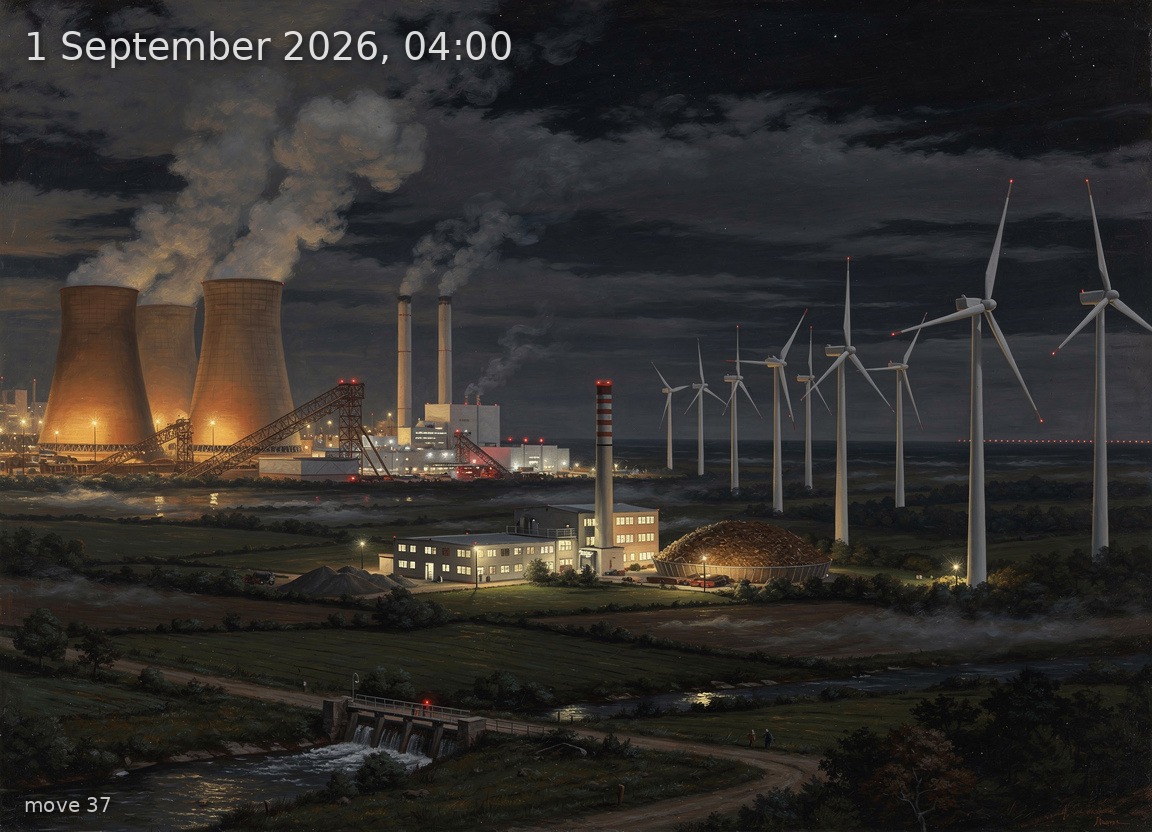
Strong onshore wind at 24 GW combines with 12.7 GW coal baseload under elevated nighttime prices of 146 EUR/MWh.
Generation mix
Wind onshore 49%
Wind offshore 5%
Solar 0%
Biomass 8%
Hydro 2%
Natural gas 9%
Hard coal 9%
Brown coal 17%
65%
Renewable share
26.5 GW
Wind (on + offshore)
0.0 GW
Solar
48.9 GW
Total generation
+48.9 GW
Net export
145.9 EUR/MWh
Day-ahead price
13.3°C / 15 km/h
Temp / Wind speed
Open-Meteo, Kassel (51.3°N 9.5°E) · surface estimate from 100 m wind
50.0% / 0.0 W/m²
Cloud cover / Radiation
250
gCO₂/kWh
Image prompt
Wind onshore 24.0 GW dominates the right two-thirds of the scene as dozens of tall three-blade turbines with white tubular towers and nacelles stretching across rolling dark farmland, rotors visibly turning in moderate wind; brown coal 8.1 GW occupies the far left as a massive lignite power station complex with four hyperbolic cooling towers emitting thick pale steam plumes lit from below by sodium-orange industrial floodlights; hard coal 4.6 GW appears just left of centre as a coal-fired plant with twin rectangular chimneys and conveyor belt infrastructure, glowing dimly; natural gas 4.4 GW sits centre-left as two compact CCGT units with tall single exhaust stacks and smaller vapour trails; biomass 4.1 GW appears as a mid-sized industrial facility with a squat stack and woodchip storage dome near the centre; wind offshore 2.5 GW is hinted at on the far right horizon as faint blinking red aviation lights of distant turbines; hydro 1.2 GW is a small run-of-river station along a dark river in the foreground. Time is 04:00—complete nighttime darkness with a black sky, no twilight, no sky glow, stars partially obscured by 50% cloud cover rendered as grey masses drifting across the firmament. Temperature is 13°C early September—lush but darkened vegetation, slight ground mist in low-lying fields. The atmosphere is heavy and oppressive reflecting the high electricity price, with industrial haze and steam merging into low clouds. Lighting comes only from sodium streetlamps along a country road, red blinking lights atop wind turbines and smokestacks, and the warm orange glow of plant facilities. Style: highly detailed oil painting in the tradition of 19th-century German Romantic landscape painters such as Caspar David Friedrich and Carl Blechen, with rich dark tones, visible confident brushwork, atmospheric depth receding into industrial haze, meticulous engineering detail on every turbine nacelle, cooling tower, and exhaust stack—a sublime nocturnal industrial panorama. No text, no labels.