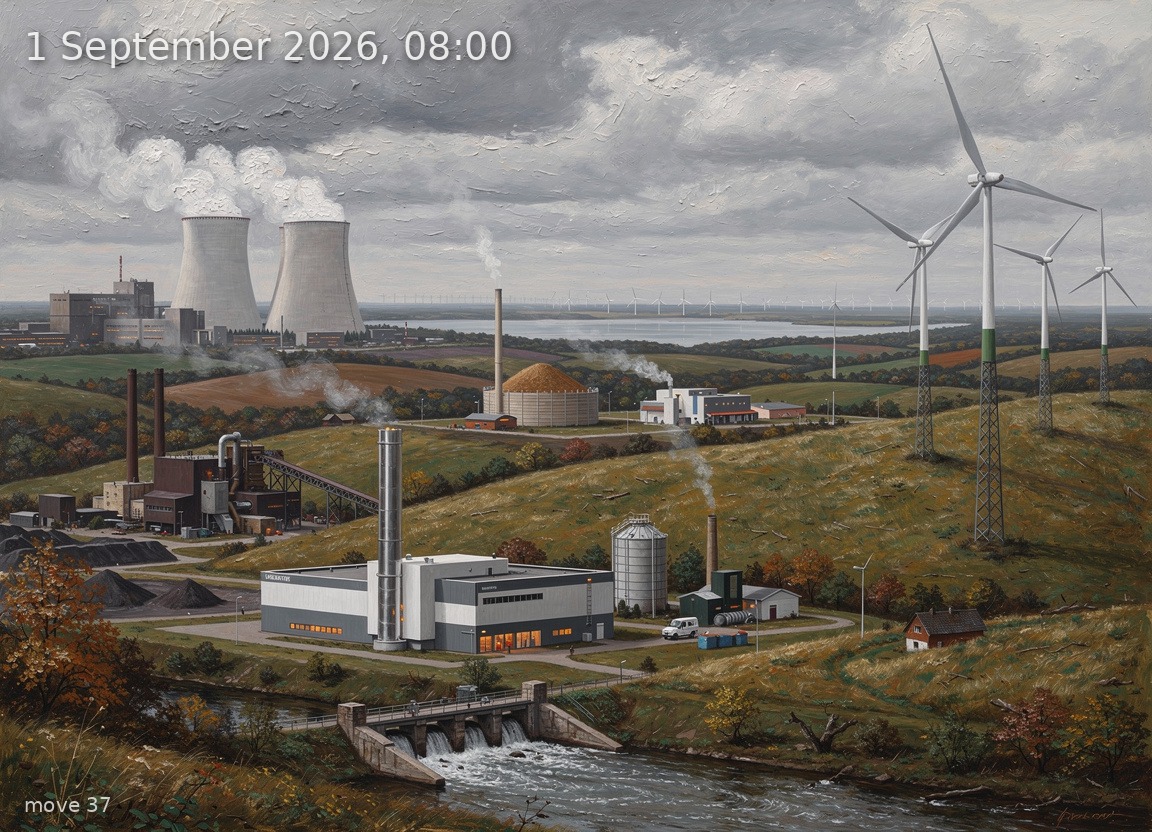
Strong onshore wind leads at 24 GW under full overcast; coal plants provide 12.9 GW baseload at elevated prices.
Generation mix
Wind onshore 49%
Wind offshore 5%
Solar 0%
Biomass 8%
Hydro 2%
Natural gas 8%
Hard coal 9%
Brown coal 17%
65%
Renewable share
26.3 GW
Wind (on + offshore)
0.0 GW
Solar
48.7 GW
Total generation
+48.7 GW
Net export
192.7 EUR/MWh
Day-ahead price
14.2°C / 17 km/h
Temp / Wind speed
Open-Meteo, Kassel (51.3°N 9.5°E) · surface estimate from 100 m wind
100.0% / 0.0 W/m²
Cloud cover / Radiation
253
gCO₂/kWh
Image prompt
Wind onshore 24.0 GW dominates the right two-thirds of the scene as dozens of three-blade turbines on lattice and tubular steel towers stretching across rolling central German hills, rotors visibly spinning in steady wind. Brown coal 8.4 GW occupies the left background as a massive lignite power station with three hyperbolic cooling towers emitting thick white steam plumes rising into the overcast sky. Hard coal 4.5 GW appears as a coal-fired plant with tall chimneys and conveyor belt infrastructure in the left-centre middle ground. Natural gas 4.1 GW is rendered as a compact CCGT facility with a single gleaming exhaust stack and low turbine hall nestled in the centre foreground. Biomass 4.1 GW appears as a mid-sized industrial plant with a rounded wood-chip silo and modest chimney releasing thin pale smoke, positioned between the gas plant and the coal station. Wind offshore 2.3 GW is suggested by a distant row of offshore turbines barely visible on the far horizon beyond a river or reservoir. Hydro 1.2 GW is a small run-of-river weir and powerhouse along a river in the foreground. No solar panels anywhere — zero solar generation. The sky is entirely blanketed by oppressive low stratus clouds at 100% cover, no blue sky visible, casting flat diffuse September morning daylight — it is 08:00 so fully light but grey and heavy. The atmosphere feels pressured and dense, reflecting the 192.7 EUR/MWh price. Temperature is a cool 14.2°C early autumn morning: grass is damp, trees show the first hints of yellowing foliage, a thin mist lingers along the river. Wind animates the scene — grass bends, tree branches sway, turbine blades blur slightly. Highly detailed oil painting in the tradition of 19th-century German Romantic landscape masters — Caspar David Friedrich's atmospheric depth merged with industrial realism. Rich tonal palette of slate greys, muted greens, ochre, and warm industrial oranges from lit facility windows. Visible confident brushwork, impasto texture in the clouds and steam plumes, meticulous engineering accuracy on turbine nacelles, cooling tower hyperboloid geometry, and CCGT exhaust stacks. No text, no labels.