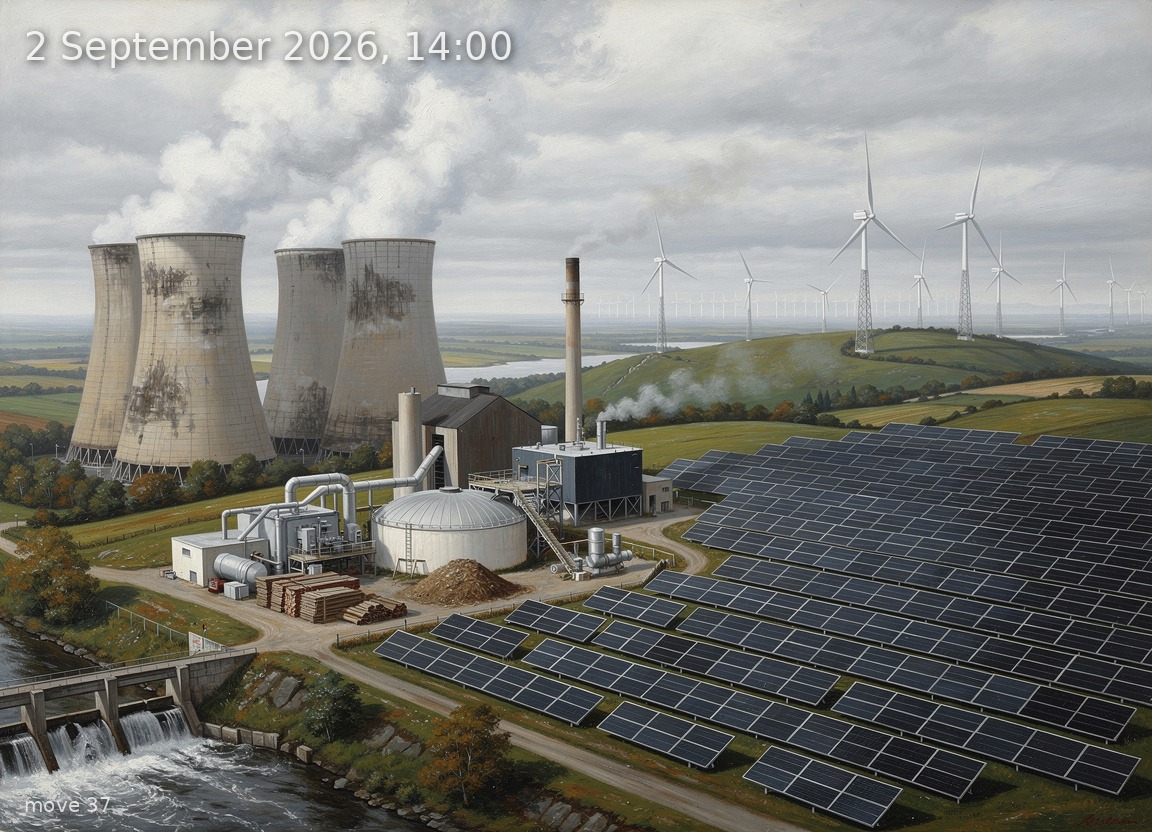
Solar at 39.4 GW and wind at 20.9 GW dominate an 86%-renewable German grid under overcast early-September skies.
Generation mix
Wind onshore 25%
Wind offshore 3%
Solar 52%
Biomass 5%
Hydro 2%
Natural gas 1%
Hard coal 5%
Brown coal 8%
86%
Renewable share
20.9 GW
Wind (on + offshore)
39.4 GW
Solar
75.3 GW
Total generation
+75.3 GW
Net export
99.1 EUR/MWh
Day-ahead price
21.7°C / 13 km/h
Temp / Wind speed
Open-Meteo, Kassel (51.3°N 9.5°E) · surface estimate from 100 m wind
100.0% / 232.0 W/m²
Cloud cover / Radiation
105
gCO₂/kWh
Image prompt
Solar 39.4 GW dominates the scene as an enormous expanse of aluminium-framed crystalline silicon photovoltaic arrays stretching across rolling fields occupying over half the canvas from centre to right; wind onshore 18.9 GW appears as dozens of tall three-blade turbines with white nacelles and lattice towers dotting green late-summer hills behind the panels, their blades turning gently in moderate wind; wind offshore 2.0 GW is suggested by a distant cluster of turbines on the hazy horizon line above a river; brown coal 6.0 GW fills the left foreground as a massive lignite power station with three hyperbolic cooling towers emitting thick white steam plumes; hard coal 3.5 GW sits adjacent as a smaller coal plant with rectangular boiler house and tall chimney stack trailing grey smoke; biomass 3.5 GW appears as a mid-sized industrial facility with a domed digester and a modest exhaust stack amid stacked timber; natural gas 0.9 GW is a compact single-stack CCGT unit partially obscured behind the coal complex; hydro 1.2 GW is rendered as a concrete weir with cascading water on the far left beside the river. The sky is fully overcast at 100% cloud cover — a flat, luminous pearl-grey ceiling of stratus — yet bright diffuse daylight floods the scene at 14:00 in early September, casting soft shadowless illumination. The atmosphere feels heavy and slightly oppressive, reflecting a high electricity price. Late-summer vegetation is lush deep green, meadow grasses tall, trees fully leafed. Style: highly detailed oil painting in the tradition of 19th-century German Romantic landscape masters — Caspar David Friedrich meets industrial sublime — rich layered colour, visible confident brushwork, atmospheric aerial perspective with haze softening distant turbines, meticulous engineering detail on every technology, dramatic compositional depth from foreground coal infrastructure receding through solar fields to wind-swept hills. No text, no labels.