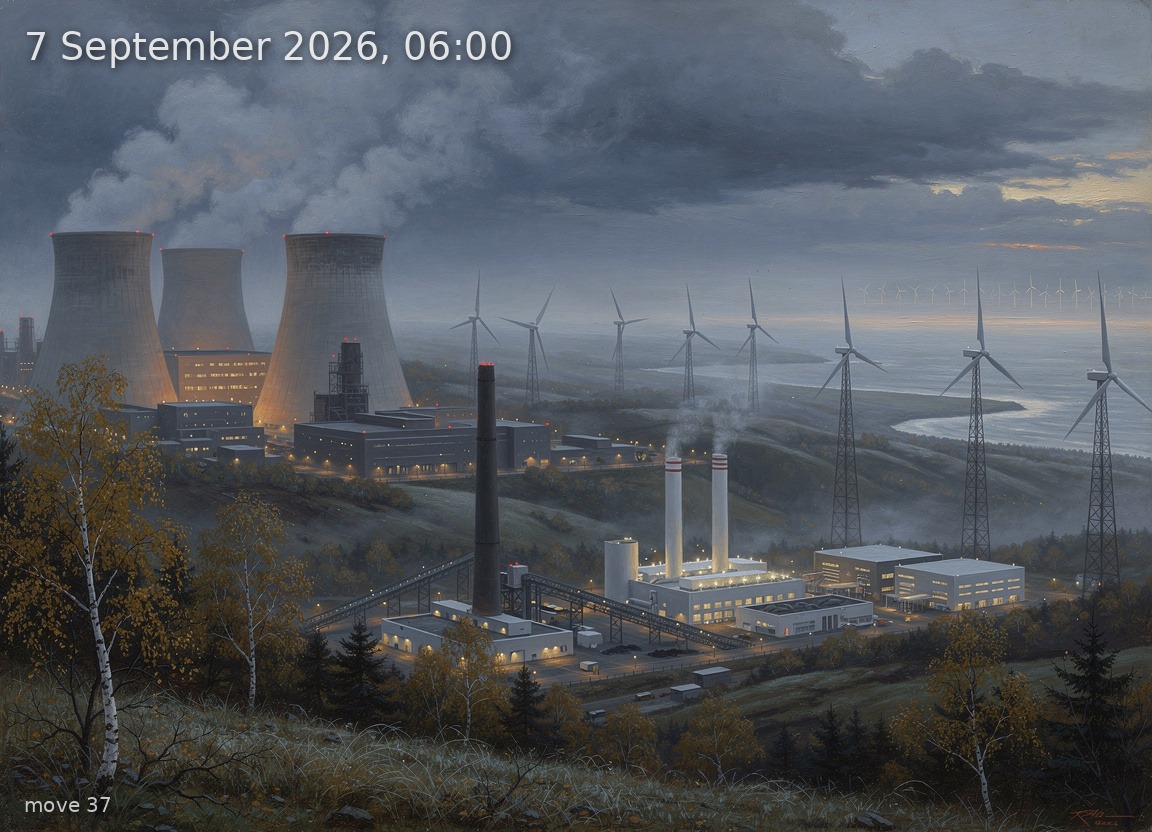
Wind leads at 16.3 GW but 14.4 GW net imports are needed as overcast skies eliminate solar and demand climbs.
Generation mix
Wind onshore 35%
Wind offshore 8%
Solar 0%
Biomass 9%
Hydro 3%
Natural gas 12%
Hard coal 8%
Brown coal 24%
56%
Renewable share
16.3 GW
Wind (on + offshore)
0.1 GW
Solar
37.2 GW
Total generation
14.4 GW
Net import
207.5 EUR/MWh
Day-ahead price
12.4°C / 8 km/h
Temp / Wind speed
Open-Meteo, Kassel (51.3°N 9.5°E) · surface estimate from 100 m wind
100.0% / 0.0 W/m²
Cloud cover / Radiation
316
gCO₂/kWh
Image prompt
Wind onshore 13.2 GW dominates the right half of the scene as dozens of large three-blade turbines on lattice and tubular towers stretching across rolling hills into the distance; wind offshore 3.1 GW appears as a faint row of turbines on the far-right horizon over a grey sea inlet. Brown coal 8.8 GW occupies the left quarter as a massive lignite power station with four hyperbolic concrete cooling towers emitting thick pale steam plumes. Natural gas 4.5 GW sits left of centre as a pair of compact CCGT plants with tall slim exhaust stacks and thin white exhaust. Hard coal 3.1 GW appears as a smaller coal-fired station with a single large smokestack beside a coal conveyor and bunker. Biomass 3.4 GW is rendered as a mid-ground wood-chip-fired CHP plant with a modest stack and steam wisp. Hydro 1.0 GW is a small run-of-river weir with turbine house visible in a river cutting through the foreground. No solar panels anywhere—no sunshine exists. Time is early dawn, 06:00 in September: the sky is deep blue-grey pre-dawn light with no direct sun, only the faintest pale luminance on the eastern horizon behind total 100% cloud cover, giving a flat oppressive overcast. Temperature 12°C with early-autumn vegetation—yellowing leaves on birch and linden trees, dew on grass. Wind speed 8.1 km/h gently bends grass and moves tree branches. The atmosphere feels heavy and expensive—thick clouds press low, the air damp and weighty, conveying the tension of a 207.5 EUR/MWh price. High-voltage transmission pylons cross the mid-ground carrying power lines that recede toward the horizon, hinting at cross-border imports. Style: highly detailed oil painting in the tradition of Caspar David Friedrich and Carl Blechen—rich, moody colour palette of slate blues, warm ambers from industrial lighting, cool greys; visible impasto brushwork; atmospheric aerial perspective with mist in valleys; meticulous engineering detail on every turbine nacelle, cooling tower rib, and CCGT stack. No text, no labels.