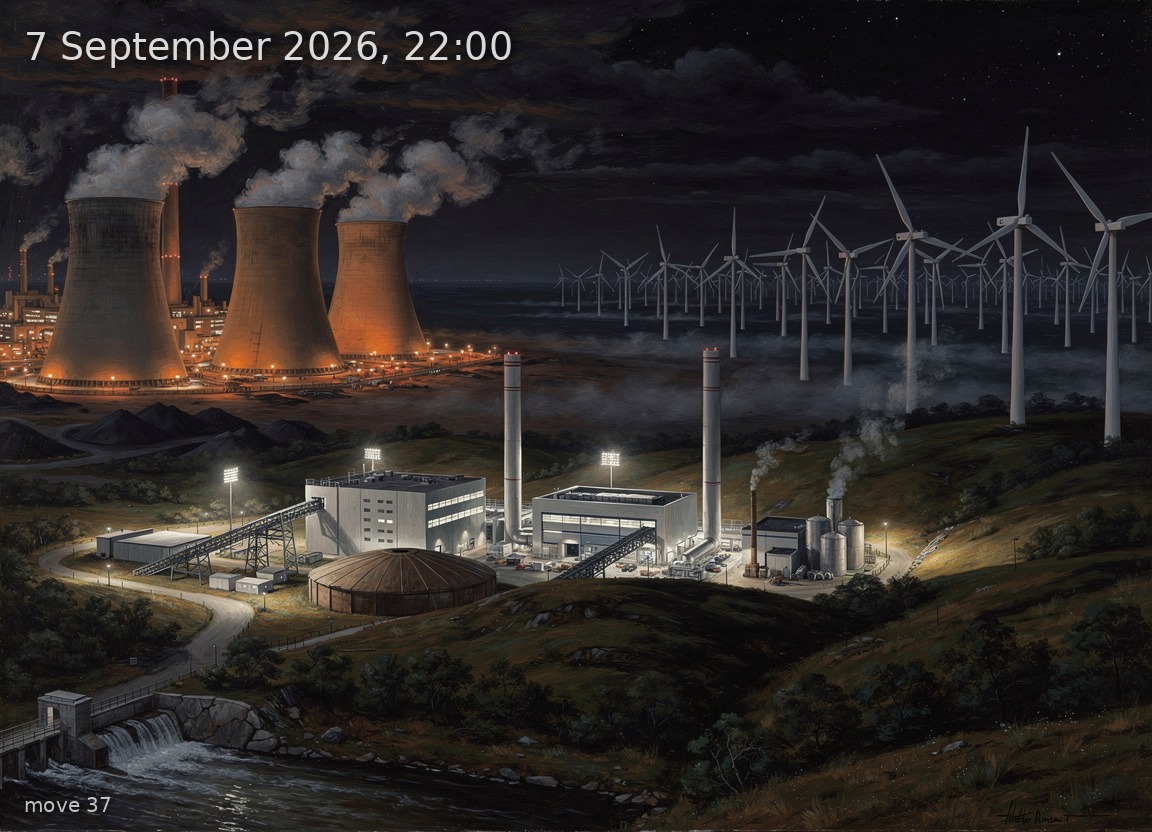
Wind leads at 18.3 GW but 11.4 GW net imports needed as nighttime demand outstrips domestic generation.
Generation mix
Wind onshore 39%
Wind offshore 7%
Biomass 8%
Hydro 2%
Natural gas 8%
Hard coal 10%
Brown coal 26%
56%
Renewable share
18.3 GW
Wind (on + offshore)
0.0 GW
Solar
39.8 GW
Total generation
11.3 GW
Net import
187.1 EUR/MWh
Day-ahead price
20.4°C / 9 km/h
Temp / Wind speed
Open-Meteo, Kassel (51.3°N 9.5°E) · surface estimate from 100 m wind
89.0% / 0.0 W/m²
Cloud cover / Radiation
325
gCO₂/kWh
Image prompt
Wind onshore 15.4 GW dominates the right half of the scene as dozens of towering three-blade turbines with white tubular towers and nacelles stretching across rolling hills into darkness; wind offshore 2.9 GW appears in the far-right background as a cluster of turbines standing in a dark sea; brown coal 10.2 GW occupies the left quarter as massive hyperbolic cooling towers with thick white steam plumes rising into the black sky, lit from below by orange sodium lights from the sprawling lignite plant complex; hard coal 4.0 GW sits left-of-centre as a blocky power station with twin chimneys and conveyor belt structures, coal piles faintly visible under floodlights; natural gas 3.3 GW appears at centre as a compact CCGT plant with a single tall exhaust stack emitting a thin heat shimmer; biomass 3.3 GW is rendered as a mid-sized industrial facility with a wood-chip storage dome and short chimney with faint exhaust, placed between the coal and gas plants; hydro 0.8 GW appears as a small dam structure at the far left edge with water glinting under artificial light. The sky is completely black with no twilight, no sky glow — deep navy-black overhead, stars barely visible through 89% heavy overcast cloud layer pressing down oppressively. The atmosphere is thick, humid, and heavy, conveying the tension of high electricity prices. Late-summer vegetation — dark green deciduous trees and grasses — flanks the foreground, barely visible in the gloom. Sodium-orange and white industrial lighting illuminates the power stations, casting long reflections on wet ground. The mood is brooding and industrial. Style: highly detailed oil painting in the tradition of 19th-century German Romantic landscape painters such as Caspar David Friedrich and Carl Blechen — rich impasto brushwork, deep chiaroscuro, atmospheric perspective fading into murky distance — but with meticulous engineering accuracy on every turbine nacelle, cooling tower, and exhaust stack. No text, no labels.