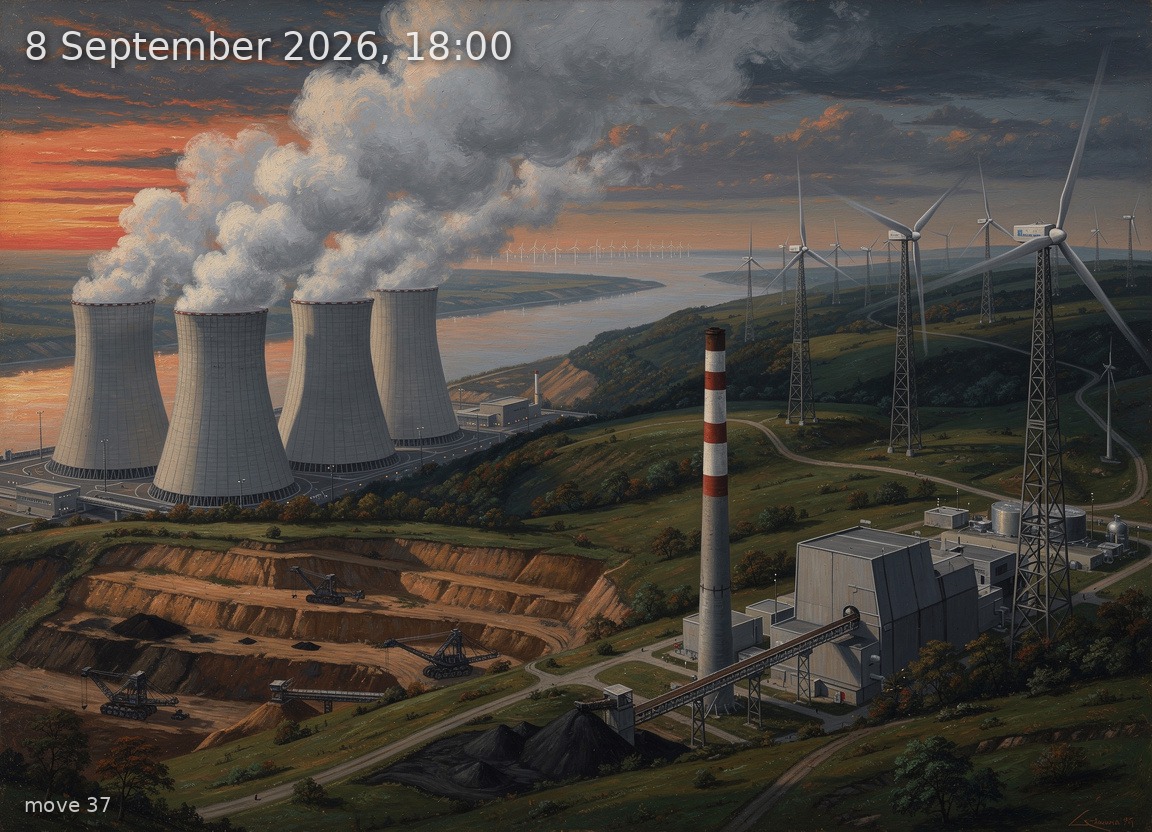
Wind leads at 14.8 GW combined but 31.4 GW net imports needed as solar fades and evening demand peaks.
Generation mix
Wind onshore 44%
Wind offshore 10%
Biomass 12%
Hydro 3%
Natural gas 4%
Hard coal 8%
Brown coal 19%
69%
Renewable share
14.9 GW
Wind (on + offshore)
0.0 GW
Solar
27.7 GW
Total generation
31.4 GW
Net import
200.6 EUR/MWh
Day-ahead price
27.4°C / 23 km/h
Temp / Wind speed
Open-Meteo, Kassel (51.3°N 9.5°E) · surface estimate from 100 m wind
52.0% / 132.0 W/m²
Cloud cover / Radiation
237
gCO₂/kWh
Image prompt
Wind onshore 12.2 GW dominates the right half of the scene as dozens of large three-blade turbines on lattice and tubular steel towers stretching across rolling green late-summer hills, blades visibly turning in moderate wind; wind offshore 2.6 GW appears in the far distance as a cluster of offshore turbines barely visible on a hazy horizon line beyond a river valley; brown coal 5.3 GW occupies the left foreground as three massive hyperbolic cooling towers with heavy white-grey steam plumes drifting eastward, beside open-pit excavation terraces in ochre and brown earth; hard coal 2.1 GW sits just right of the lignite complex as a single large stack emitting a thinner grey plume beside a conveyor belt and coal bunker; biomass 3.4 GW appears as a mid-ground cluster of modest industrial buildings with wooden chip storage piles and low cylindrical digesters with small exhaust vents releasing faint vapour; natural gas 1.2 GW is rendered as a compact CCGT unit with a single tall polished exhaust stack and slim vapour trail, positioned between the coal complex and the wind turbines; hydro 0.8 GW is visible as a small dam and spillway in a wooded side valley at far right. Time is 18:00 dusk in early September — the sky is a deep gradient from warm orange-red at the low western horizon fading through amber to darkening steel-blue overhead, with broken clouds at 52 percent cover catching the last copper light. The atmosphere feels heavy, oppressive, almost electric, reflecting extreme electricity prices — the air is thick and hazy from 27.4 °C summer heat, vegetation is lush dark green but slightly wilted. High-voltage transmission pylons and cables cross the mid-ground, symbolising the massive power flows arriving from beyond the frame. Style: highly detailed oil painting in the tradition of 19th-century German Romantic landscape painters — Caspar David Friedrich meets industrial sublime — rich impasto brushwork, dramatic chiaroscuro, atmospheric aerial perspective with depth haze, meticulous engineering detail on every turbine nacelle, cooling tower flute, and smokestack. No text, no labels.