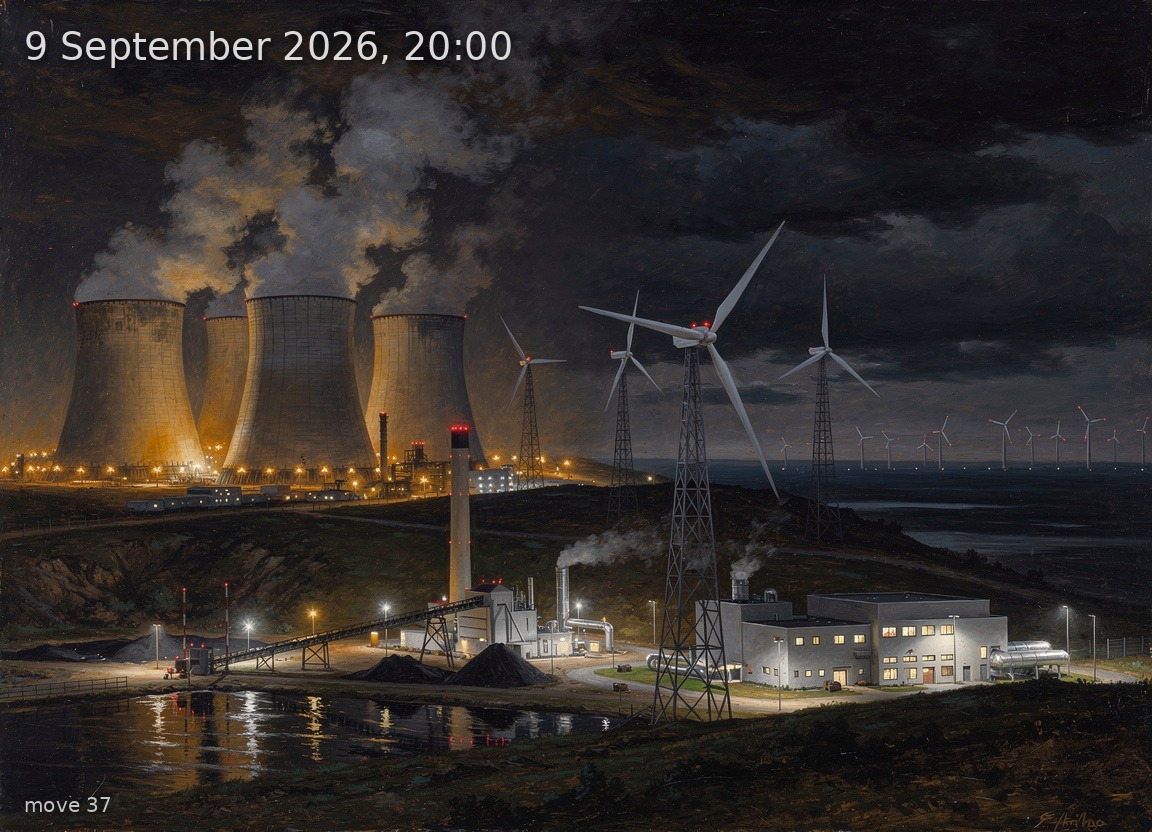
Wind leads at 24.2 GW but 16.8 GW net imports and lignite fill the post-sunset consumption gap.
Generation mix
Wind onshore 45%
Wind offshore 14%
Solar 0%
Biomass 9%
Hydro 2%
Natural gas 5%
Hard coal 7%
Brown coal 18%
70%
Renewable share
24.1 GW
Wind (on + offshore)
0.0 GW
Solar
40.9 GW
Total generation
16.9 GW
Net import
202.4 EUR/MWh
Day-ahead price
16.4°C / 16 km/h
Temp / Wind speed
Open-Meteo, Kassel (51.3°N 9.5°E) · surface estimate from 100 m wind
86.0% / 3.0 W/m²
Cloud cover / Radiation
224
gCO₂/kWh
Image prompt
Wind onshore 18.5 GW dominates the right two-thirds of the scene as dozens of massive three-blade turbines on lattice towers stretching across rolling dark hills, rotors visibly turning in moderate wind; wind offshore 5.7 GW appears as a distant row of turbines on the far right horizon above a dark estuary; brown coal 7.2 GW occupies the left quarter as a cluster of hyperbolic cooling towers emitting thick white-grey steam plumes, lit from below by orange sodium lamps of an industrial complex; hard coal 2.9 GW sits as a smaller power station with a single tall chimney and conveyor belts just left of centre; natural gas 2.0 GW appears as a compact CCGT plant with a single sleek exhaust stack and modest vapour trail beside the coal facilities; biomass 3.6 GW is represented by a medium-sized plant with a cylindrical silo and woodchip storage yard in the centre-left, warmly lit; hydro 0.9 GW appears as a small dam spillway in the lower-left foreground with white rushing water. TIME: 20:00 in September, fully dark — a black sky with no twilight glow, heavy 86% overcast clouds faintly visible only where industrial light catches them from below, no stars visible. The atmosphere is oppressive and heavy, reflecting the 202 EUR/MWh price — a thick humid haze hangs in the air, diffusing all artificial light into amber and sulphur halos. Temperature is a mild 16°C early autumn evening: vegetation is still green but muted, leaves just beginning to turn. The landscape is northern German lowland. All facilities are illuminated only by artificial sodium-vapour streetlights, orange safety beacons, and glowing windows, casting long reflections on wet ground. Highly detailed oil painting in the tradition of 19th-century German Romantic landscape painters — rich, dark colour palette of deep navy, umber, amber, and charcoal, visible impasto brushwork, dramatic atmospheric depth and chiaroscuro between dark sky and industrially lit ground. Each energy technology rendered with meticulous engineering accuracy: turbine nacelles, three-blade rotors, aluminium cooling tower ribbing, CCGT exhaust geometry. No text, no labels.