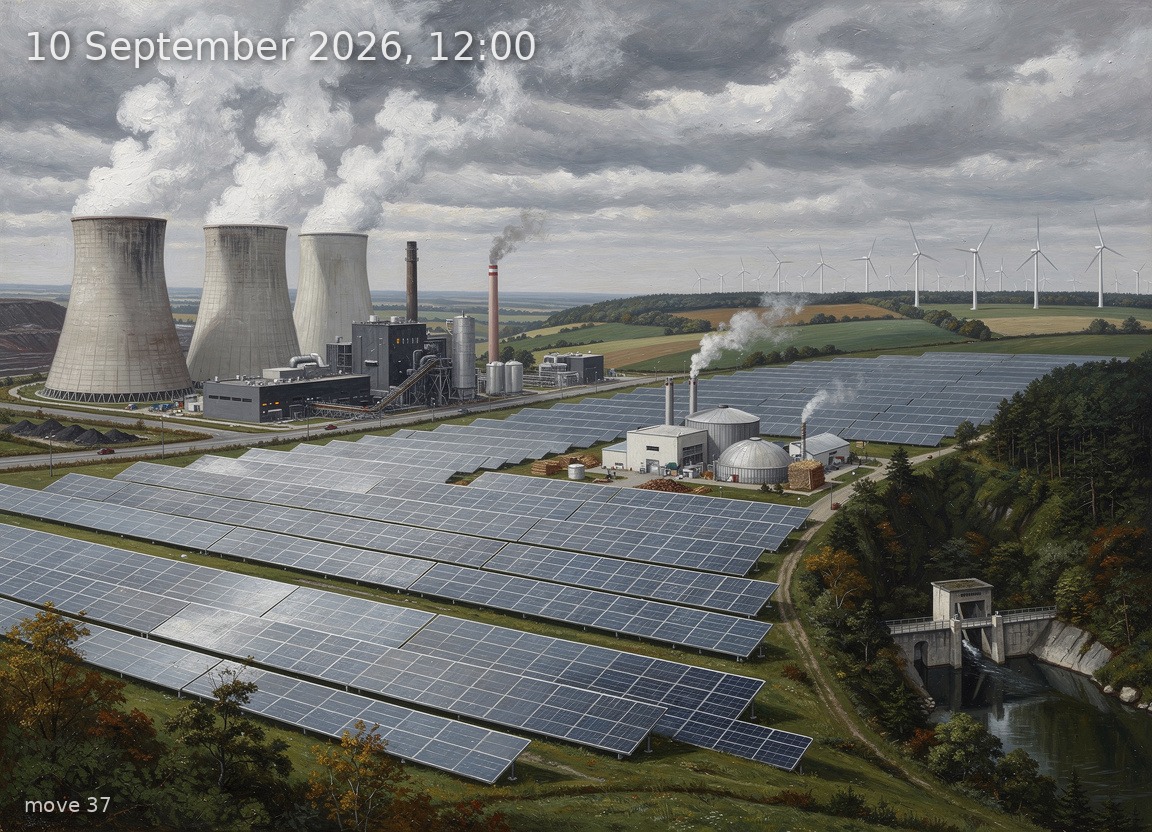
Solar leads at 41.7 GW under heavy overcast; brown coal and gas persist as thermal baseload despite 13.3 GW net export.
Generation mix
Wind onshore 8%
Wind offshore 2%
Solar 56%
Biomass 5%
Hydro 1%
Natural gas 8%
Hard coal 7%
Brown coal 12%
72%
Renewable share
7.0 GW
Wind (on + offshore)
41.7 GW
Solar
74.6 GW
Total generation
+13.3 GW
Net export
76.6 EUR/MWh
Day-ahead price
16.3°C / 3 km/h
Temp / Wind speed
Open-Meteo, Kassel (51.3°N 9.5°E) · surface estimate from 100 m wind
91.0% / 186.0 W/m²
Cloud cover / Radiation
197
gCO₂/kWh
Image prompt
Solar 41.7 GW dominates the right two-thirds of the scene as vast fields of aluminium-framed crystalline silicon PV panels stretching across gentle rolling hills into the hazy distance, their blue-grey surfaces reflecting a flat, overcast midday sky; brown coal 9.2 GW occupies the far left as a cluster of massive hyperbolic concrete cooling towers emitting thick white steam plumes that merge with the low grey cloud ceiling; natural gas 6.1 GW appears as a pair of modern compact CCGT plants with tall slender exhaust stacks and smaller vapour trails, positioned left of centre; hard coal 5.5 GW sits beside the lignite station as a blocky industrial facility with conveyor belts, bunker silos, and a single broad chimney trailing faint grey smoke; wind onshore 5.8 GW is rendered as a sparse row of tall three-blade turbines on a distant ridgeline, their rotors barely turning in the near-calm air; wind offshore 1.2 GW appears as a tiny cluster of turbines on a far horizon line suggesting the North Sea coast; biomass 4.0 GW is a modest wood-chip-fed power station with a domed silo and short stack near the centre-right; hydro 1.1 GW shows as a small concrete dam and penstock structure nestled in a forested valley at the far right edge. The sky is a heavy, unbroken blanket of 91% cloud cover in muted silver-grey tones, yet full diffuse midday daylight illuminates everything evenly without direct shadows — September light at noon in central Germany. The air feels dense and slightly oppressive, hinting at the elevated 76.6 EUR/MWh price. Vegetation is late-summer green beginning to fade toward early autumn tones at 16.3°C. No wind motion in trees or grass. Highly detailed oil painting in the tradition of 19th-century German Romantic landscape masters — Caspar David Friedrich meets industrial realism — with rich impasto brushwork, atmospheric aerial perspective, meticulous engineering accuracy on every turbine nacelle, every cooling tower rib, every PV cell grid line. Dramatic compositional depth from foreground solar arrays through midground thermal plants to distant wind turbines vanishing in haze. No text, no labels.