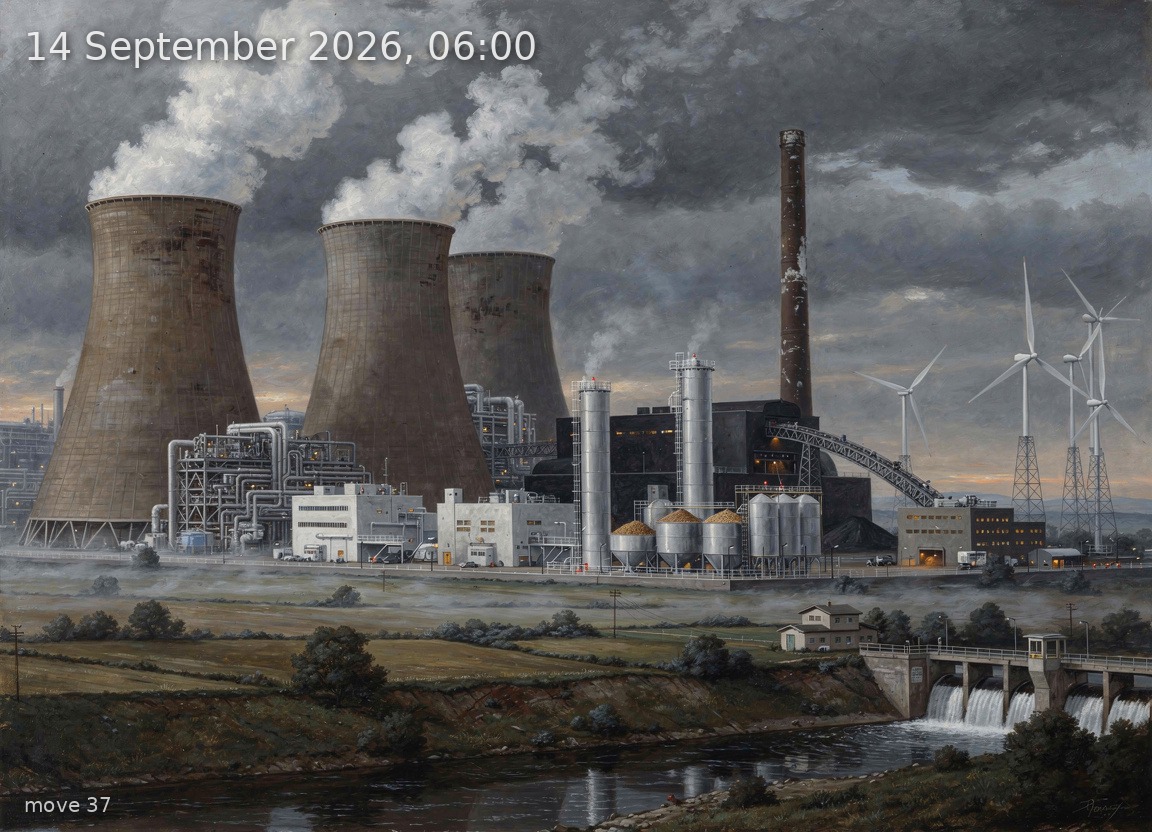
Brown coal, gas, and hard coal dominate as near-zero solar and weak wind force heavy net imports at dawn.
Generation mix
Wind onshore 11%
Wind offshore 1%
Solar 0%
Biomass 12%
Hydro 3%
Natural gas 23%
Hard coal 13%
Brown coal 35%
28%
Renewable share
3.9 GW
Wind (on + offshore)
0.0 GW
Solar
31.2 GW
Total generation
21.8 GW
Net import
254.7 EUR/MWh
Day-ahead price
12.6°C / 3 km/h
Temp / Wind speed
Open-Meteo, Kassel (51.3°N 9.5°E) · surface estimate from 100 m wind
90.0% / 0.0 W/m²
Cloud cover / Radiation
503
gCO₂/kWh
Image prompt
Brown coal 10.9 GW dominates the left third of the scene as a massive lignite power complex with four hyperbolic cooling towers emitting thick white steam plumes into heavy grey skies; natural gas 7.3 GW fills the centre-left as two compact CCGT plants with tall single exhaust stacks and smaller vapour trails; hard coal 4.1 GW appears centre-right as a traditional coal-fired station with a large smokestack and conveyor belt feeding dark fuel; biomass 3.9 GW is rendered as a mid-sized industrial plant with rounded silos of wood pellets and a modest chimney; onshore wind 3.5 GW occupies the right portion as a modest cluster of three-blade turbines on lattice towers, their rotors barely turning in the still air; hydro 0.9 GW appears as a small concrete dam with a thin waterfall in the far right background; offshore wind 0.4 GW is a faint silhouette of two turbines on the distant horizon line. The time is 06:00 in mid-September — pre-dawn light paints the sky in deep blue-grey with the faintest pale luminescence along the eastern horizon, no direct sunlight visible. Cloud cover is 90%, creating a heavy oppressive overcast ceiling that presses down on the landscape. The air temperature is cool at 12.6°C; early autumn vegetation shows hints of yellowing leaves on scattered birch and oak trees in the foreground. The atmosphere feels dense and weighty, reflecting the extreme electricity price — the clouds seem almost to sag with industrial weight. Sodium streetlights still glow amber along an access road in the foreground. The landscape is flat central German terrain with gentle rolling fields. Highly detailed oil painting in the tradition of 19th-century German Romantic landscape painters — rich, sombre colour palette of slate greys, deep blues, warm amber industrial glows, and earthy browns; visible confident brushwork; atmospheric depth with layers of industrial haze; meticulous engineering detail on every installation including turbine nacelles, three-blade rotors, aluminium conduit, cooling tower ribbing, and concrete structures. The scene evokes a grand industrial sublime — no text, no labels.