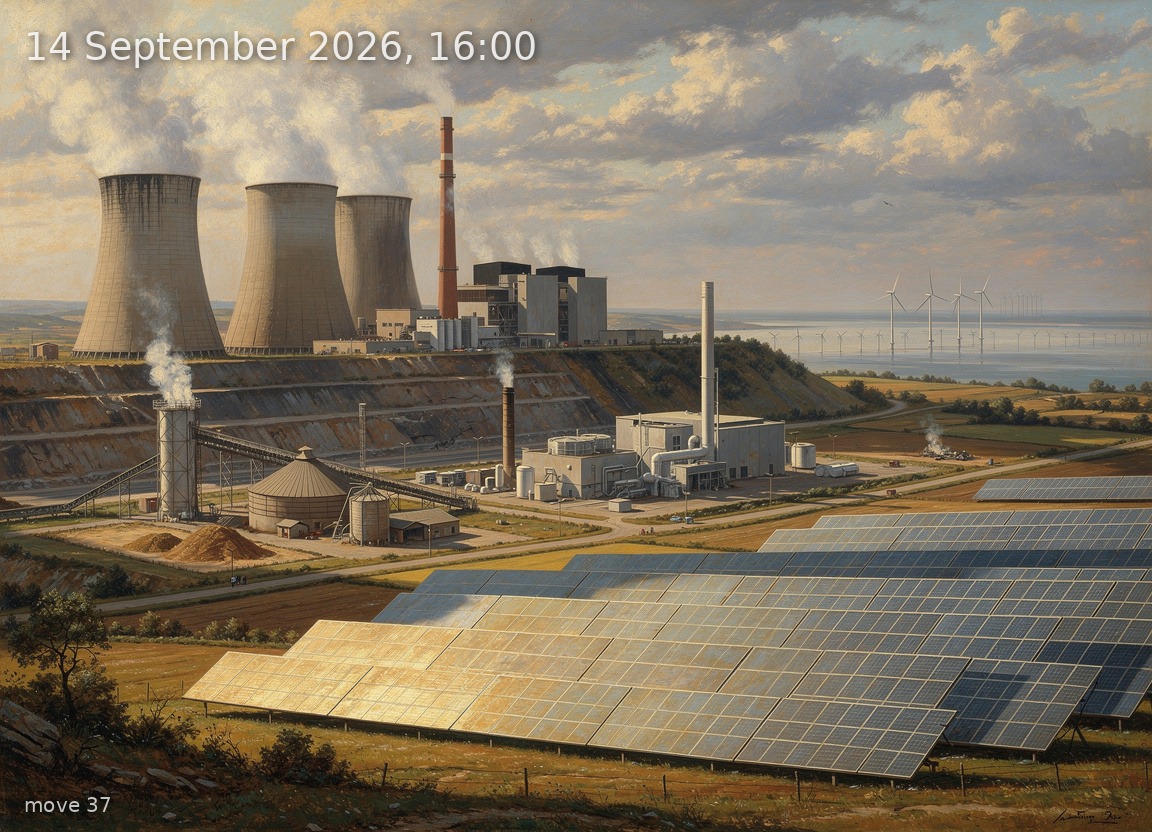
Strong solar and heavy coal prop up a wind-starved grid requiring 8.5 GW net imports at 180.6 EUR/MWh.
Generation mix
Wind onshore 2%
Wind offshore 2%
Solar 49%
Biomass 8%
Hydro 2%
Natural gas 10%
Hard coal 9%
Brown coal 18%
63%
Renewable share
2.0 GW
Wind (on + offshore)
23.9 GW
Solar
48.9 GW
Total generation
8.6 GW
Net import
180.6 EUR/MWh
Day-ahead price
21.2°C / 6 km/h
Temp / Wind speed
Open-Meteo, Kassel (51.3°N 9.5°E) · surface estimate from 100 m wind
56.0% / 176.0 W/m²
Cloud cover / Radiation
265
gCO₂/kWh
Image prompt
Solar 23.9 GW dominates the right half of the scene as vast fields of aluminium-framed crystalline silicon photovoltaic panels stretching across rolling late-summer farmland, angled toward an afternoon sun partially veiled by broken cumulus clouds. Brown coal 9.0 GW occupies the left quarter as a massive lignite power station complex with three hyperbolic concrete cooling towers emitting thick white steam plumes, adjacent to open-pit mine terraces. Hard coal 4.2 GW appears as a smaller coal-fired plant with rectangular mechanical-draft cooling towers and a tall brick chimney behind the lignite complex. Natural gas 4.9 GW is rendered as a compact CCGT facility with a single tall exhaust stack and smaller heat-recovery unit situated between the coal plants and solar fields. Biomass 3.7 GW appears as a modest wood-chip-fed generating station with a conical fuel silo and low smokestack near the middle ground. Wind onshore 1.2 GW is shown as a sparse cluster of three-blade turbines on a distant ridge, rotors barely turning. Wind offshore 0.8 GW is suggested by a faint line of offshore turbines on a hazy horizon. Hydro 1.2 GW is a small run-of-river weir with penstock visible along a river in the foreground. Time is 4 PM on a warm September afternoon: full daylight, sun at roughly 35° elevation in the southwest, warm golden tones filtered through 56% broken cloud cover creating alternating patches of light and shadow across the landscape. Vegetation is late-summer green beginning to hint at early autumn yellowing. The atmosphere feels heavy, oppressive, and hazy—reflecting the high electricity price—with industrial smoke and steam layering the air. Style: highly detailed oil painting in the tradition of 19th-century German Romantic landscape painters such as Caspar David Friedrich and Carl Blechen, with rich saturated colour, visible impasto brushwork, atmospheric aerial perspective, dramatic chiaroscuro from the cloud-broken sun, and meticulous engineering accuracy in every turbine nacelle, PV module, cooling tower, and smokestack. No text, no labels.