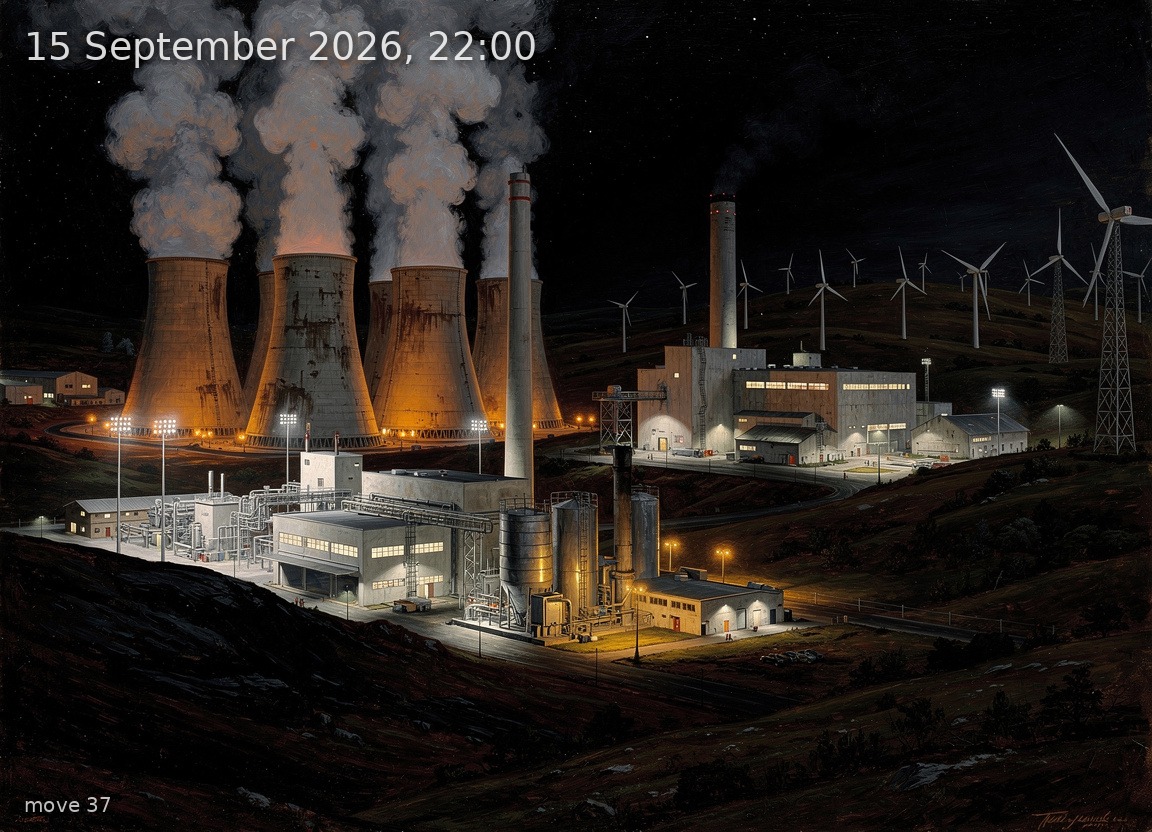
Brown coal, gas, and wind dominate nighttime generation as Germany imports 7.7 GW to meet evening demand.
Generation mix
Wind onshore 26%
Wind offshore 6%
Biomass 10%
Hydro 2%
Natural gas 19%
Hard coal 10%
Brown coal 27%
44%
Renewable share
13.9 GW
Wind (on + offshore)
0.0 GW
Solar
43.5 GW
Total generation
7.7 GW
Net import
199.5 EUR/MWh
Day-ahead price
18.2°C / 6 km/h
Temp / Wind speed
Open-Meteo, Kassel (51.3°N 9.5°E) · surface estimate from 100 m wind
0.0% / 0.0 W/m²
Cloud cover / Radiation
389
gCO₂/kWh
Image prompt
Brown coal 11.8 GW dominates the left third of the scene as a cluster of massive hyperbolic cooling towers emitting thick white-grey steam plumes, lit from below by orange sodium lights; wind onshore 11.3 GW spans the right third as dozens of three-blade turbines on lattice and tubular towers across rolling hills, their red aviation warning lights blinking; natural gas 8.2 GW fills the centre-left as compact CCGT power blocks with tall single exhaust stacks releasing thin heat shimmer, illuminated by facility floodlights; hard coal 4.3 GW appears centre-right as a coal-fired station with a large rectangular boiler house and a single wide smokestack; biomass 4.3 GW is rendered as a mid-sized industrial plant with cylindrical fuel silos and a modest chimney, warmly lit; wind offshore 2.5 GW is suggested by a distant row of turbines on the far-right horizon near a dark coastline with tiny red lights; hydro 1.1 GW appears as a small dam structure with spillway visible in the far background. The scene is set at 22:00 on a September night — the sky is completely black with faint stars visible through perfectly clear skies, zero cloud cover, no twilight glow whatsoever. A mild 18°C evening: green deciduous trees still in full late-summer foliage, grass slightly dry, beginning hints of early autumn. Light wind barely moves the tree leaves. The atmosphere feels heavy and oppressive despite the clear sky, conveying the tension of high electricity prices — a subtle amber-tinted industrial haze hangs low. All illumination comes from artificial sources: sodium-vapor streetlights casting orange pools, white industrial floodlights on plant structures, glowing control-room windows. Highly detailed oil painting in the tradition of 19th-century German Romantic landscape painters — rich impasto brushwork, deep atmospheric chiaroscuro, dramatic contrast between the dark natural landscape and the luminous industrial installations. Each technology rendered with meticulous engineering accuracy: turbine nacelles with three-blade rotors, aluminium cooling tower frameworks, CCGT heat recovery steam generators. The composition evokes Caspar David Friedrich's sense of sublime scale but applied to an industrial nocturne. No text, no labels.