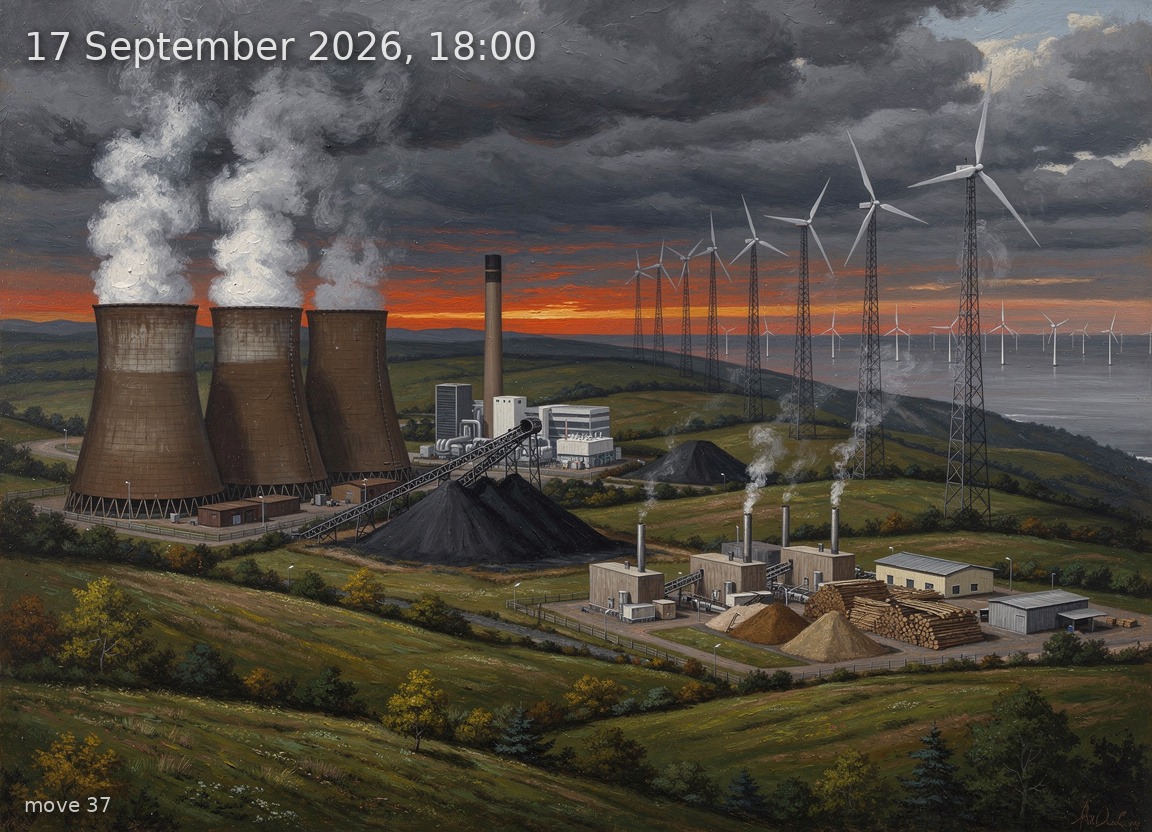
Strong wind and persistent lignite underpin a 59 GW evening peak requiring 11 GW net imports under overcast skies.
Generation mix
Wind onshore 40%
Wind offshore 10%
Solar 8%
Biomass 8%
Hydro 3%
Natural gas 8%
Hard coal 7%
Brown coal 17%
68%
Renewable share
24.0 GW
Wind (on + offshore)
3.7 GW
Solar
48.1 GW
Total generation
11.2 GW
Net import
198.5 EUR/MWh
Day-ahead price
18.3°C / 17 km/h
Temp / Wind speed
Open-Meteo, Kassel (51.3°N 9.5°E) · surface estimate from 100 m wind
90.0% / 99.0 W/m²
Cloud cover / Radiation
228
gCO₂/kWh
Image prompt
Wind onshore 19.4 GW dominates the right half and deep background as dozens of tall three-blade turbines on lattice towers stretching across rolling green late-summer hills, rotors visibly turning in moderate wind. Brown coal 8.1 GW occupies the left foreground as a massive lignite power station with four hyperbolic cooling towers emitting thick white steam plumes that merge into the overcast sky. Wind offshore 4.6 GW appears at the far right horizon as a row of turbines standing in a grey sea visible through a valley gap. Natural gas 3.8 GW is rendered as a compact CCGT plant with a tall single exhaust stack and low rectangular heat-recovery unit, positioned centre-left behind the lignite station. Hard coal 3.3 GW sits adjacent as a smaller coal plant with a single tall chimney and conveyor belt feeding from a dark coal pile. Biomass 4.0 GW appears as a cluster of modest wood-chip-fed generating units with short stacks and timber storage yards in the centre-right middle ground. Solar 3.7 GW is shown as a field of aluminium-framed crystalline silicon panels in the centre foreground, their surfaces dull and reflecting only grey sky — no sunshine, no glint. Hydro 1.3 GW is a small concrete dam and spillway visible in a wooded ravine at the far left. The sky is dusk at 18:00 in September: a narrow band of deep orange-red glow along the lower western horizon rapidly giving way to darkening grey-blue cloud overhead, 90 percent overcast with thick stratiform clouds pressing down oppressively to reflect the high electricity price. The atmosphere is heavy and humid. Late-summer vegetation — green but beginning to hint at early autumn yellows — covers the hillsides. Style: highly detailed oil painting in the tradition of 19th-century German Romantic landscape masters such as Caspar David Friedrich and Carl Blechen, with rich saturated colour, visible impasto brushwork, dramatic atmospheric depth, and meticulous engineering accuracy for every technology depicted. No text, no labels.