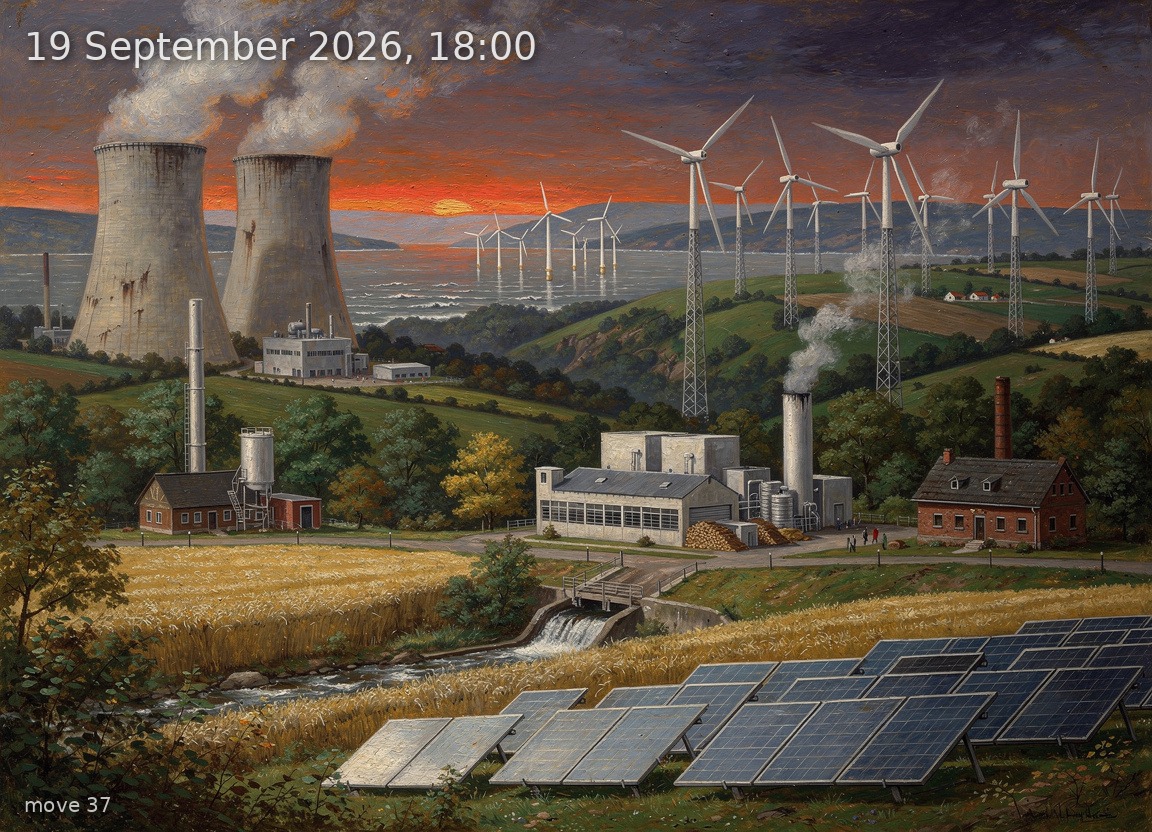
Wind onshore and offshore supply two-thirds of German demand at dusk, with thermal plants and minor imports closing the gap.
Generation mix
Wind onshore 56%
Wind offshore 12%
Solar 8%
Biomass 8%
Hydro 2%
Natural gas 6%
Hard coal 2%
Brown coal 7%
86%
Renewable share
33.0 GW
Wind (on + offshore)
3.7 GW
Solar
49.0 GW
Total generation
1.2 GW
Net import
65.5 EUR/MWh
Day-ahead price
21.1°C / 19 km/h
Temp / Wind speed
Open-Meteo, Kassel (51.3°N 9.5°E) · surface estimate from 100 m wind
48.0% / 145.0 W/m²
Cloud cover / Radiation
98
gCO₂/kWh
Image prompt
Wind onshore 27.3 GW dominates the scene as vast ranks of three-blade turbines with lattice towers stretching across rolling green hills from centre to right, their rotors visibly turning in moderate wind; wind offshore 5.7 GW appears in the distant background as a cluster of white monopile turbines standing in a grey sea glimpsed through a valley gap; solar 3.7 GW occupies a modest foreground strip as rows of aluminium-framed crystalline silicon panels angled toward the low western sun; biomass 4.1 GW is rendered as a mid-ground wood-chip-fed power station with a squat industrial chimney emitting thin white steam; brown coal 3.3 GW appears on the far left as two hyperbolic concrete cooling towers releasing thick pale steam plumes; natural gas 2.8 GW sits beside them as a compact CCGT facility with a single tall exhaust stack and heat-recovery unit; hard coal 1.0 GW is a smaller gabled boiler house with a dark brick chimney; hydro 1.1 GW is a small concrete weir and penstock visible along a river in the middle distance. The time is 18:00 in September—a dusk scene with a rapidly fading orange-red glow concentrated along the lower western horizon, the sky above transitioning from amber through deep violet to darkening blue overhead, the first faint stars appearing at the zenith. The landscape is late-summer central Germany: still-green deciduous trees with the earliest hints of yellowing leaves, harvested wheat fields in golden stubble, gentle Thuringian hills. A moderate haze hangs in the air suggesting a slightly oppressive, heavy atmosphere reflecting a mid-range electricity price. The style is a highly detailed oil painting in the tradition of 19th-century German Romantic landscape painters—Caspar David Friedrich meets industrial modernity—with rich impasto colour, visible expressive brushwork, deep atmospheric perspective, dramatic chiaroscuro from the dusk lighting, and meticulous engineering accuracy on every turbine nacelle, cooling tower, and PV panel. No text, no labels.