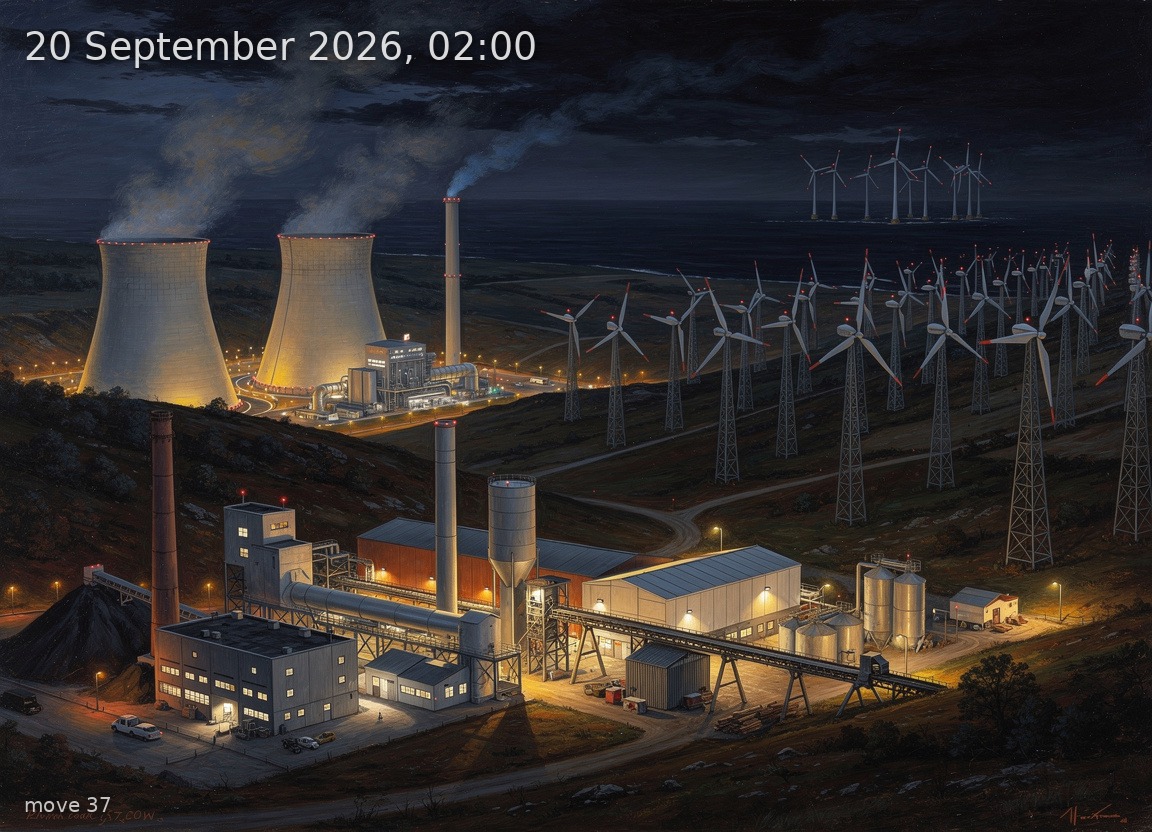
Strong overnight wind generation drives 83.5% renewables, 7.8 GW net exports, and a 10 EUR/MWh price.
Generation mix
Wind onshore 58%
Wind offshore 15%
Biomass 8%
Hydro 2%
Natural gas 6%
Hard coal 3%
Brown coal 8%
84%
Renewable share
33.4 GW
Wind (on + offshore)
0.0 GW
Solar
45.7 GW
Total generation
+7.8 GW
Net export
10.0 EUR/MWh
Day-ahead price
14.4°C / 15 km/h
Temp / Wind speed
Open-Meteo, Kassel (51.3°N 9.5°E) · surface estimate from 100 m wind
95.0% / 0.0 W/m²
Cloud cover / Radiation
115
gCO₂/kWh
Image prompt
Wind onshore 26.6 GW dominates the scene as vast rows of three-blade turbines with lattice towers stretching across rolling Central German hills from centre to far right, their rotors turning briskly in moderate wind. Wind offshore 6.7 GW appears in the distant background as a cluster of tall monopile turbines on a dark horizon line above a faintly visible sea. Brown coal 3.7 GW occupies the lower left as a pair of massive hyperbolic cooling towers with pale steam plumes rising into the black sky, lit from below by amber sodium lights from an adjacent industrial complex. Biomass 3.7 GW sits beside the coal plant as a smaller facility with a rectangular smokestack and a wood-chip conveyor, warmly illuminated by facility floodlights. Natural gas 2.5 GW is rendered as a compact CCGT plant with a single tall exhaust stack and a visible heat-recovery unit, positioned centre-left with a faint blue-white exhaust plume. Hard coal 1.3 GW appears as a modest conventional power station with a single large chimney and coal bunker, partially in shadow at the far left edge. Hydro 1.1 GW is suggested by a small dam and spillway at the base of a wooded hillside on the right margin, with white water catching artificial light. Time is 02:00 at night: the sky is completely black to deep navy, 95% cloud cover visible as a dense low overcast ceiling barely discernible against the darkness, no stars, no moon, no twilight glow whatsoever. All illumination comes from sodium-orange streetlights along rural roads, white and amber floodlights on the power plants, and red aviation warning lights blinking atop the wind turbine nacelles, creating points of ruby light receding into the distance. The landscape is early-autumn Central German terrain with dark green-to-yellowing grass and scattered deciduous trees just beginning to hint at autumn colour, temperature mild at 14°C. The atmosphere is calm and expansive, reflecting the low electricity price — open, quiet, unhurried. Style: highly detailed oil painting in the tradition of 19th-century German Romantic landscape painters such as Caspar David Friedrich and Carl Blechen — rich, deep colour palette of indigo, umber, ochre, and warm amber; visible confident brushwork; strong atmospheric depth and chiaroscuro contrast between the dark sky and the glowing industrial facilities; meticulous engineering accuracy on every turbine nacelle, cooling tower curvature, and exhaust stack detail. No text, no labels.