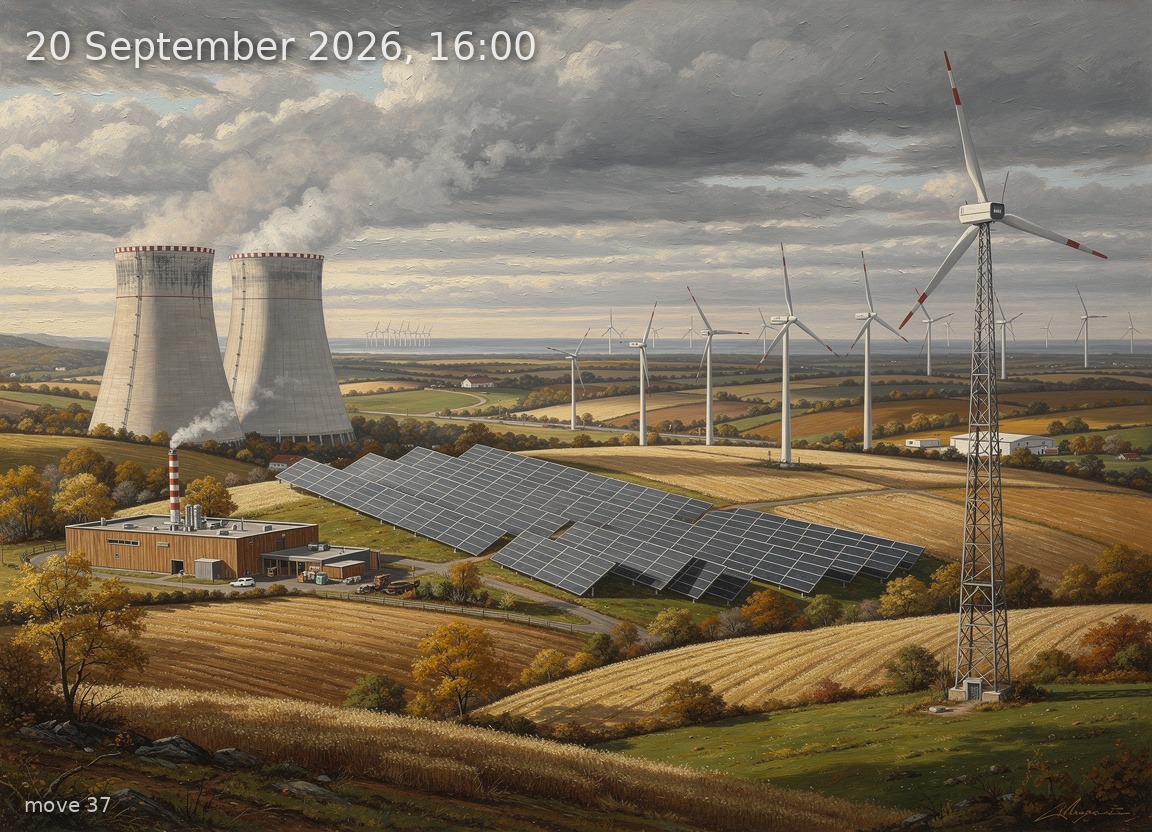
Strong onshore wind at 33.6 GW drives 14.5 GW net export and a marginally negative price under overcast skies.
Generation mix
Wind onshore 54%
Wind offshore 5%
Solar 26%
Biomass 6%
Hydro 2%
Natural gas 3%
Hard coal 1%
Brown coal 4%
92%
Renewable share
36.9 GW
Wind (on + offshore)
16.0 GW
Solar
62.7 GW
Total generation
+14.4 GW
Net export
-0.1 EUR/MWh
Day-ahead price
17.9°C / 18 km/h
Temp / Wind speed
Open-Meteo, Kassel (51.3°N 9.5°E) · surface estimate from 100 m wind
86.0% / 14.0 W/m²
Cloud cover / Radiation
56
gCO₂/kWh
Image prompt
Wind onshore 33.6 GW dominates the scene, filling the right two-thirds of the canvas with vast ranks of three-blade turbines on lattice and tubular towers stretching across rolling central German farmland, rotors visibly spinning in strong wind, blades caught mid-sweep. Solar 16.0 GW appears in the centre-left as broad fields of aluminium-framed crystalline silicon PV panels covering gentle hillsides, their surfaces reflecting only diffuse grey light under dense overcast. Wind offshore 3.4 GW is glimpsed far in the background as a distant cluster of white turbines on the horizon line. Biomass 3.5 GW is rendered as a modest wood-clad industrial plant with a single smokestack emitting thin white exhaust near the left edge. Brown coal 2.6 GW sits in the far left as a pair of hyperbolic concrete cooling towers with lazy steam plumes drifting in the wind. Natural gas 1.6 GW appears as a compact CCGT facility with a slender exhaust stack between the lignite plant and the biomass facility. Hydro 1.2 GW is depicted as a small weir and powerhouse nestled in a stream valley at the painting's lower-left corner. Hard coal 0.8 GW is a single dark industrial stack barely visible behind the lignite towers. The sky is thick with 86% cloud cover — a continuous layer of grey stratus lit from behind by a late-afternoon sun that barely penetrates, casting flat diffuse daylight at 16:00 in September; no direct sunbeams, but the scene retains the brightness of an overcast afternoon. The landscape shows early-autumn vegetation: fields of stubble and green pasture turning golden, deciduous trees with leaves beginning to yellow, temperature a mild 17.9 °C. The atmosphere feels calm and open despite the clouds — no oppression, reflecting the near-zero electricity price. Rendered as a highly detailed oil painting in the tradition of 19th-century German Romantic landscape painters such as Caspar David Friedrich and Carl Blechen — rich layered colour, visible impasto brushwork, atmospheric depth and aerial perspective, dramatic scale contrast between the tiny human structures and the sweeping sky. Meticulous engineering accuracy on every turbine nacelle, PV panel frame, cooling tower ribbing, and exhaust stack. No text, no labels.