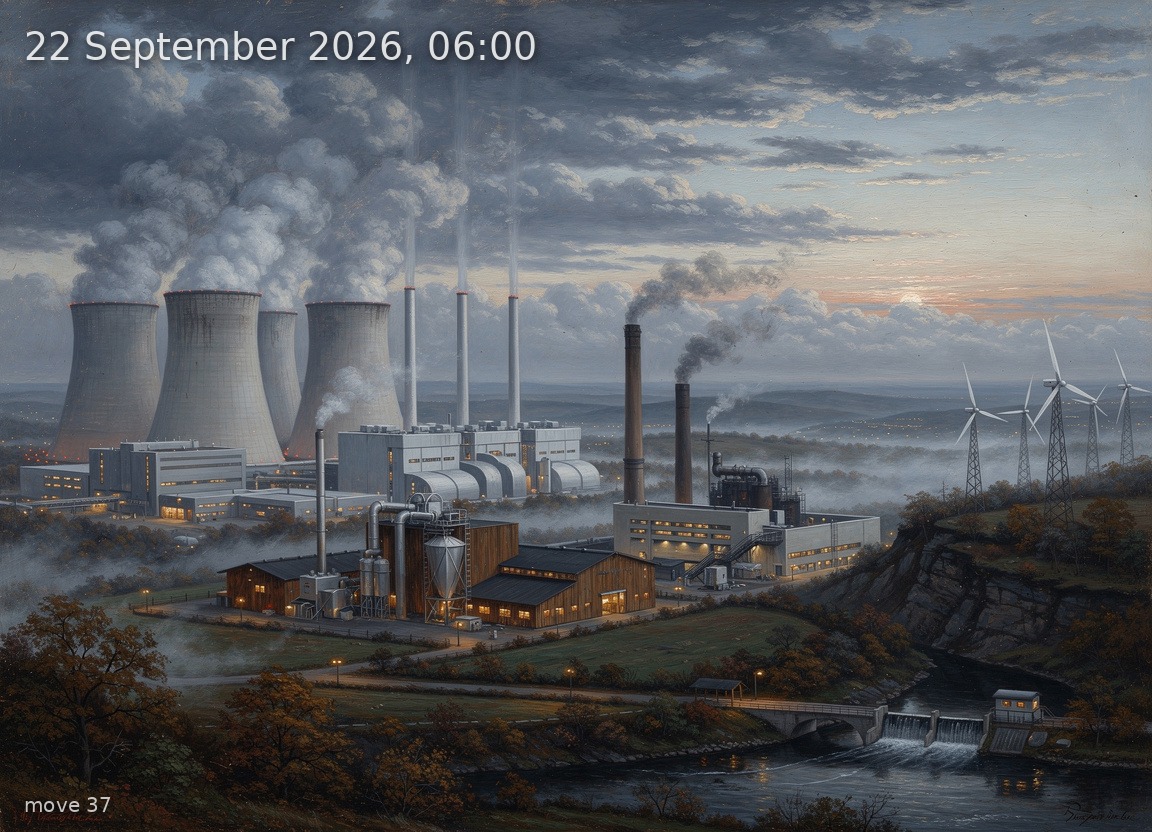
Brown coal, gas, and hard coal dominate as zero solar and light wind force heavy thermal dispatch and 18.5 GW net imports.
Generation mix
Wind onshore 17%
Wind offshore 2%
Solar 0%
Biomass 11%
Hydro 2%
Natural gas 20%
Hard coal 13%
Brown coal 35%
32%
Renewable share
6.3 GW
Wind (on + offshore)
0.0 GW
Solar
33.9 GW
Total generation
18.5 GW
Net import
238.6 EUR/MWh
Day-ahead price
7.5°C / 1 km/h
Temp / Wind speed
Open-Meteo, Kassel (51.3°N 9.5°E) · surface estimate from 100 m wind
54.0% / 0.0 W/m²
Cloud cover / Radiation
481
gCO₂/kWh
Image prompt
Brown coal 11.8 GW dominates the left third of the scene as a dense cluster of massive hyperbolic cooling towers with thick white-grey steam plumes rising into the sky; natural gas 6.9 GW fills the centre-left as a row of compact CCGT power plants with tall single exhaust stacks emitting thin vapour trails; hard coal 4.3 GW appears centre-right as a smaller coal-fired station with rectangular boiler houses and a pair of tapered chimneys; wind onshore 5.7 GW occupies the right quarter as a modest line of three-blade turbines on lattice towers standing nearly motionless on a ridgeline; biomass 3.7 GW appears as a wood-clad industrial facility with a modest smokestack near the centre; hydro 0.8 GW is a small dam structure visible in a valley in the far right background; wind offshore 0.6 GW is barely suggested as tiny turbine silhouettes on the distant horizon line. The time is early dawn, 06:00 in late September—the sky is a deep blue-grey with the faintest pale pre-dawn glow along the eastern horizon, no direct sunlight, no sun disc visible. No solar panels anywhere. The landscape is early-autumn German lowland terrain with cooling grass, scattered deciduous trees showing the first yellowing leaves, temperature around 7.5°C conveyed by faint mist hugging the ground. Cloud cover at 54% rendered as broken mid-level stratocumulus dimly backlit by pre-dawn light. The atmosphere feels heavy, oppressive, and industrial, reflecting the extreme 238.6 EUR/MWh price—thick haze hangs in the air, the steam plumes merge with low clouds, and the scene carries a brooding, weighty mood. Overhead high-voltage transmission lines with steel pylons cross the scene, emphasising the massive import flows. Rendered as a highly detailed oil painting in the tradition of 19th-century German Romantic landscape painters—rich, dark colour palette of slate blues, warm ochres from sodium lights on the industrial facilities, deep umber shadows, visible impasto brushwork, atmospheric perspective with distant towers fading into haze. Each technology painted with meticulous engineering accuracy: three-blade rotor geometry, hyperbolic concrete cooling tower curvature, CCGT turbine hall proportions. The composition evokes Caspar David Friedrich's sublime industrial sublime—vast, contemplative, slightly melancholy. No text, no labels.