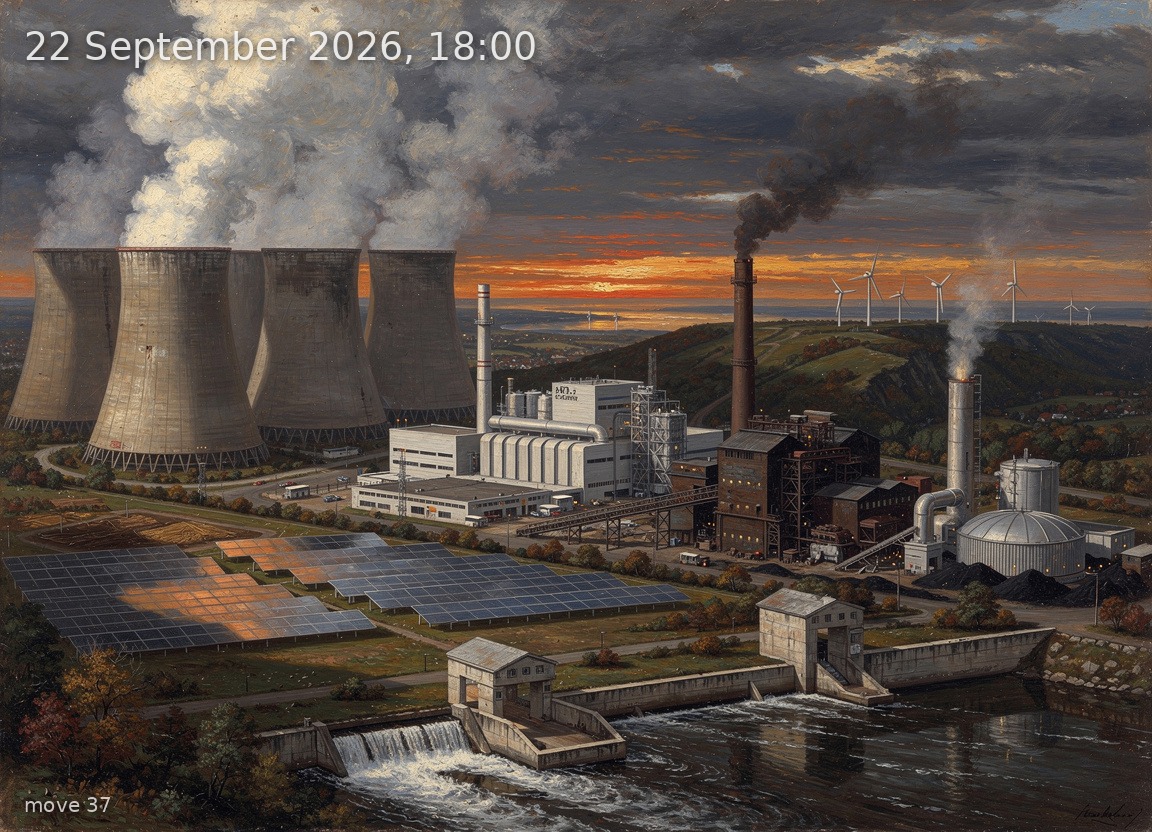
Brown coal and gas dominate a 31.8 GW domestic supply as 27 GW of net imports fill the evening peak.
Generation mix
Wind onshore 7%
Wind offshore 1%
Solar 12%
Biomass 12%
Hydro 3%
Natural gas 17%
Hard coal 14%
Brown coal 34%
35%
Renewable share
2.6 GW
Wind (on + offshore)
3.7 GW
Solar
31.8 GW
Total generation
26.9 GW
Net import
374.8 EUR/MWh
Day-ahead price
16.1°C / 7 km/h
Temp / Wind speed
Open-Meteo, Kassel (51.3°N 9.5°E) · surface estimate from 100 m wind
71.0% / 78.0 W/m²
Cloud cover / Radiation
465
gCO₂/kWh
Image prompt
Brown coal 10.7 GW dominates the left third of the scene as a cluster of massive hyperbolic cooling towers with thick white-grey steam plumes rising into heavy air; natural gas 5.6 GW occupies the centre-left as compact CCGT power blocks with tall single exhaust stacks trailing thin heat shimmer; hard coal 4.4 GW appears centre-right as a blocky coal-fired station with conveyor belts and a broad chimney; solar 3.7 GW is rendered as a modest field of aluminium-framed crystalline silicon panels in the mid-ground catching the last orange light at low angle; biomass 3.7 GW sits as a wood-chip burning facility with a rounded storage dome and modest stack; wind onshore 2.4 GW appears as a small group of three-blade turbines on a distant ridge, rotors barely turning in still air; hydro 1.1 GW is a low concrete run-of-river weir with modest white water in the foreground; wind offshore 0.2 GW is a pair of tiny turbine silhouettes on the far horizon. Time is 18:00 late September dusk in central Germany — the sun is very low, casting a narrow band of deep amber-orange glow along the lower horizon while the upper sky transitions rapidly from slate grey to darkening blue-grey; 71% cloud cover creates heavy layered stratus formations pressing down oppressively. The atmosphere is thick and brooding, conveying the tension of an extremely high electricity price — the air itself feels weighted and taut. Mild 16°C early-autumn setting: deciduous trees in the mid-ground show the first hints of yellowing leaves, grass still green but muted. Transmission pylons recede into the haze toward the horizon, symbolising the massive import flows. Painted in the style of a highly detailed 19th-century German Romantic oil painting — rich impasto brushwork, dramatic chiaroscuro between the glowing industrial facilities and the darkening sky, atmospheric sfumato in the distance, luminous treatment of steam and smoke against fading light. Meticulous engineering accuracy on all infrastructure. No text, no labels.