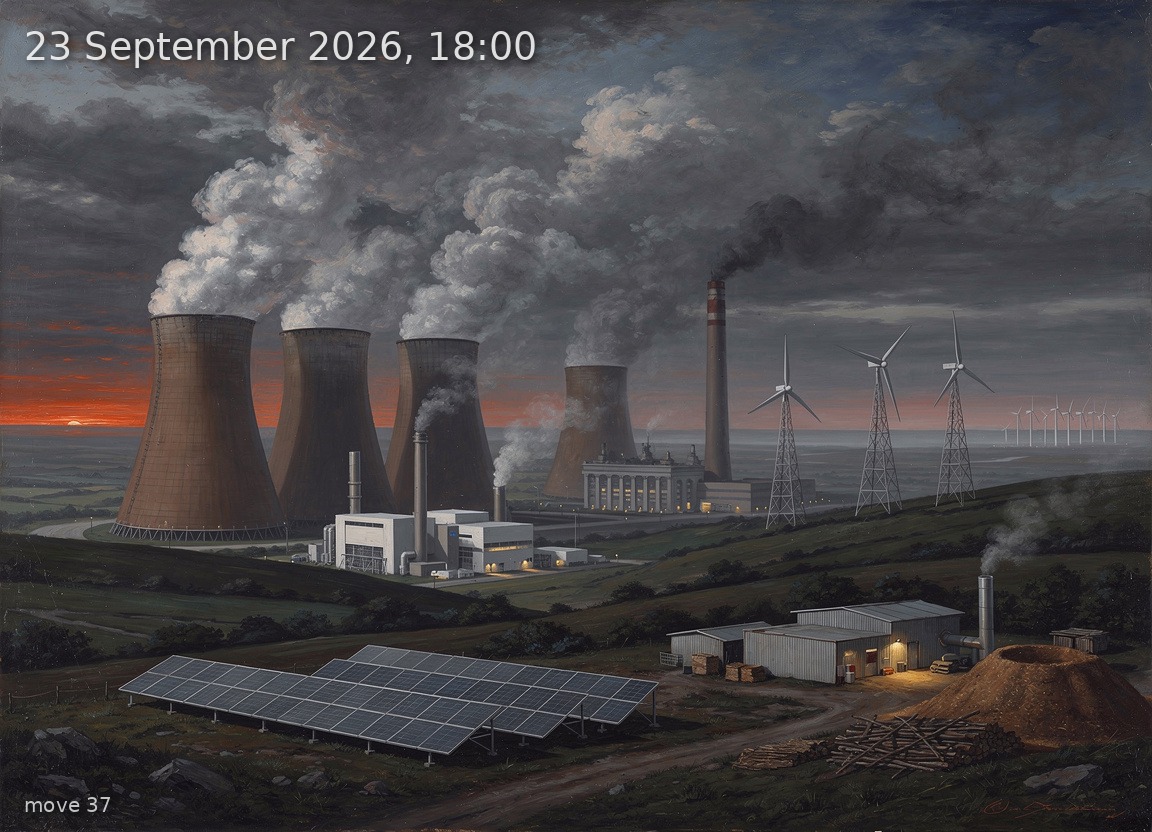
Brown coal and gas dominate as full cloud cover and fading light limit renewables, driving high prices and large net imports.
Generation mix
Wind onshore 9%
Wind offshore 12%
Solar 10%
Biomass 10%
Hydro 3%
Natural gas 18%
Hard coal 10%
Brown coal 27%
44%
Renewable share
8.0 GW
Wind (on + offshore)
3.7 GW
Solar
37.8 GW
Total generation
21.2 GW
Net import
243.7 EUR/MWh
Day-ahead price
18.3°C / 10 km/h
Temp / Wind speed
Open-Meteo, Kassel (51.3°N 9.5°E) · surface estimate from 100 m wind
100.0% / 78.0 W/m²
Cloud cover / Radiation
392
gCO₂/kWh
Image prompt
Brown coal 10.4 GW dominates the left third of the scene as four massive hyperbolic cooling towers with billowing white-grey steam plumes; natural gas 6.8 GW fills the centre-left as a pair of compact CCGT plants with tall single exhaust stacks and heat-shimmer emissions; hard coal 4.0 GW appears centre-right as a classical coal-fired station with a single large chimney trailing darker smoke; wind offshore 4.7 GW is rendered as a distant row of tall three-blade turbines on the far-right horizon above a grey sea; wind onshore 3.3 GW stands as a cluster of lattice-towered turbines with slowly turning rotors on gentle hills right of centre; biomass 3.9 GW appears as a mid-sized wood-chip facility with a modest stack and a pile of timber beside it in the right foreground; solar 3.7 GW is shown as a small field of aluminium-framed crystalline silicon panels in the centre foreground, their surfaces dull and unreflective under the overcast sky; hydro 1.1 GW is a small concrete dam with a thin waterfall visible at the far right edge. The sky is late dusk at 18:00 in September — a narrow band of deep orange-red glow clings to the lower horizon on the left, while the upper sky darkens rapidly to slate grey and deep blue, fully blanketed by 100% cloud cover with no stars or clear patches visible. The atmosphere is heavy and oppressive, reflecting the extreme electricity price — a brooding, sulfurous quality to the air, haze drifting between the industrial structures. Vegetation is early-autumn: trees with leaves just beginning to turn yellow-brown at the edges, green grass still present but muted in the fading light. Gentle breeze suggested by slight motion in flags and grass. Temperature is mild at 18°C. Style: highly detailed oil painting in the tradition of 19th-century German Romantic landscape painters such as Caspar David Friedrich and Carl Blechen — rich impasto brushwork, dramatic chiaroscuro, atmospheric depth with layers of industrial haze receding toward the horizon, warm amber artificial lighting beginning to glow from plant windows and sodium streetlamps contrasting against the cold darkening sky. Meticulous engineering accuracy in every turbine nacelle, cooling tower profile, and panel array. No text, no labels, no people prominently featured — the machines themselves are the protagonists of this industrial twilight.