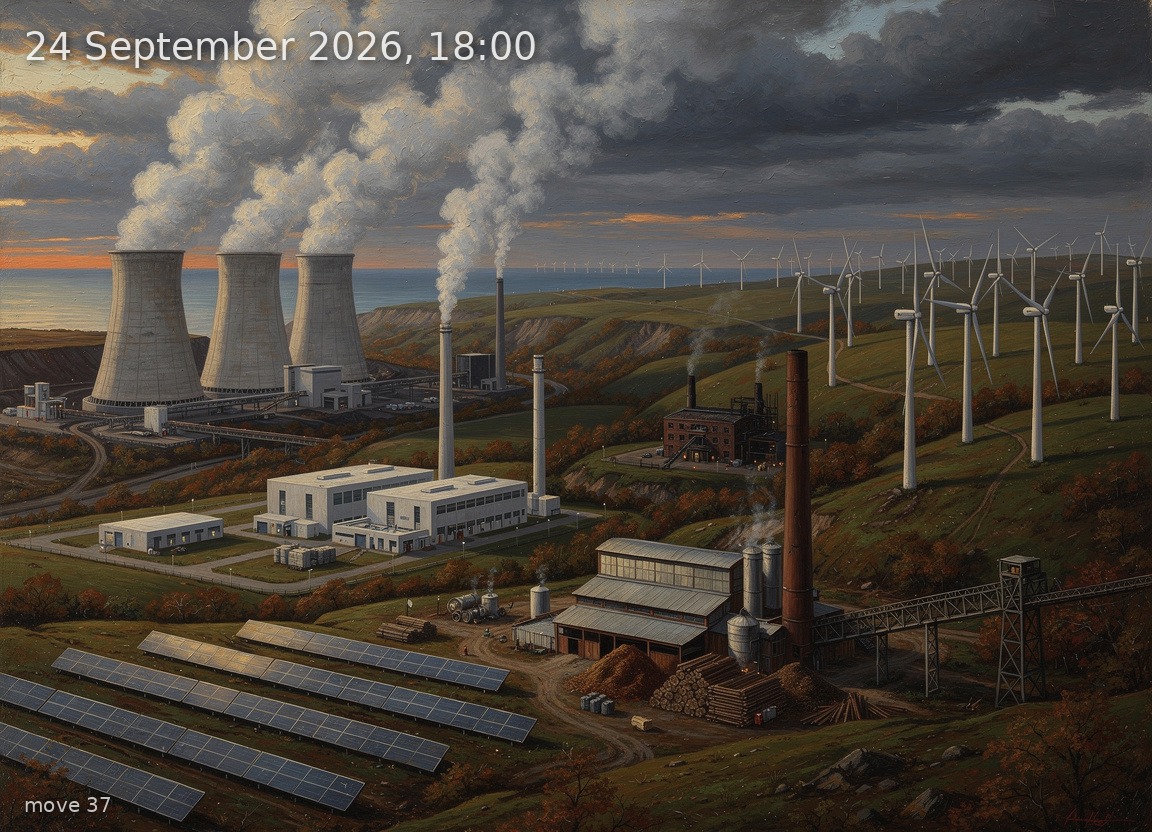
Onshore wind leads at 15.5 GW but brown coal and gas fill a 12.9 GW import gap as solar fades at dusk.
Generation mix
Wind onshore 34%
Wind offshore 6%
Solar 6%
Biomass 9%
Hydro 2%
Natural gas 13%
Hard coal 10%
Brown coal 20%
56%
Renewable share
18.1 GW
Wind (on + offshore)
2.8 GW
Solar
46.1 GW
Total generation
12.9 GW
Net import
226.0 EUR/MWh
Day-ahead price
16.1°C / 19 km/h
Temp / Wind speed
Open-Meteo, Kassel (51.3°N 9.5°E) · surface estimate from 100 m wind
45.0% / 71.0 W/m²
Cloud cover / Radiation
307
gCO₂/kWh
Image prompt
Onshore wind 15.5 GW dominates the right half of the canvas as dozens of three-blade turbines on lattice and tubular towers stretching across rolling green-brown autumn hills, blades visibly turning in moderate wind; brown coal 9.4 GW occupies the left quarter as a massive lignite power station with four hyperbolic cooling towers emitting thick white-grey steam plumes rising into the sky; natural gas 5.8 GW appears left of centre as two compact CCGT units with tall single exhaust stacks and thinner heat exhaust; hard coal 4.8 GW sits adjacent as a dark industrial block with a single large smokestack and coal conveyor belt; biomass 4.2 GW is rendered as a mid-ground cluster of smaller industrial buildings with timber-pile yards and modest steam vents; solar 2.8 GW appears as a modest field of aluminium-framed crystalline silicon panels in the mid-ground catching the last feeble orange light; offshore wind 2.6 GW is suggested on the far horizon as faint turbine silhouettes against the sea; hydro 1.0 GW is a small dam and spillway visible in a valley at far right. The sky is a dusk scene at 18:00 in late September: the upper sky deepening to dark blue-grey, the lower western horizon glowing intense orange-red fading upward, 45% cloud cover rendered as broken cumulus catching the last warm light underneath while darkening above. The atmosphere feels heavy and oppressive, reflecting the 226 EUR/MWh price — a brooding, pressing quality to the clouds and industrial haze. Autumn vegetation: fields turning golden-brown, deciduous trees showing early yellowing foliage, temperature around 16°C suggested by the cool palette. Rendered as a highly detailed oil painting in the tradition of 19th-century German Romantic landscape painters — rich, saturated colour with visible impasto brushwork, atmospheric perspective with depth and haze, dramatic chiaroscuro from the dusk light playing across industrial and natural forms. Meticulous engineering accuracy on every turbine nacelle, cooling tower curvature, PV panel frame, and gas stack. The scene feels monumental, a masterwork painting of the industrial-pastoral landscape. No text, no labels.