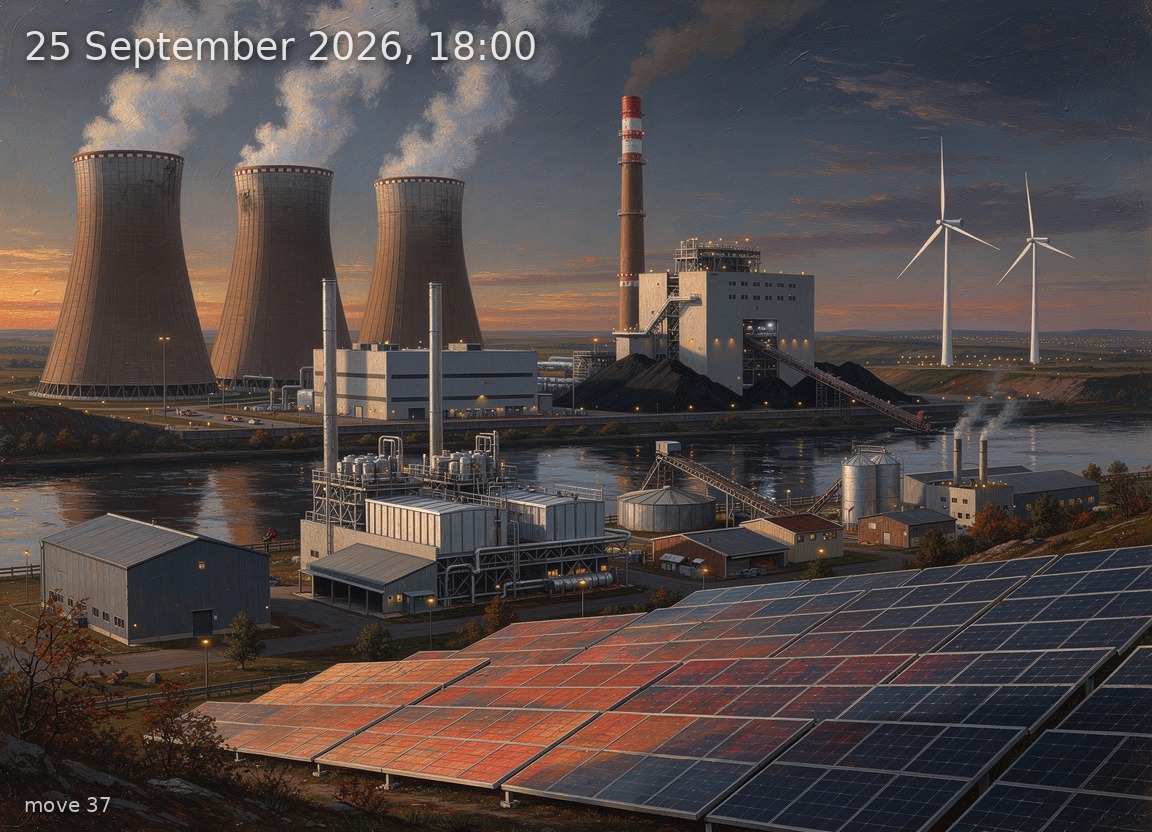
Brown coal and gas dominate as weak wind and fading solar force 23.7 GW of net imports at elevated prices.
Generation mix
Wind onshore 4%
Wind offshore 5%
Solar 12%
Biomass 13%
Hydro 3%
Natural gas 20%
Hard coal 11%
Brown coal 32%
37%
Renewable share
2.8 GW
Wind (on + offshore)
3.8 GW
Solar
32.3 GW
Total generation
23.7 GW
Net import
241.4 EUR/MWh
Day-ahead price
19.2°C / 6 km/h
Temp / Wind speed
Open-Meteo, Kassel (51.3°N 9.5°E) · surface estimate from 100 m wind
9.0% / 127.0 W/m²
Cloud cover / Radiation
444
gCO₂/kWh
Image prompt
Brown coal 10.4 GW dominates the left third of the scene as a massive lignite power station with four hyperbolic cooling towers emitting tall white-grey steam plumes; natural gas 6.6 GW occupies the centre-left as two compact CCGT units with slender exhaust stacks trailing thin heat shimmer; hard coal 3.4 GW appears centre-right as a single coal plant with a rectangular boiler house and conveyor belt feeding stockpiles; biomass 4.2 GW is rendered as a cluster of modest wood-chip combustion plants with corrugated-metal silos and short chimneys emitting pale wisps; solar 3.8 GW appears as a field of aluminium-framed crystalline silicon panels in the right foreground catching the last orange-red rays at a low angle; wind onshore 1.3 GW is shown as three widely spaced three-blade turbines on a distant ridge, rotors barely turning in light air; wind offshore 1.6 GW is suggested by a faint row of turbines visible on the far horizon beyond a river; hydro 1.1 GW appears as a small run-of-river weir with a concrete powerhouse at the river's edge in the lower right. The sky is a dusk scene at 18:00 in late September: a band of deep orange-red light clings to the lower horizon, transitioning upward through warm amber into a rapidly darkening steel-blue sky overhead, with only 9% cloud cover—a few thin alto-cirrus wisps tinged gold. The atmosphere is heavy and oppressive, conveying economic strain—a faint industrial haze blankets the middle distance, lending a sulphurous amber cast to the fading light. Vegetation is late-summer green beginning to show early autumn yellowing at the edges, with warm 19°C air suggested by soft, still foliage. The river reflects the copper sky and the glowing industrial lights beginning to flicker on. Rendered as a highly detailed oil painting in the tradition of 19th-century German Romantic landscape painters—rich saturated colour, visible impasto brushwork, atmospheric aerial perspective—yet with meticulous engineering accuracy on every turbine nacelle, cooling tower fluting, PV cell grid pattern, and exhaust stack. No text, no labels.