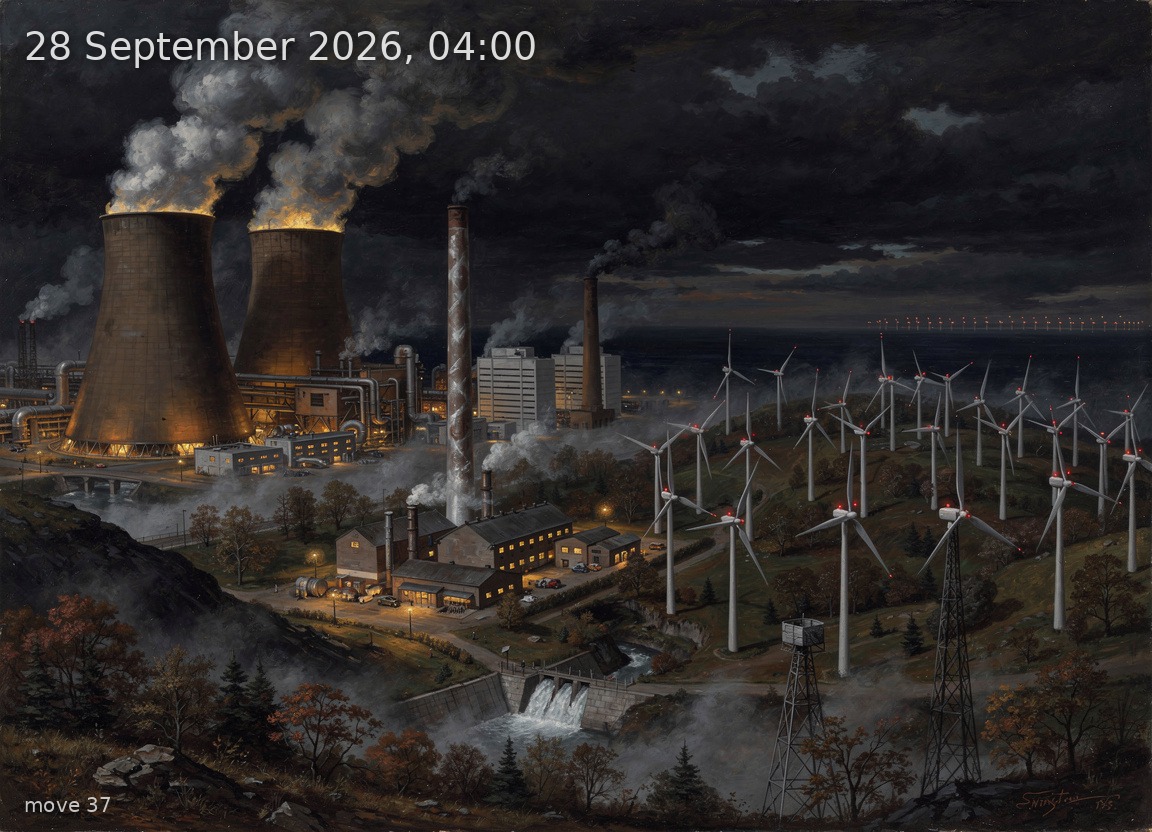
Wind leads at 13.6 GW but brown coal and gas run heavily to cover 6.5 GW of net imports overnight.
Generation mix
Wind onshore 31%
Wind offshore 8%
Biomass 11%
Hydro 2%
Natural gas 13%
Hard coal 10%
Brown coal 24%
53%
Renewable share
13.5 GW
Wind (on + offshore)
0.0 GW
Solar
34.2 GW
Total generation
6.5 GW
Net import
161.0 EUR/MWh
Day-ahead price
9.8°C / 9 km/h
Temp / Wind speed
Open-Meteo, Kassel (51.3°N 9.5°E) · surface estimate from 100 m wind
80.0% / 0.0 W/m²
Cloud cover / Radiation
335
gCO₂/kWh
Image prompt
Brown coal 8.3 GW dominates the left third of the scene as a massive lignite power station with three hyperbolic cooling towers emitting thick grey-white steam plumes lit from below by amber sodium lights; natural gas 4.4 GW occupies the centre-left as two compact CCGT blocks with tall single exhaust stacks venting thin hot plumes; hard coal 3.3 GW appears centre-right as a smaller coal plant with rectangular boiler houses and a single wide chimney trailing dark smoke; wind onshore 10.8 GW fills the right half of the composition as dozens of three-blade turbines on lattice and tubular towers stretching across rolling hills into the distance, red aircraft-warning lights blinking on every nacelle; wind offshore 2.8 GW is suggested by a faint line of turbine lights on the far-right horizon over a dark sea; biomass 3.8 GW appears as a cluster of modest industrial buildings with short stacks and warm amber-lit windows in the middle ground; hydro 0.8 GW is a small dam structure at the far centre with a trickle of white water catching the industrial light. The sky is completely dark — deep black-navy, no twilight, no stars visible through 80 percent cloud cover, the overcast ceiling pressing low and heavy, giving an oppressive atmosphere reflecting the high electricity price. Temperature is a cool 9.8 degrees Celsius in late September: the vegetation is early-autumn, leaves beginning to turn bronze and gold, visible only where sodium streetlights catch them. Ground-level mist drifts between the turbine bases. The entire scene is illuminated solely by artificial light — orange sodium lamps along access roads, cool white security lights on plant perimeters, red blinking lights on turbine tips, and the warm industrial glow from boiler houses. Painted in the style of a highly detailed 19th-century German Romantic oil painting — rich, deep colour palette of blacks, navy blues, warm ambers, and industrial oranges — with visible confident brushwork, atmospheric depth and chiaroscuro, yet meticulous engineering accuracy on every cooling tower, turbine nacelle, rotor blade, and exhaust stack. No text, no labels.