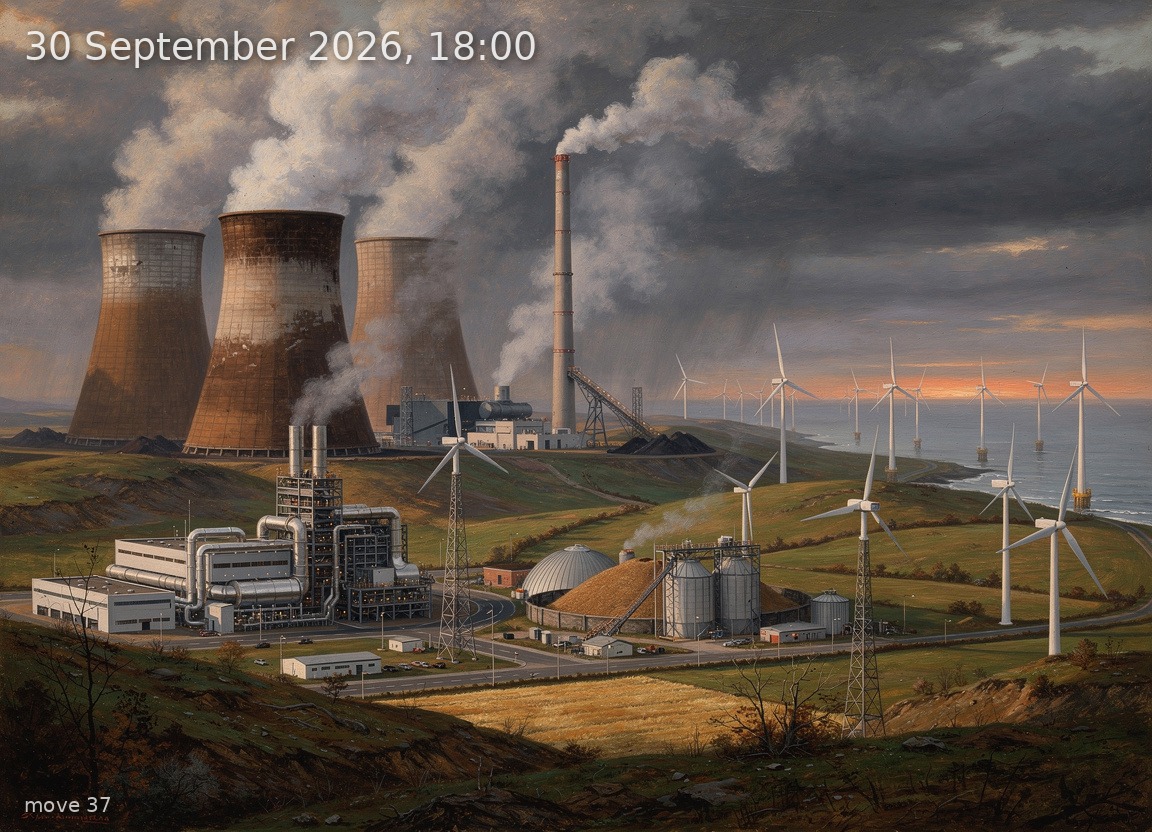
Wind leads at 18.2 GW but heavy imports of 14.1 GW and lignite at 10.4 GW cover the evening demand peak.
Generation mix
Wind onshore 30%
Wind offshore 11%
Solar 5%
Biomass 9%
Hydro 2%
Natural gas 12%
Hard coal 9%
Brown coal 23%
56%
Renewable share
18.2 GW
Wind (on + offshore)
2.1 GW
Solar
45.1 GW
Total generation
14.1 GW
Net import
230.3 EUR/MWh
Day-ahead price
25.1°C / 7 km/h
Temp / Wind speed
Open-Meteo, Kassel (51.3°N 9.5°E) · surface estimate from 100 m wind
65.0% / 81.0 W/m²
Cloud cover / Radiation
317
gCO₂/kWh
Image prompt
Brown coal 10.4 GW dominates the left quarter as a cluster of massive hyperbolic cooling towers with thick white-grey steam plumes rising into a heavy, oppressive dusk sky; wind onshore 13.4 GW fills the centre-right as dozens of three-blade turbines on lattice and tubular towers spread across rolling green-and-gold late-summer hills, blades turning slowly in light wind; wind offshore 4.8 GW appears in the far right distance as a line of turbines standing in a grey-blue sea near the horizon; natural gas 5.5 GW sits centre-left as two compact CCGT plants with twin exhaust stacks venting thin heat shimmer; hard coal 4.1 GW appears behind the lignite complex as a single conventional plant with a tall chimney and conveyor belt; biomass 4.1 GW is rendered as a mid-ground industrial facility with a wood-chip storage dome and modest smokestack; solar 2.1 GW appears as a small field of aluminium-framed crystalline silicon panels in the foreground catching the last weak orange light; hydro 0.8 GW is a small dam and spillway visible in a valley at far left. The sky is a dusk scene at 18:00 in late September — rapidly fading orange-red glow on the lower western horizon, the upper sky darkening to deep slate-blue and indigo, 65% cloud cover forming broad stratocumulus bands that absorb the warm light from below and press down oppressively on the landscape. The temperature is warm at 25°C; vegetation is late-summer green beginning to show the first hints of autumn gold on deciduous trees. Direct sunlight is nearly gone, indirect diffuse light bathes the scene in muted amber tones. The atmosphere feels heavy and tense, reflecting the extreme electricity price. Style: highly detailed oil painting in the tradition of 19th-century German Romantic landscape painters such as Caspar David Friedrich and Carl Blechen — rich colour palette, visible expressive brushwork, dramatic atmospheric depth and chiaroscuro, meticulous engineering detail on every turbine nacelle, cooling tower reinforcement ring, PV cell grid pattern, and gas-plant piping. No text, no labels.