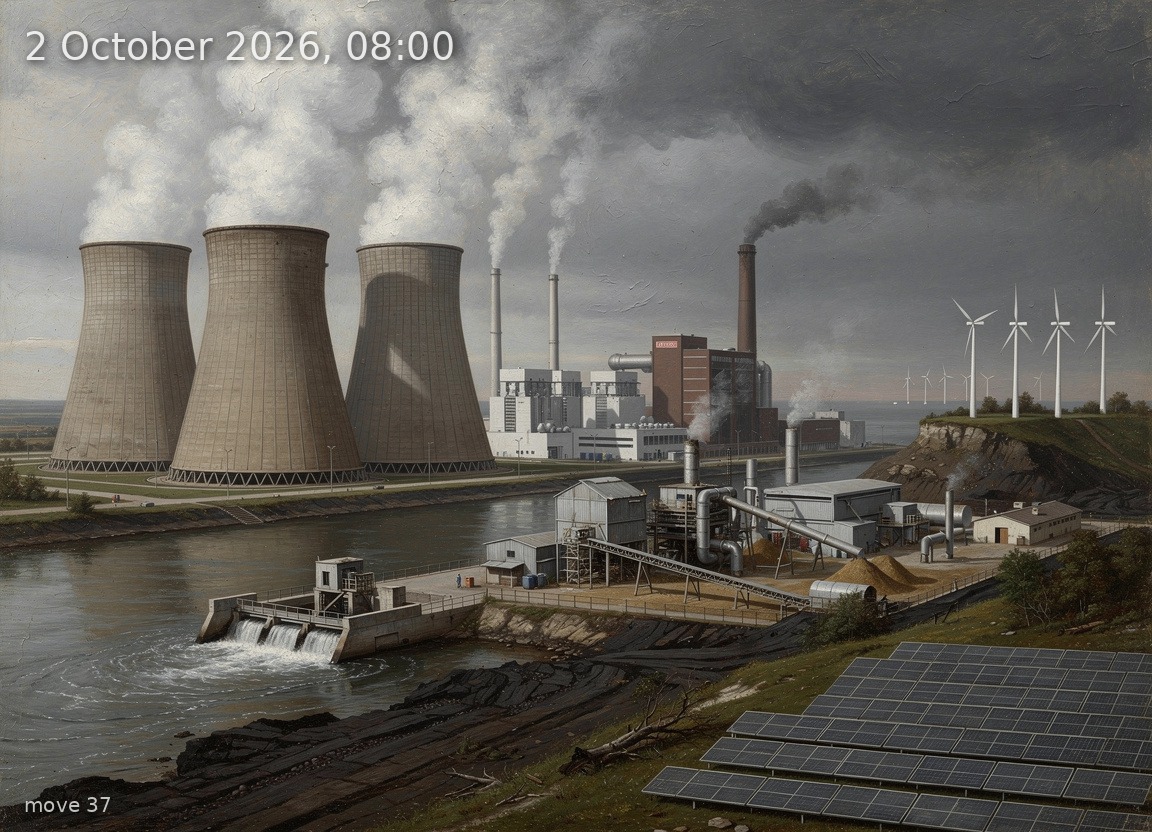
Brown coal and gas dominate as overcast, calm conditions suppress renewables, driving heavy imports and elevated prices.
Generation mix
Wind onshore 8%
Wind offshore 1%
Solar 10%
Biomass 12%
Hydro 2%
Natural gas 25%
Hard coal 9%
Brown coal 33%
33%
Renewable share
3.5 GW
Wind (on + offshore)
3.6 GW
Solar
36.9 GW
Total generation
23.5 GW
Net import
264.3 EUR/MWh
Day-ahead price
13.5°C / 4 km/h
Temp / Wind speed
Open-Meteo, Kassel (51.3°N 9.5°E) · surface estimate from 100 m wind
92.0% / 0.0 W/m²
Cloud cover / Radiation
460
gCO₂/kWh
Image prompt
Brown coal 12.1 GW dominates the left third of the scene as a massive lignite power complex with four hyperbolic cooling towers emitting thick white steam plumes into the grey sky; natural gas 9.3 GW fills the centre-left as a row of modern CCGT plants with tall slender exhaust stacks trailing thin vapour; biomass 4.3 GW appears centre-right as a cluster of industrial biomass facilities with wood-chip conveyor belts and modest chimneys with faint smoke; hard coal 3.3 GW sits behind the biomass as a traditional coal plant with a single large smokestack; wind onshore 3.0 GW is represented by a sparse line of five three-blade turbines on a low ridge to the far right, their rotors barely turning in the still air; solar 3.6 GW appears as a modest field of aluminium-framed crystalline silicon panels in the right foreground, their surfaces dull and unreflective under the heavy clouds; hydro 0.8 GW is a small run-of-river station visible along a grey river in the middle distance; wind offshore 0.5 GW is a faint trio of offshore turbines on a hazy horizon line. The lighting is full autumn morning daylight at 08:00 but deeply muted — a 92% overcast sky presses low and heavy, uniformly grey with no sun breaks, zero direct radiation, the landscape lit by flat diffuse light. The atmosphere feels oppressive and weighted, reflecting the extreme 264 EUR/MWh price. Temperature is 13.5°C: the vegetation is early-autumn browns and fading greens, some yellowing birch and beech trees, damp ground. Air is nearly still at 4 km/h — no motion in grasses, flags limp. Transmission pylons recede into the misty distance, suggesting the vast import flows. Style: highly detailed oil painting in the tradition of 19th-century German Romantic landscape painters — Caspar David Friedrich meets industrial realism — rich sombre earth tones, visible impasto brushwork, deep atmospheric perspective, meticulous engineering detail on every turbine nacelle, cooling tower ribbing, and panel frame. No text, no labels.