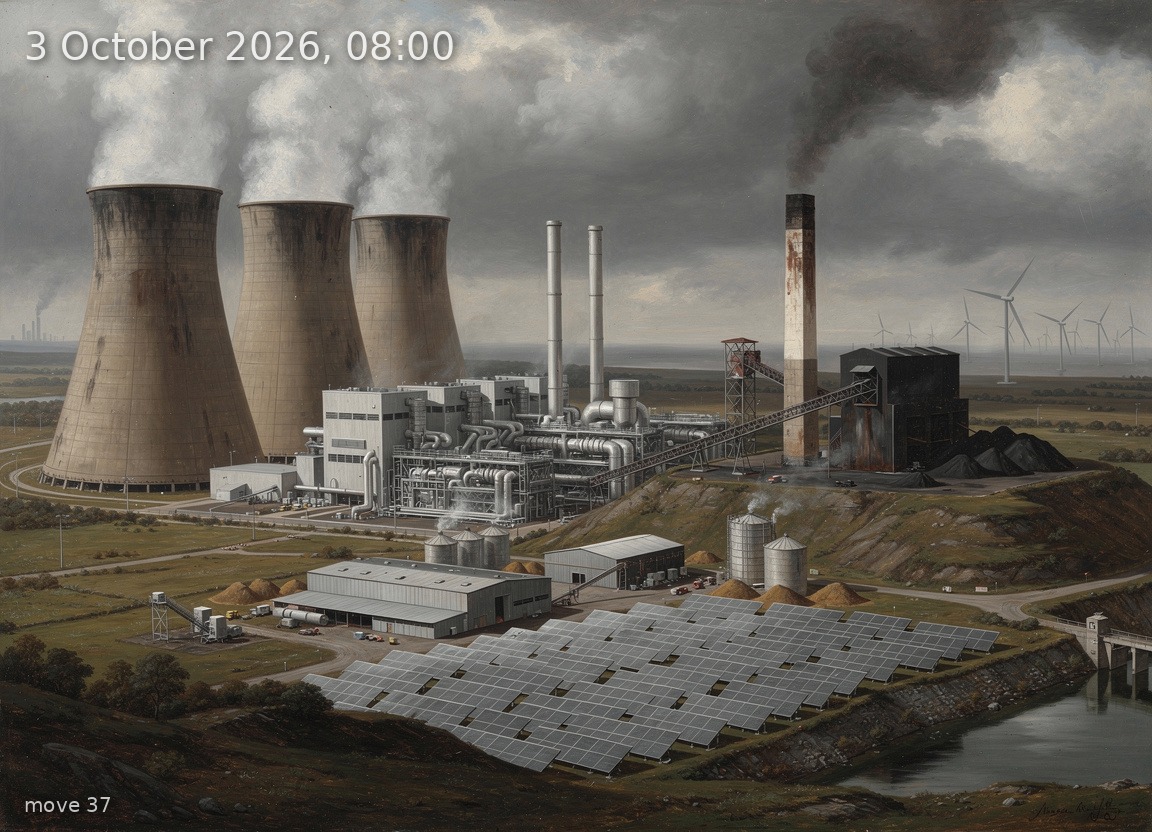
Brown coal and gas dominate as near-zero wind and full overcast drive elevated prices and 5 GW net imports.
Generation mix
Wind onshore 5%
Wind offshore 5%
Solar 15%
Biomass 12%
Hydro 2%
Natural gas 21%
Hard coal 9%
Brown coal 32%
38%
Renewable share
3.7 GW
Wind (on + offshore)
5.3 GW
Solar
36.5 GW
Total generation
5.0 GW
Net import
189.1 EUR/MWh
Day-ahead price
8.8°C / 1 km/h
Temp / Wind speed
Open-Meteo, Kassel (51.3°N 9.5°E) · surface estimate from 100 m wind
100.0% / 0.0 W/m²
Cloud cover / Radiation
429
gCO₂/kWh
Image prompt
Brown coal 11.6 GW dominates the left third of the scene as a vast complex of hyperbolic cooling towers with thick white-grey steam plumes rising into heavy overcast; natural gas 7.7 GW fills the centre-left as a row of compact CCGT power blocks with tall single exhaust stacks emitting thin heat shimmer; hard coal 3.2 GW appears centre-right as a smaller coal plant with conveyor belts and a square chimney stack; solar 5.3 GW is represented in the mid-ground as expansive fields of aluminium-framed crystalline silicon PV panels, their surfaces dull and grey under diffuse light with no sun reflections; biomass 4.3 GW appears as a cluster of modest industrial buildings with wood-chip silos and low stacks; wind onshore 1.7 GW shows as a handful of three-blade turbines on a distant ridge, rotors completely still in the dead-calm air; wind offshore 2.0 GW is suggested by faint turbine silhouettes on a far grey horizon line; hydro 0.6 GW is a small dam structure at the far right edge. The time is 08:00 on an October morning — full daylight but entirely overcast with 100% cloud cover, a flat uniform grey-white sky pressing down oppressively, no blue sky visible anywhere, no direct sunlight, all illumination soft and diffuse. Temperature is near 9°C: autumn trees with leaves turning gold and brown, some bare branches, dew on grass, muted earth tones. The wind is essentially zero — no motion in vegetation, no flags stirring, perfectly still smoke plumes rising straight upward. The atmosphere feels heavy, oppressive, and expensive — a thick pall of industrial haze merging with low clouds. Highly detailed oil painting in the tradition of 19th-century German Romantic landscape painters such as Caspar David Friedrich and Carl Blechen — rich sombre colour palette of greys, ochres, and muted golds, visible expressive brushwork, atmospheric depth with industrial haze receding into the distance, chiaroscuro modelling on cooling towers and machinery. Meticulous technical accuracy on all engineering details: turbine nacelles, lattice towers, PV panel framing, cooling tower parabolic geometry, conveyor infrastructure. The scene reads as a monumental Romantic industrial landscape, brooding and grand. No text, no labels.