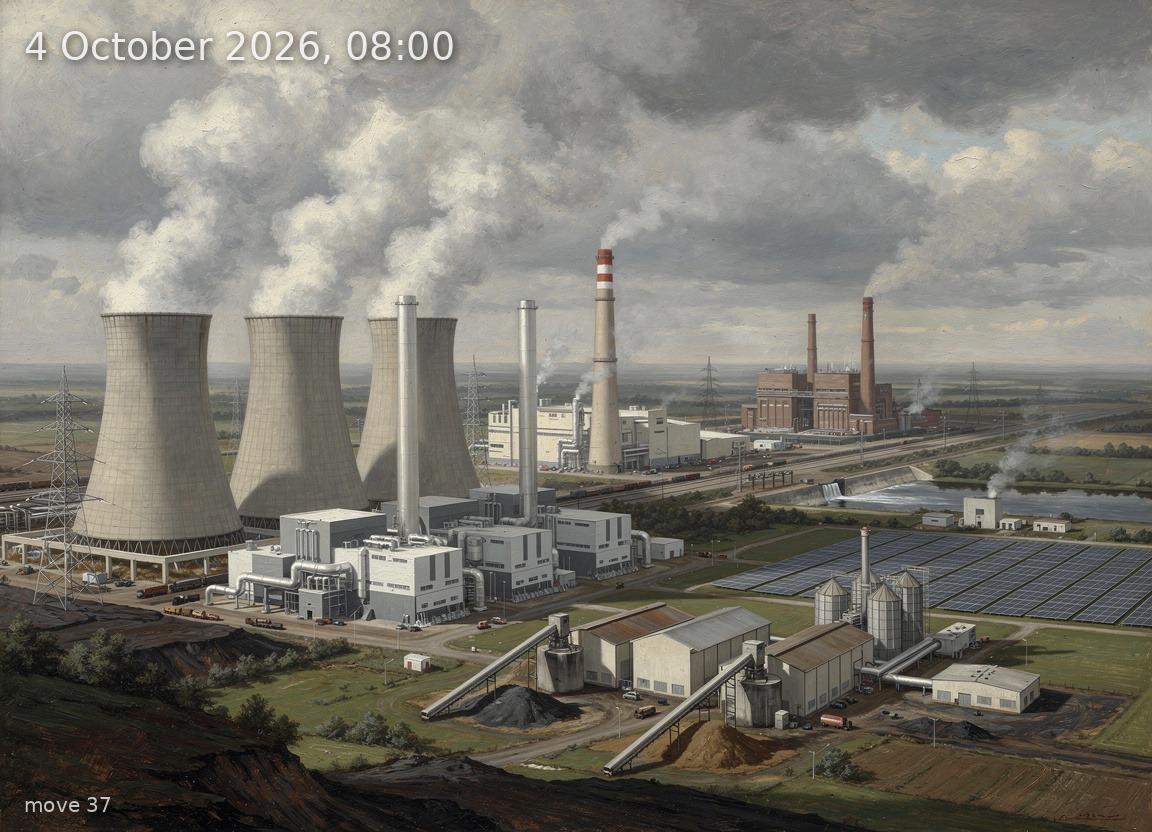
Brown coal and gas dominate as near-zero wind and full overcast suppress renewables, driving 12 GW net imports.
Generation mix
Wind onshore 2%
Wind offshore 1%
Solar 15%
Biomass 13%
Hydro 2%
Natural gas 23%
Hard coal 9%
Brown coal 35%
34%
Renewable share
1.0 GW
Wind (on + offshore)
5.2 GW
Solar
33.7 GW
Total generation
12.2 GW
Net import
186.7 EUR/MWh
Day-ahead price
9.1°C / 1 km/h
Temp / Wind speed
Open-Meteo, Kassel (51.3°N 9.5°E) · surface estimate from 100 m wind
100.0% / 0.0 W/m²
Cloud cover / Radiation
463
gCO₂/kWh
Image prompt
Brown coal 11.7 GW dominates the left third of the scene as a massive lignite power station complex with four hyperbolic cooling towers emitting thick white-grey steam plumes rising into the overcast; natural gas 7.7 GW fills the centre-left as three compact CCGT plants with tall single exhaust stacks venting shimmering heat haze; solar 5.2 GW appears centre-right as extensive fields of aluminium-framed crystalline silicon PV panels stretching across flat farmland, their surfaces dull and unreflective under the heavy clouds; biomass 4.4 GW is rendered as a cluster of mid-sized industrial boiler buildings with wood-chip conveyor belts and modest chimneys producing thin pale smoke; hard coal 3.0 GW sits behind the lignite complex as a pair of tall-chimneyed conventional power stations with coal bunkers and rail sidings; hydro 0.8 GW appears as a small concrete run-of-river dam with a modest spillway in the middle distance; wind onshore 0.6 GW is represented by three distant three-blade turbines on a low ridge, rotors completely still; wind offshore 0.4 GW is barely suggested as tiny turbine silhouettes on the far grey horizon. The sky is entirely overcast with a thick, low, uniform blanket of steel-grey stratus clouds pressing down oppressively — no sun visible, diffuse pale October morning daylight at 08:00, casting flat shadowless illumination. The landscape is autumnal central German lowland: muted brown and olive fields, bare-branching deciduous trees with a few remaining rust-coloured leaves, temperature near 9°C suggested by faint ground mist lingering in hollows. The air is dead still — no motion in grass or flags. The atmosphere feels heavy, costly, pressured. Highly detailed oil painting in the tradition of 19th-century German Romantic landscape painters — Caspar David Friedrich meets industrial sublime — rich colour palette of greys, ochres, umber and muted greens, visible impasto brushwork, atmospheric aerial perspective with haze softening distant elements, meticulous engineering detail on all energy infrastructure. No text, no labels.