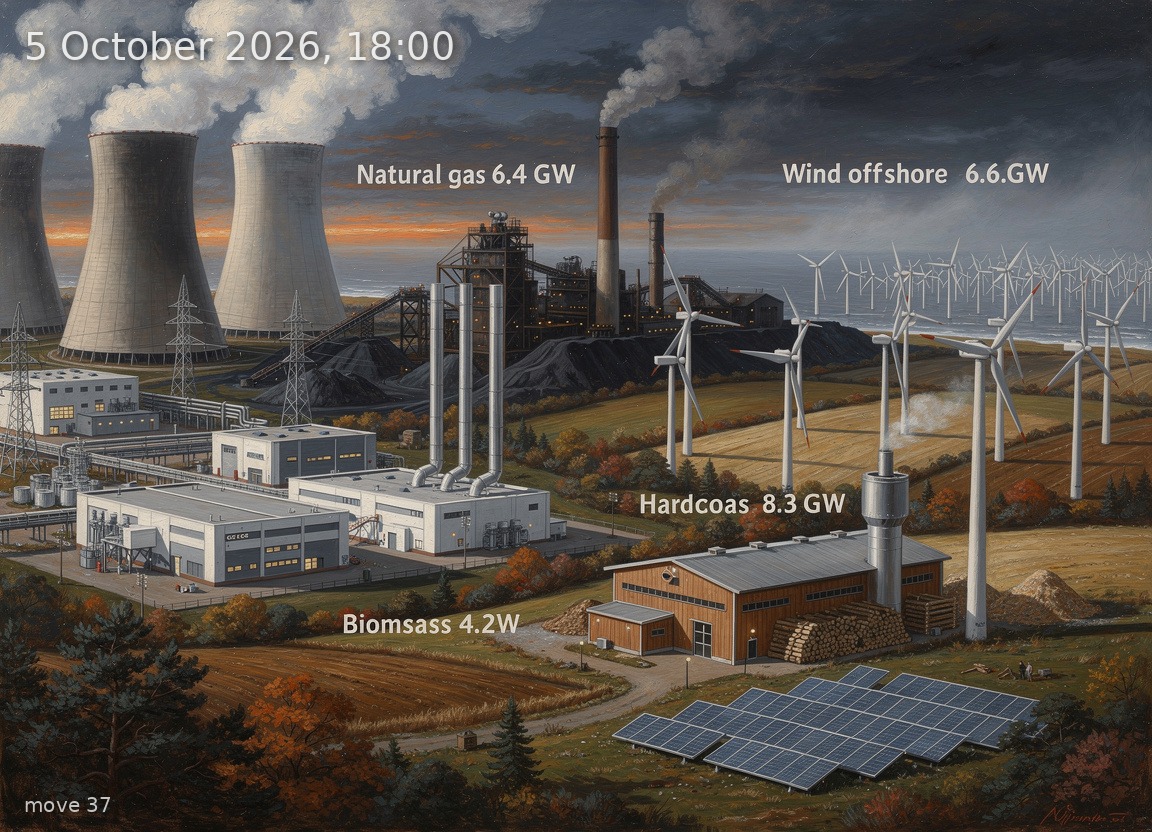
Brown coal leads at 11 GW with strong wind at 14.8 GW combined; 18.8 GW net imports needed at evening peak.
Generation mix
Wind onshore 19%
Wind offshore 15%
Solar 4%
Biomass 10%
Hydro 2%
Natural gas 15%
Hard coal 10%
Brown coal 25%
50%
Renewable share
14.8 GW
Wind (on + offshore)
1.6 GW
Solar
43.3 GW
Total generation
18.8 GW
Net import
224.7 EUR/MWh
Day-ahead price
19.1°C / 15 km/h
Temp / Wind speed
Open-Meteo, Kassel (51.3°N 9.5°E) · surface estimate from 100 m wind
0.0% / 88.0 W/m²
Cloud cover / Radiation
357
gCO₂/kWh
Image prompt
Brown coal 11.0 GW dominates the left third of the scene as a massive lignite power complex with four hyperbolic cooling towers emitting thick white steam plumes against the darkening sky; wind onshore 8.2 GW fills the centre-right as dozens of tall three-blade turbines on lattice and tubular towers stretching across rolling autumn farmland, blades in moderate rotation; wind offshore 6.6 GW appears in the far right background as a dense array of turbines standing in a grey North Sea glimpsed through a valley opening; natural gas 6.4 GW occupies the centre-left as two compact CCGT plant blocks with slender exhaust stacks venting thin heat shimmer; hard coal 4.3 GW sits behind the gas plants as a dark gritty facility with a single large smokestack and coal conveyor belts; biomass 4.2 GW appears as a modest wood-clad industrial plant with a short cylindrical stack and stacked timber nearby; solar 1.6 GW is represented by a small field of aluminium-framed crystalline silicon panels in the foreground, their surfaces reflecting the last orange-red glow of dusk rather than generating strongly; hydro 0.8 GW is a small concrete run-of-river weir visible along a stream in the lower foreground. The sky is a dusk scene at 18:00 in early October: the lower horizon glows deep orange-red fading rapidly upward through violet into a darkening steel-blue canopy, with zero cloud cover revealing the first faint stars above. The atmosphere feels heavy and oppressive despite the clear sky, conveying the strain of a 224.7 EUR/MWh price — a thick industrial haze clings low across the midground, tinted amber by the dying light. Vegetation is early-autumn: fields of stubble and yellowing deciduous trees with leaves just beginning to turn gold and russet. Temperature is mild at 19°C, no frost. Rendered as a highly detailed oil painting in the tradition of 19th-century German Romantic landscape painters — rich impasto brushwork, luminous atmospheric depth reminiscent of Caspar David Friedrich crossed with industrial realism, meticulous engineering detail on every turbine nacelle, cooling tower, and panel frame. No text, no labels.