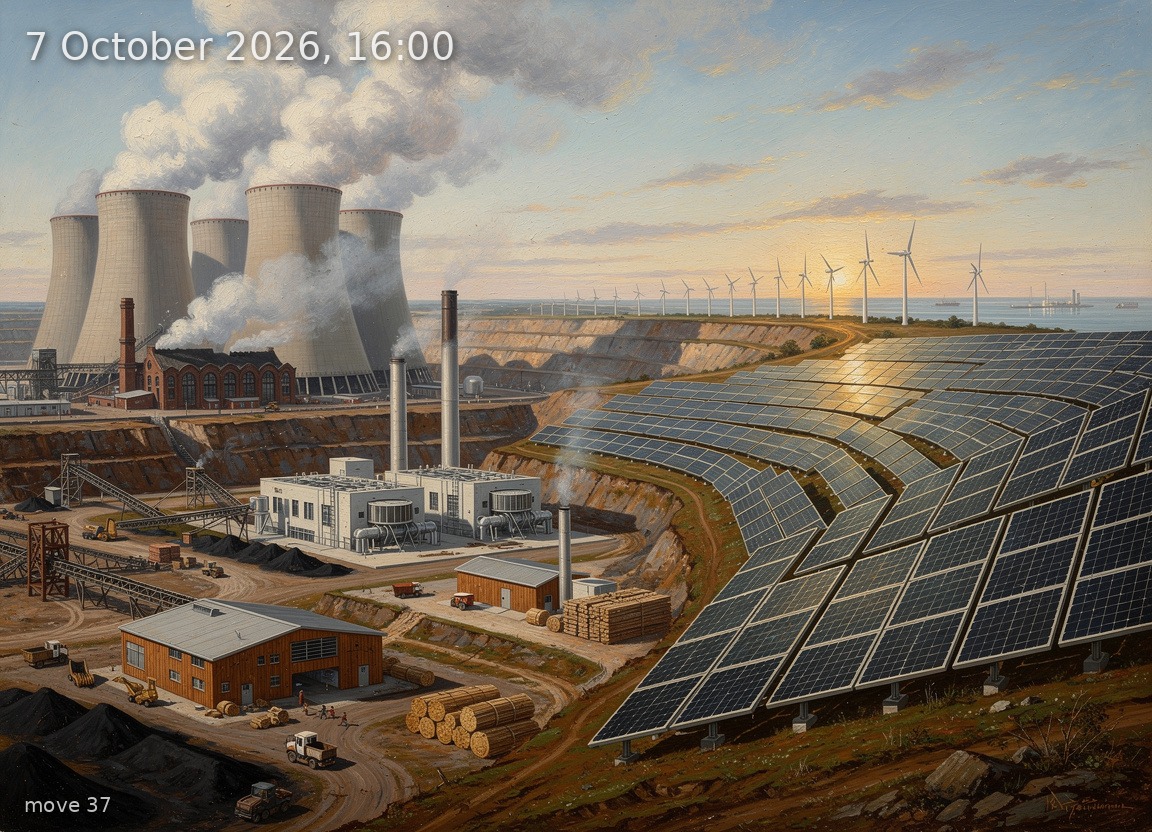
Strong solar leads at 20.7 GW, but 9.3 GW net imports are needed as fossil plants and light winds cannot close the consumption gap.
Generation mix
Wind onshore 7%
Wind offshore 2%
Solar 43%
Biomass 8%
Hydro 2%
Natural gas 11%
Hard coal 8%
Brown coal 19%
62%
Renewable share
4.4 GW
Wind (on + offshore)
20.7 GW
Solar
48.3 GW
Total generation
9.3 GW
Net import
181.6 EUR/MWh
Day-ahead price
21.7°C / 9 km/h
Temp / Wind speed
Open-Meteo, Kassel (51.3°N 9.5°E) · surface estimate from 100 m wind
5.0% / 308.0 W/m²
Cloud cover / Radiation
270
gCO₂/kWh
Image prompt
Solar 20.7 GW dominates the right half of the scene as vast fields of aluminium-framed crystalline silicon PV panels stretching across gentle rolling hills, angled toward a low afternoon sun; brown coal 9.3 GW occupies the left quarter as a cluster of massive hyperbolic cooling towers with thick white-grey steam plumes rising into the sky, surrounded by conveyor belts and open-pit mine terraces; natural gas 5.2 GW appears as two compact CCGT power stations with tall single exhaust stacks and shimmering heat haze in the centre-left; hard coal 3.8 GW is rendered as a dark brick power station with twin chimneys emitting pale grey smoke beside a coal yard, positioned behind the gas plants; biomass 3.8 GW appears as a modest wood-clad plant with a single smoking stack and timber piles in the mid-ground; wind onshore 3.5 GW is shown as a sparse line of three-blade turbines on a distant ridge turning slowly; wind offshore 0.9 GW is a faint cluster of turbines on the far horizon near a hazy coastline; hydro 1.0 GW appears as a small concrete dam with water cascading down a wooded valley in the far right background. TIME AND LIGHT: late afternoon in early October, the sun is at roughly 20–25° above the western horizon casting long warm golden light across the landscape, deep shadows stretching eastward, the sky is almost entirely clear (5% cloud cover) with a rich blue dome overhead fading to warm amber near the horizon. ATMOSPHERE: despite the golden light, a heavy, slightly oppressive industrial haze hangs over the thermal plants on the left, reflecting the high electricity price—the air feels dense and warm at 21.7°C, vegetation is early-autumn green with hints of yellow and orange at the leaf edges, dry grass in the foreground. STYLE: highly detailed oil painting in the tradition of 19th-century German Romantic landscape painters such as Caspar David Friedrich and Carl Blechen, with rich impasto brushwork, luminous atmospheric depth, dramatic chiaroscuro between the sunlit solar fields and the brooding industrial haze, meticulous engineering detail on every turbine nacelle, PV panel frame, cooling tower profile, and exhaust stack. No text, no labels.