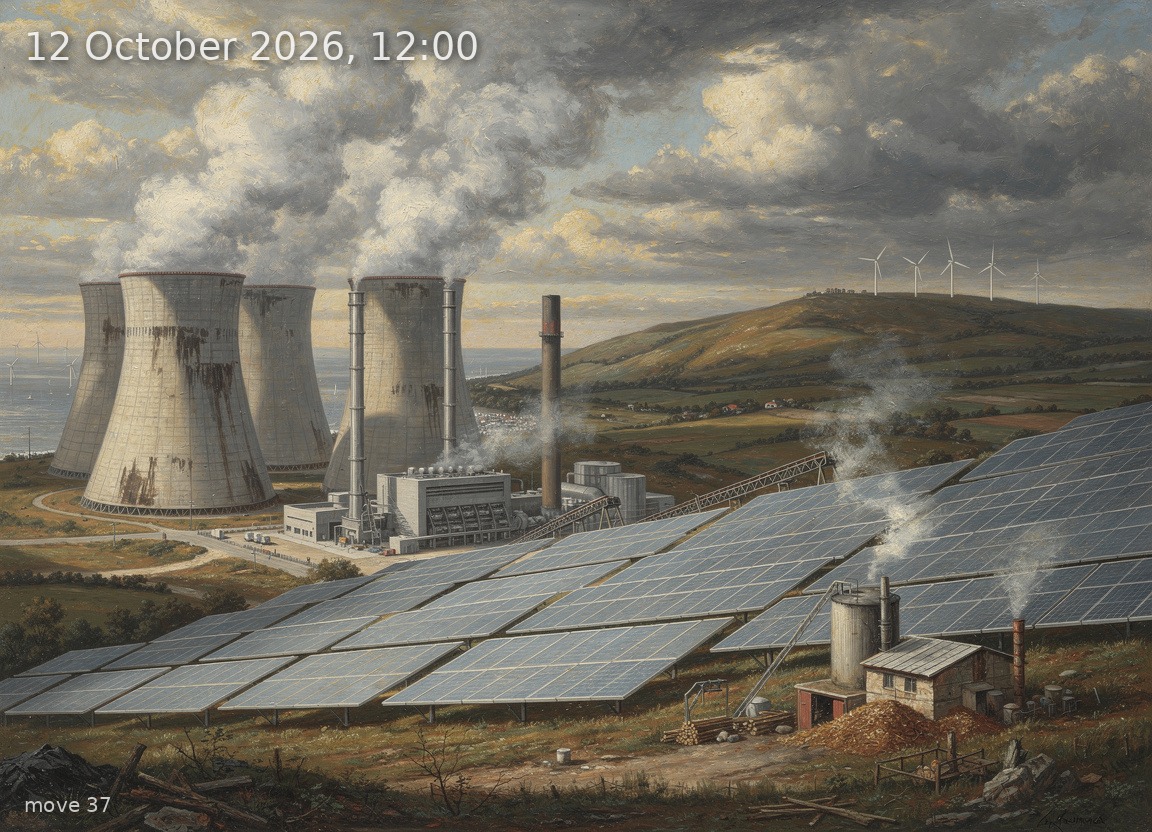
Solar leads at 37.5 GW alongside heavy brown coal and gas; weak wind and high prices define midday exports.
Generation mix
Wind onshore 4%
Wind offshore 2%
Solar 51%
Biomass 6%
Hydro 1%
Natural gas 14%
Hard coal 5%
Brown coal 17%
64%
Renewable share
4.2 GW
Wind (on + offshore)
37.5 GW
Solar
73.9 GW
Total generation
+10.6 GW
Net export
150.6 EUR/MWh
Day-ahead price
10.3°C / 7 km/h
Temp / Wind speed
Open-Meteo, Kassel (51.3°N 9.5°E) · surface estimate from 100 m wind
65.0% / 173.0 W/m²
Cloud cover / Radiation
250
gCO₂/kWh
Image prompt
Solar 37.5 GW dominates the centre-right as a vast rolling field of aluminium-framed crystalline silicon PV panels stretching toward the horizon, catching diffused midday light through broken cloud; brown coal 12.7 GW occupies the left quarter as a cluster of massive hyperbolic concrete cooling towers with thick white-grey steam plumes rising heavily into the sky; natural gas 10.2 GW sits left-of-centre as a group of modern combined-cycle gas turbine plants with tall slim exhaust stacks trailing thin heat shimmer; hard coal 4.0 GW appears as a smaller coal-fired station with a single rectangular stack and conveyor belt, positioned behind the gas units; biomass 4.4 GW is rendered as a modest wood-chip burning facility with a low cylindrical silo and wispy exhaust, nestled among the panels; wind onshore 3.1 GW shows a small row of three-blade turbines on a distant ridge, their rotors barely turning in the calm air; wind offshore 1.1 GW appears as tiny turbines on a hazy sea glimpsed at the far left horizon; hydro 0.9 GW is a small dam with spillway visible in a valley fold at far right. The sky is midday bright but oppressive—65% cloud cover creates a patchwork of grey cumulus and pale blue gaps, with direct sunlight breaking through in angled shafts onto the solar field. The atmosphere feels heavy and close, conveying the high electricity price: a faint haze hangs over the industrial structures, the air slightly yellowish near the cooling towers. October vegetation: trees in muted amber and rust-brown foliage, fields of stubble and faded green, ground damp. Temperature around 10°C suggested by figures in jackets near a substation gate. Central German rolling landscape with gentle hills. Style: highly detailed oil painting in the tradition of 19th-century German Romantic landscape masters such as Caspar David Friedrich and Carl Blechen—rich, layered colour with visible impasto brushwork, dramatic atmospheric depth, golden and slate tonal palette, meticulous engineering detail on every turbine nacelle, every panel frame, every cooling tower ribbing—an epic industrial landscape rendered as a masterwork painting. No text, no labels.