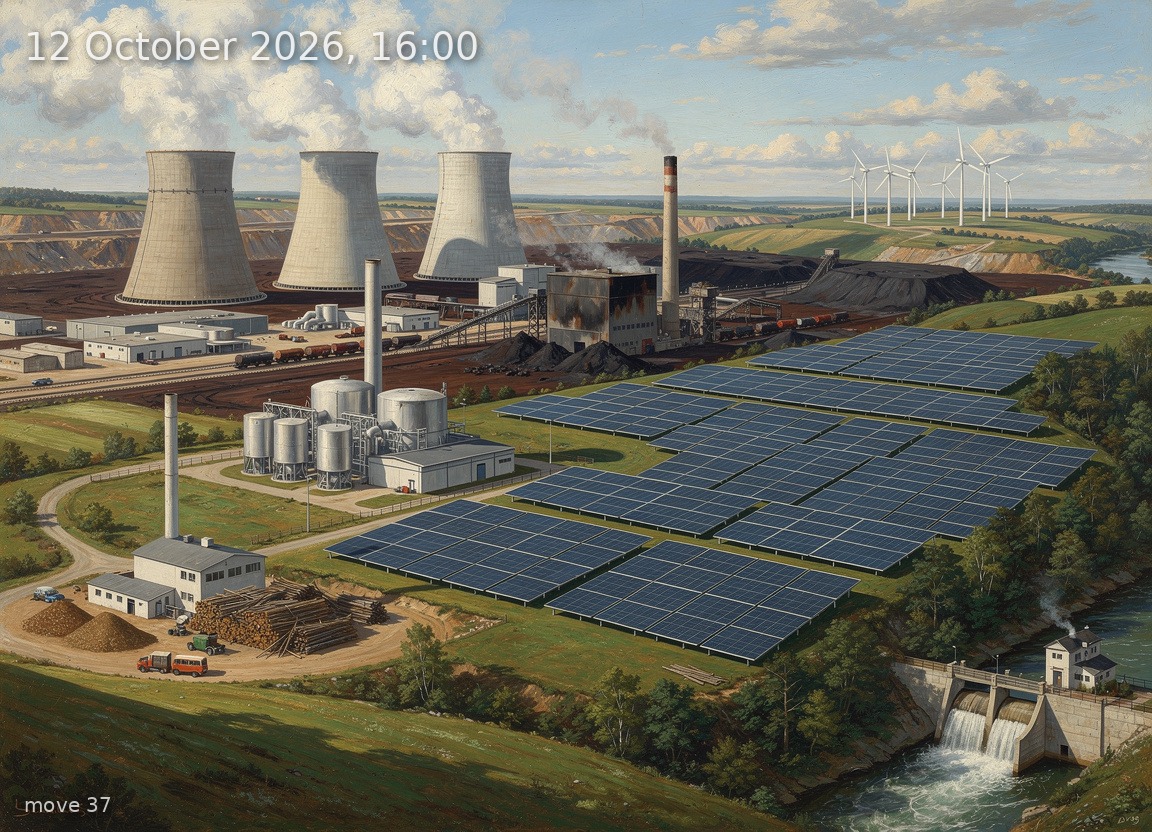
Strong solar and heavy brown coal underpin a supply-short grid requiring 13 GW of net imports at elevated prices.
Generation mix
Wind onshore 5%
Wind offshore 4%
Solar 38%
Biomass 9%
Hydro 2%
Natural gas 10%
Hard coal 8%
Brown coal 24%
58%
Renewable share
4.2 GW
Wind (on + offshore)
17.8 GW
Solar
46.6 GW
Total generation
13.1 GW
Net import
180.7 EUR/MWh
Day-ahead price
14.3°C / 9 km/h
Temp / Wind speed
Open-Meteo, Kassel (51.3°N 9.5°E) · surface estimate from 100 m wind
14.0% / 255.0 W/m²
Cloud cover / Radiation
308
gCO₂/kWh
Image prompt
Brown coal 11.2 GW dominates the left quarter as a sprawling lignite complex with three massive hyperbolic cooling towers trailing thick white steam plumes into the sky; solar 17.8 GW fills the centre-right as vast fields of aluminium-framed crystalline silicon photovoltaic panels stretching across gentle rolling hills, their surfaces gleaming under strong direct sunlight; natural gas 4.6 GW appears as two compact CCGT power stations with tall single exhaust stacks and smaller cylindrical heat-recovery units, positioned centre-left; hard coal 3.9 GW is rendered as a dark industrial block with a single large smokestack and coal conveyors beside a rail siding, just behind the gas plants; biomass 4.0 GW appears as a mid-sized wood-chip fired plant with a modest stack and timber storage yard at far left; wind onshore 2.3 GW shown as a small cluster of three-blade turbines on a distant ridge with slowly turning rotors reflecting light winds; wind offshore 1.9 GW depicted as a faint line of turbines on the far horizon suggesting the North Sea; hydro 0.9 GW as a small dam and spillway nestled in a wooded valley at the far right edge. The lighting is late-afternoon October daylight at 16:00 in central Germany — the sun is moderately low in the western sky casting long warm golden shadows across the landscape, the sky mostly clear with only thin wisps of cloud covering roughly 14 percent. The atmosphere feels heavy and oppressive despite the sunshine, with a faint brownish industrial haze hanging over the thermal plants suggesting high electricity prices and strained supply. Autumn foliage on deciduous trees — amber, russet, pale gold — at a temperature around 14 degrees Celsius; grass still green but muted. Rendered as a highly detailed oil painting in the tradition of 19th-century German Romantic landscape painters such as Caspar David Friedrich and Carl Blechen, with rich saturated colour, visible confident brushwork, atmospheric aerial perspective giving depth, meticulous engineering accuracy on every turbine nacelle, PV panel frame, cooling tower contour, and smokestack detail. The composition balances industrial sublime with pastoral calm. No text, no labels.