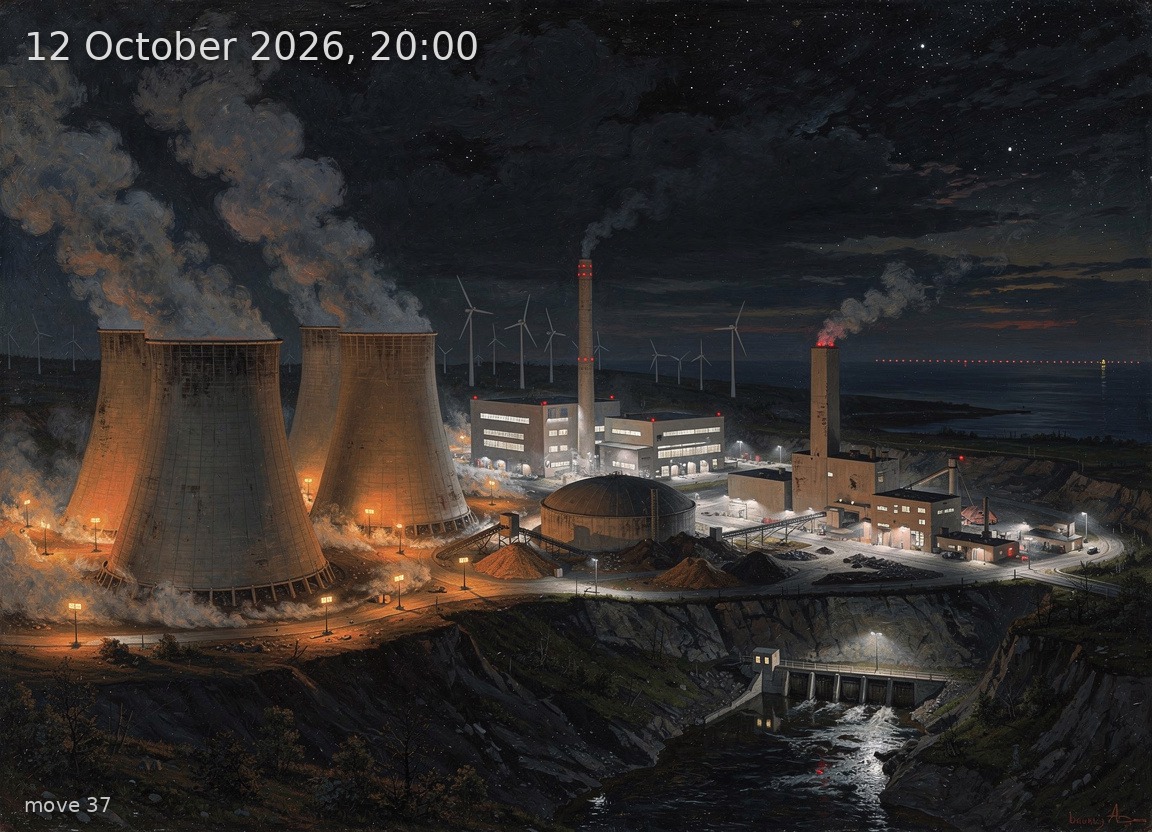
Brown coal, gas, and hard coal dominate as wind falters and imports fill a 20.5 GW gap at nightfall.
Generation mix
Wind onshore 8%
Wind offshore 7%
Biomass 11%
Hydro 2%
Natural gas 27%
Hard coal 12%
Brown coal 32%
29%
Renewable share
6.0 GW
Wind (on + offshore)
0.0 GW
Solar
39.8 GW
Total generation
20.5 GW
Net import
250.4 EUR/MWh
Day-ahead price
9.0°C / 4 km/h
Temp / Wind speed
Open-Meteo, Kassel (51.3°N 9.5°E) · surface estimate from 100 m wind
11.0% / 0.0 W/m²
Cloud cover / Radiation
486
gCO₂/kWh
Image prompt
Brown coal 12.8 GW dominates the left third of the scene as a massive lignite power station with four hyperbolic cooling towers emitting thick steam plumes lit from below by sodium-orange industrial lights; natural gas 10.9 GW fills the centre-left as two compact CCGT plants with tall single exhaust stacks releasing shimmering heat haze, their turbine halls glowing with interior light; hard coal 4.6 GW appears centre-right as a smaller conventional coal plant with a single rectangular chimney and conveyor belts visible under floodlights; wind onshore 3.3 GW is rendered as a modest cluster of three-blade turbines on a distant ridge, their rotors barely turning in the still air, warning lights blinking red; wind offshore 2.7 GW is suggested by a faint line of turbine lights far on the horizon over a dark body of water at the far right; biomass 4.5 GW appears as a mid-sized industrial facility with a wood-chip storage dome and a squat smokestack emitting pale vapour, positioned between the coal and gas plants; hydro 0.9 GW is a small dam structure nestled in a darkened valley at the far right foreground with water glistening under artificial light. The sky is completely dark — deep black-navy with no twilight, no sky glow, only scattered stars visible through 11% cloud cover. The autumn landscape is rendered in muted browns and fading greens, bare-branching deciduous trees at 9°C. The air is nearly still, no motion in foliage. The atmosphere feels heavy and oppressive, reflecting the 250 EUR/MWh price — a brooding weight pressing down on the industrial panorama. Painted in the style of a highly detailed 19th-century German Romantic oil painting with rich, dark colour palette, visible impasto brushwork, and deep atmospheric perspective, reminiscent of Caspar David Friedrich meeting industrial realism. Meticulous engineering accuracy on every turbine nacelle, cooling tower profile, and exhaust stack. No text, no labels.