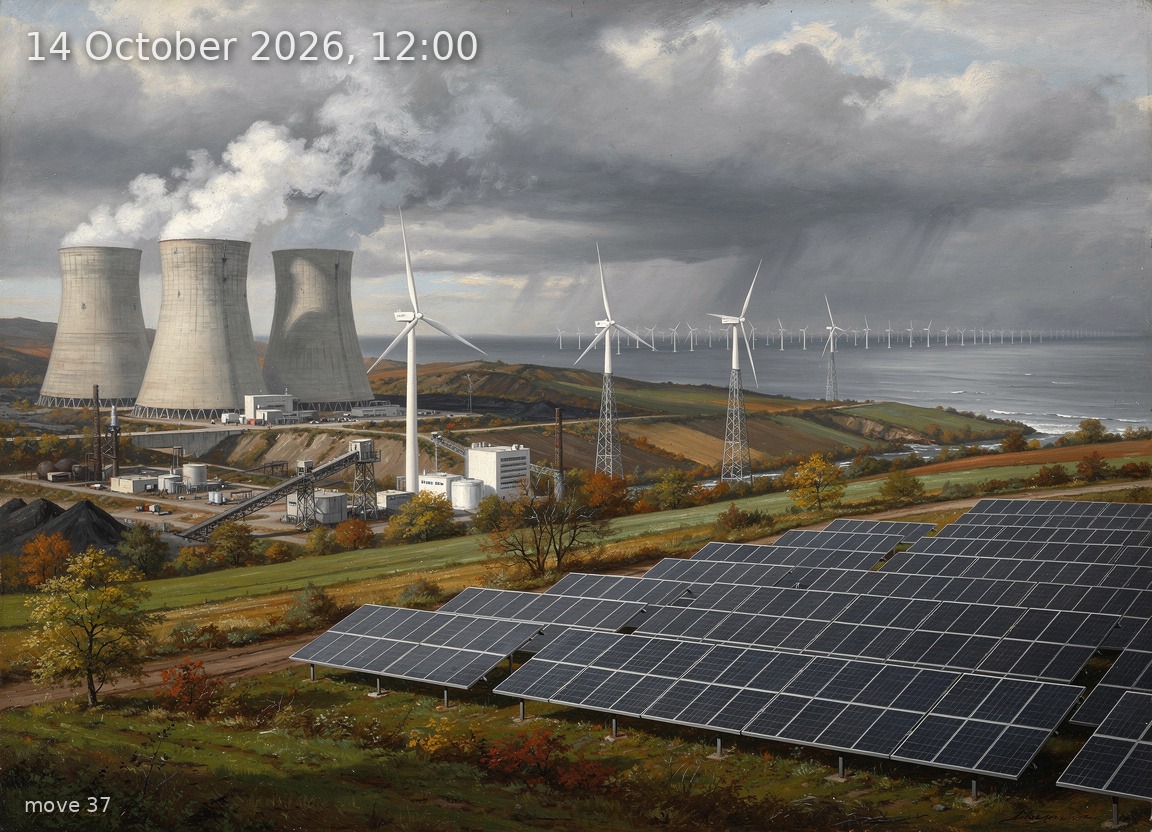
Solar leads at 32.6 GW with 16.5 GW wind; brown coal persists at 10.3 GW despite 10.5 GW net export.
Generation mix
Wind onshore 18%
Wind offshore 4%
Solar 44%
Biomass 6%
Hydro 1%
Natural gas 7%
Hard coal 5%
Brown coal 14%
74%
Renewable share
16.4 GW
Wind (on + offshore)
32.6 GW
Solar
73.6 GW
Total generation
+10.5 GW
Net export
111.0 EUR/MWh
Day-ahead price
13.0°C / 5 km/h
Temp / Wind speed
Open-Meteo, Kassel (51.3°N 9.5°E) · surface estimate from 100 m wind
94.0% / 118.0 W/m²
Cloud cover / Radiation
189
gCO₂/kWh
Image prompt
Solar 32.6 GW dominates the foreground and right half of the scene as vast fields of aluminium-framed crystalline silicon PV panels stretching across gently rolling autumn farmland, their surfaces reflecting a flat, diffuse grey-white light under near-total overcast; wind onshore 13.6 GW fills the middle distance as dozens of three-blade turbines on lattice and tubular towers dotting the hills, blades turning slowly in light breeze; wind offshore 2.9 GW appears as a distant cluster of offshore turbines on the far horizon where a grey sea meets grey sky; brown coal 10.3 GW occupies the left third as a massive lignite power station complex with four hyperbolic cooling towers emitting thick white steam plumes that merge into the low cloud ceiling; natural gas 5.1 GW sits centre-left as a compact CCGT plant with slender exhaust stacks and a heat-recovery unit venting thin vapour; hard coal 4.0 GW appears behind it as a traditional coal plant with a single large chimney and conveyor belts; biomass 4.2 GW is rendered as a wood-chip-fed CHP facility with a modest stack and timber storage yard at the left edge; hydro 1.0 GW is a small run-of-river weir with a powerhouse visible along a stream in the valley. The sky is a heavy, oppressive blanket of 94% cloud cover in layered greys and muted pewter, consistent with high electricity prices, lit by full midday daylight but entirely diffuse with no visible sun disc and no shadows. The season is mid-October: trees show early autumn colour in amber, rust, and fading green; the temperature is a mild 13°C, the grass still green but damp. Style: highly detailed oil painting in the tradition of 19th-century German Romantic landscape painters — Caspar David Friedrich's atmospheric depth meets Adolph Menzel's industrial precision — rich, muted earth tones and steel-greys, visible confident brushwork, atmospheric perspective with haze softening distant turbines and cooling towers. Every technology rendered with meticulous engineering accuracy: turbine nacelles, rotor hubs, PV module gridlines, cooling tower parabolic profiles, CCGT exhaust diffusers. No text, no labels.